Integer Overflow Response: Immediate Containment and Recovery Steps
Integer overflows often bypass standard input validation by corrupting memory structures before the application logic can detect malformed data.

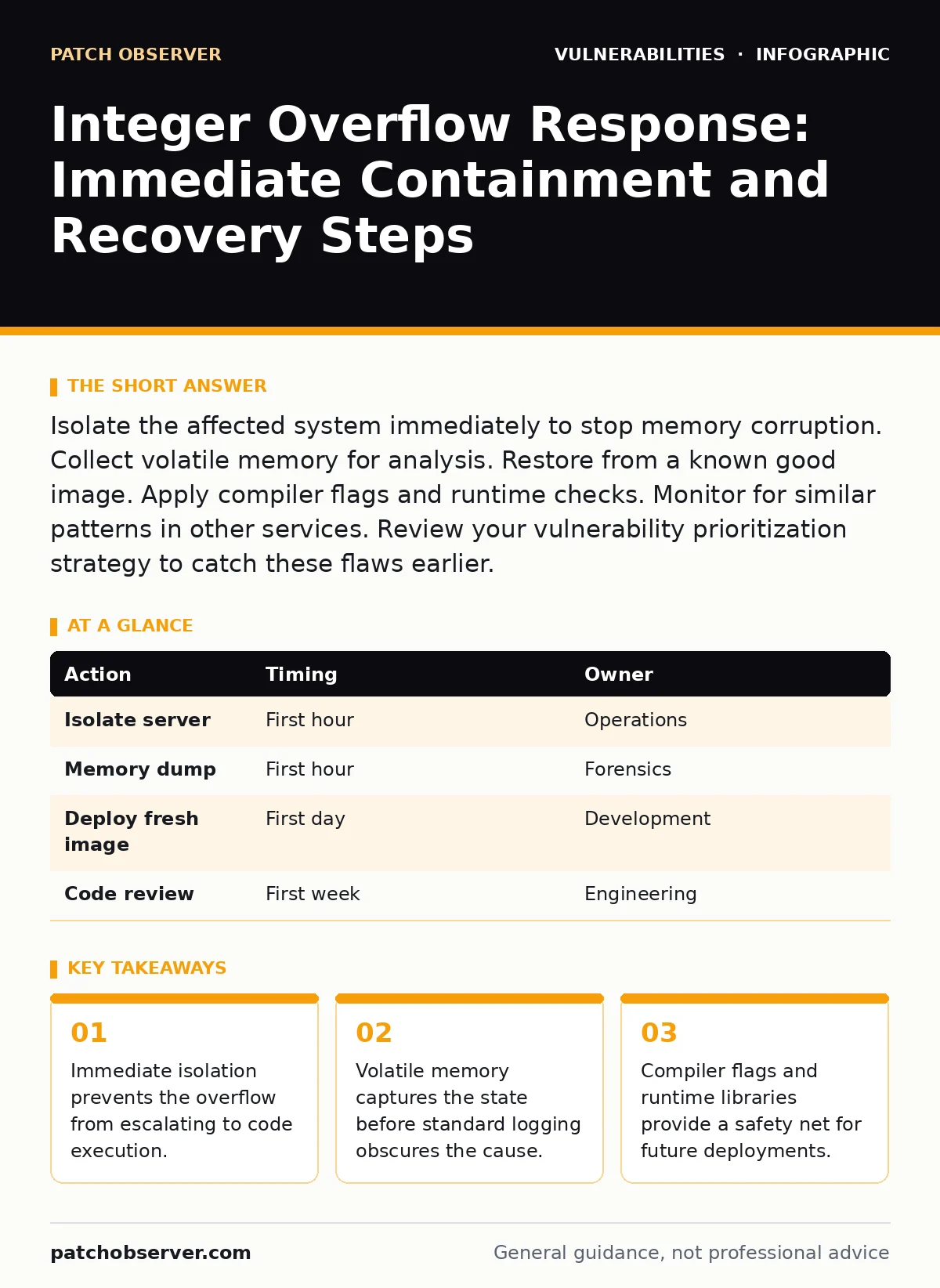
Isolate the affected system immediately to stop memory corruption. Collect volatile memory for analysis. Restore from a known good image. Apply compiler flags and runtime checks. Monitor for similar patterns in other services. Review your vulnerability prioritization strategy to catch these flaws earlier.
Assess the Initial Impact
Integer overflow vulnerabilities occur when a calculation exceeds the maximum value a variable can hold. The variable wraps around, often becoming negative or zero. This unexpected value breaks security checks. You must determine if the overflow allowed unauthorized memory access. Check system logs for unusual process termination or memory allocation errors. Look for processes that consumed unexpected amounts of memory. These signs indicate the application state is compromised. Do not assume the issue is limited to a single user session. Memory corruption can persist across requests if the heap is not cleaned.
First Hour
The first hour dictates whether the breach expands. You need to act quickly to contain the damage. Follow this checklist to stabilize the environment.
- Isolate the affected server from the network immediately.
- Capture a memory dump of the running process.
- Disable the specific input endpoint triggering the overflow.
- Notify the development team of the memory corruption event.
- Preserve disk images for forensic analysis later.
Contain the Active Threat
Isolation is the primary containment strategy. Cut network access to the vulnerable host. This stops further exploitation attempts. If the service is critical, redirect traffic to a standby instance. Ensure the standby instance does not run the same vulnerable code. Check for lateral movement. An attacker may have used the overflow to execute code. Look for new processes or outbound connections from the host. Use network flow data to identify suspicious traffic. Block these connections at the firewall. This limits the attacker's ability to exfiltrate data.
Recover the System State
Recovery requires restoring the system to a known good state. Do not simply patch the running system. The memory may still be corrupted. Deploy a fresh instance from a verified backup image. Verify the backup does not contain the vulnerable code. Restore configuration files from a secure source. Do not restore configuration from the compromised server. Attackers may have altered settings to maintain access. Re-enable services one by one. Monitor each service for errors. Ensure the input validation logic is active before opening the endpoint.
Communicate with Stakeholders
Clear communication prevents panic and confusion. Tell technical teams about the memory corruption. They need to know the specific variable type and function involved. Tell management about the operational impact. Use plain language to describe the risk. Avoid technical jargon like "heap spray" or "stack pivot". Focus on the business impact and recovery timeline. If user data was potentially exposed, prepare a notification. Coordinate with legal counsel before sending messages. Ensure all messages are consistent. Inconsistent information erodes trust.
See also: Attack Vectors Explained: Mechanisms, Limits, and Defense Strategies · Social Engineering Tactics: How Attackers Bypass Technical Defenses
Prevent Future Recurrences
Prevention requires changes to the development lifecycle. Use compiler flags that detect integer overflows. Enable runtime integer overflow checks in your build process. These checks add a small performance cost. The trade-off is safety. Review your code for manual arithmetic operations. Use safe libraries for math functions. These libraries check for overflow before performing the calculation. Implement static analysis tools. These tools scan code for unsafe patterns. Integrate them into your continuous integration pipeline. Catch these flaws before deployment.
Review Your Security Posture
Integer overflows are often part of larger exploit chains. An attacker may combine an overflow with other flaws. Review your other security controls. Check for vulnerabilities in self-hosted GitLab if you use it for code hosting. Ensure your backported security fixes are applied to all systems. Review your server-side template injection protections. These flaws often coexist in web applications. Check for weak password policies that allow easy account takeover. A single vulnerability is rarely the only issue. Look for related weaknesses in your infrastructure.
Analyze the Root Cause
Understanding the root cause prevents similar issues. Identify the specific input that triggered the overflow. Determine why the input validation failed. Was the check performed after the calculation? Was the variable type too small? Document the finding. Share it with the development team. Update your coding standards. Add specific rules for integer arithmetic. Train developers on the risks of implicit type conversion. This education reduces the likelihood of similar mistakes.
| Action | Timing | Owner |
|---|---|---|
| Isolate server | First hour | Operations |
| Memory dump | First hour | Forensics |
| Deploy fresh image | First day | Development |
| Code review | First week | Engineering |
Update Detection Rules
Update your intrusion detection systems. Add signatures for the specific exploit pattern. Monitor for similar arithmetic errors in other applications. Use heuristics to detect unusual memory usage. This helps catch zero-day variants. Review your attack vectors in CVSS scoring. Integer overflows often have high impact. Ensure your vulnerability prioritization reflects this risk. Adjust your scanning frequency. Scan for these flaws more often. This proactive approach reduces exposure.
Validate the Fix
Testing confirms the vulnerability is resolved. Reproduce the original overflow condition. Verify the application handles it safely. Check that the error message does not leak information. Ensure the service remains stable under load. Perform fuzzing tests. These tests send random inputs to find new flaws. Look for edge cases in your arithmetic logic. Test with large and negative numbers. Ensure the validation logic catches all cases. Document the test results. This documentation serves as proof of remediation.
Strengthen Development Practices
Long-term security requires cultural change. Encourage developers to use safe APIs. Discourage manual memory management where possible. Use languages with built-in safety features. These languages handle memory automatically. They prevent many common vulnerabilities. If you must use low-level languages, enforce strict coding standards. Require peer reviews for all arithmetic operations. Use static analysis tools in the build process. These tools catch errors early. This reduces the cost of fixing flaws. It also improves overall code quality.
Monitor for Related Threats
Stay alert for new threats. The security landscape changes constantly. New integer overflow techniques may emerge. Subscribe to security advisories. Monitor for new CVEs related to your technologies. Review your IoT device vulnerabilities if you use them. These devices often have limited resources. They are prone to integer issues. Keep your systems updated. Apply patches promptly. Maintain an incident response plan. Practice your response regularly. This preparation reduces reaction time. It ensures you handle incidents effectively.
Key takeaways
- Immediate isolation prevents the overflow from escalating to code execution.
- Volatile memory captures the state before standard logging obscures the cause.
- Compiler flags and runtime libraries provide a safety net for future deployments.
Frequently asked questions
How do I know if an integer overflow is happening?
Look for unexpected negative values or zero results from positive calculations. Check for crashes or memory allocation errors. Monitor for unusual process behavior or memory usage spikes.
Can firewalls stop integer overflow attacks?
Firewalls can block network traffic but cannot inspect application logic. They may stop some exploit attempts based on signatures. They cannot prevent the vulnerability from existing in your code.
Do compiler flags completely prevent integer overflows?
Compiler flags help detect overflows at compile time or runtime. They do not eliminate the need for safe coding practices. Some complex logic may still bypass these checks. Regular code reviews are still necessary.
What is the difference between integer overflow and buffer overflow?
Integer overflow is a calculation error that produces an unexpected value. Buffer overflow is a memory error caused by writing too much data. Integer overflows often lead to buffer overflows by miscalculating sizes.
How this guide was produced: written by the Patch Observer editorial team with AI assistance, checked against the public references listed below, and reviewed when the facts change. See our editorial policy or report an error.