CI/CD Pipeline Breach Response: Steps to Contain and Recover
Compromised build artifacts often spread malware faster than network intrusions because trust flows downstream to production automatically.

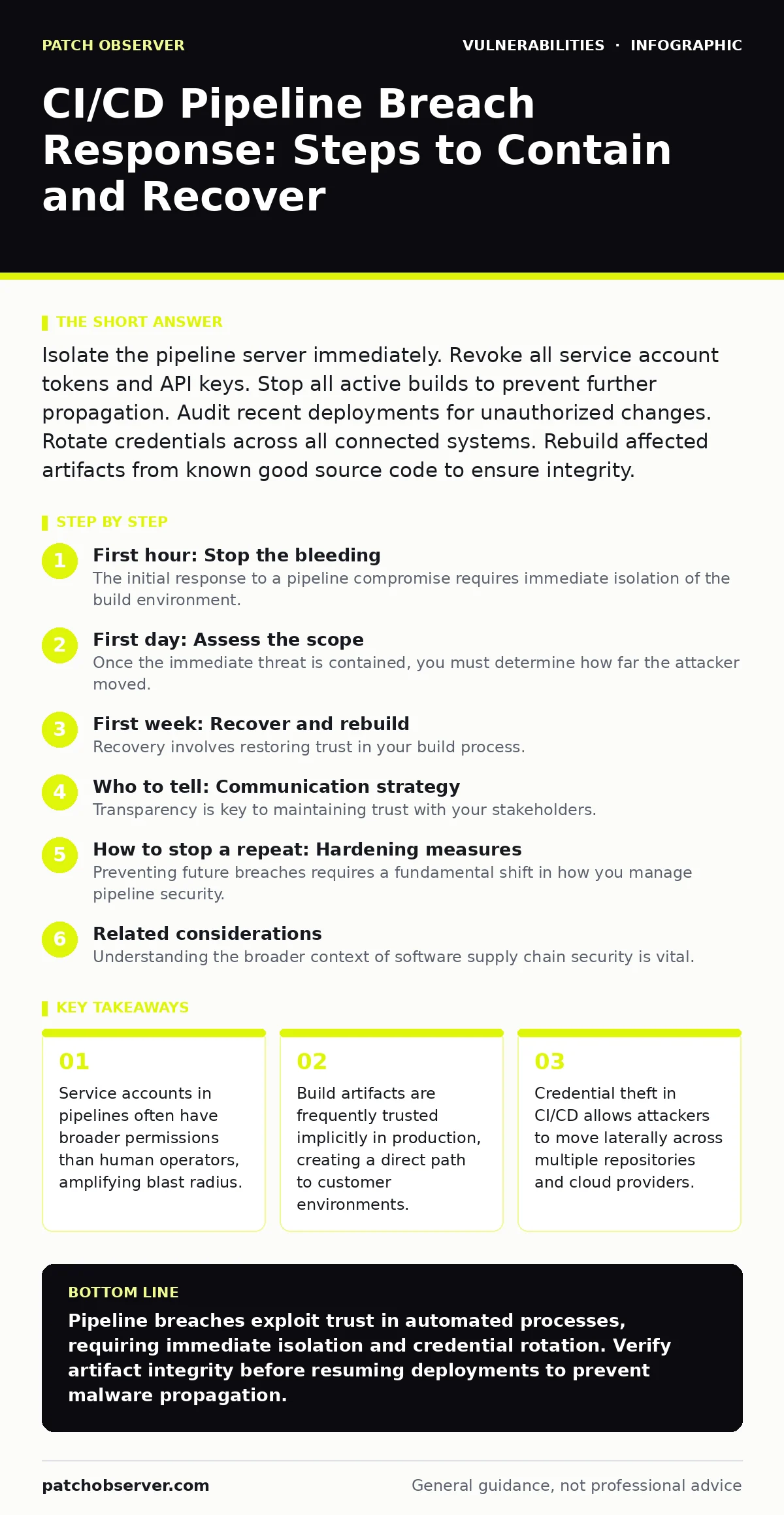
Isolate the pipeline server immediately. Revoke all service account tokens and API keys. Stop all active builds to prevent further propagation. Audit recent deployments for unauthorized changes. Rotate credentials across all connected systems. Rebuild affected artifacts from known good source code to ensure integrity.
First hour: Stop the bleeding
The initial response to a pipeline compromise requires immediate isolation of the build environment. You must halt all automated processes to prevent the spread of malicious code. Attackers often inject payloads into build artifacts that deploy directly to production. These artifacts bypass traditional security checks because they originate from a trusted source. The trust model in continuous integration assumes the build server is secure. When that assumption breaks, the entire deployment chain becomes compromised.
- Stop all active builds and scheduled jobs on the affected pipeline server.
- Disconnect the pipeline server from the network to prevent lateral movement.
- Identify the specific service accounts used by the pipeline for authentication.
- Revoke tokens, SSH keys, and API credentials associated with those accounts.
- Halt all running jobs
- Isolate the build server network interface
- Revoke service account credentials
- Notify the incident response team
First day: Assess the scope
Once the immediate threat is contained, you must determine how far the attacker moved. Pipeline credentials often grant access to multiple repositories and cloud infrastructure. An attacker with access to a build server can often write to other repositories. This allows them to insert backdoors into other projects within the same organization. You need to map the trust relationships between your repositories and the compromised pipeline.
Check the access logs of the build server for unusual activity. Look for builds triggered by unknown users or at unusual times. Examine the commit history of repositories that the pipeline has access to. Attackers often modify source code to include malicious dependencies or obfuscated scripts. These changes may appear legitimate if they are signed with a valid key. You must verify the integrity of recent commits against known good hashes.
Review the deployment logs for the past few weeks. Identify which artifacts were built and deployed during the compromise window. These artifacts may contain malware that is now running in your production environment. You need to correlate the build timestamps with the deployment timestamps to find the affected systems. This step is critical for understanding the full impact of the breach.
First week: Recover and rebuild
Recovery involves restoring trust in your build process. You cannot simply resume normal operations until you have verified the integrity of your source code and build environment. You must rebuild all affected artifacts from a known good state. This means pulling the source code from a secure, read-only copy of the repository. You should not use the compromised build server for this initial rebuild.
Use a fresh, isolated environment to rebuild the artifacts. This environment should have no network connectivity except for pulling source code and pushing the final artifacts. Verify the checksums of the rebuilt artifacts against the expected values. Deploy these clean artifacts to your staging environment first. Run a full suite of security tests before promoting them to production. This ensures that no residual malware remains in the build process.
You must also rotate all credentials that were potentially exposed. This includes database passwords, cloud provider keys, and third-party service tokens. Even if you believe the attacker did not access these credentials, you must assume they were compromised. This is a defensive measure to prevent future attacks. Document every step of the recovery process for future reference and compliance purposes.
Who to tell: Communication strategy
Transparency is key to maintaining trust with your stakeholders. You need to inform your internal teams about the breach and the steps being taken to resolve it. Clear communication prevents confusion and ensures that everyone is working towards the same goal. You should also notify your customers if their data was potentially exposed. This may involve legal and public relations teams to manage the messaging.
External partners and vendors may also need to be notified if they shared credentials with your pipeline. This is especially true if the breach involved third-party plugins or integrations. You must coordinate with these partners to ensure they rotate their credentials and monitor for suspicious activity. Failure to notify affected parties can lead to further breaches and legal liability.
How to stop a repeat: Hardening measures
Preventing future breaches requires a fundamental shift in how you manage pipeline security. You must adopt a zero-trust approach to your build environment. This means verifying every request and assuming that no component is inherently trusted. You should implement strict access controls for your pipeline servers. Only authorized personnel should be able to modify the build configuration or deploy artifacts.
Use secrets management tools to store and rotate credentials automatically. This reduces the risk of credential leakage and ensures that compromised keys are quickly invalidated. You should also implement code signing for your build artifacts. This allows you to verify the integrity of artifacts before deployment. Unsigned artifacts should be rejected by your deployment pipeline.
Regularly audit your pipeline configurations and access logs. Look for anomalies that may indicate a breach. Implement automated security scans for your source code and dependencies. These scans can detect known vulnerabilities and malicious code before they reach production. You should also review the security of any third-party plugins or integrations used in your pipeline.
See also: Social Engineering Tactics: How Attackers Bypass Technical Defenses · Integer Overflow Response: Immediate Containment and Recovery Steps
Related considerations
Understanding the broader context of software supply chain security is vital. You may find insights in our guide on vulnerabilities in self-hosted GitLab if you use that platform. The principles of responsible disclosure also apply when you discover vulnerabilities in your own pipelines.
While HTTP request smuggling is a different vector, it highlights the importance of input validation. OpenSSH vulnerabilities can also compromise build servers if not patched. IoT device vulnerabilities remind us that trust extends to all connected devices. Attack vectors in CVSS help you prioritize remediation efforts. Firmware update management parallels the need for secure artifact deployment. Weak password policies remain a common entry point for attackers.
Final verification steps
Before declaring the incident resolved, you must perform a final verification. This involves a comprehensive review of the entire pipeline lifecycle. You should test the resilience of your security controls against simulated attacks. This ensures that your hardening measures are effective. You must also update your incident response plan based on the lessons learned. This prepares you for future incidents and reduces response time.
Document the root cause of the breach and the steps taken to resolve it. This documentation serves as a valuable resource for future incidents. You should share these findings with your development and security teams. This fosters a culture of security awareness and continuous improvement. Regular training and awareness programs can help prevent human error, which is often a factor in breaches.
Key takeaways
- Service accounts in pipelines often have broader permissions than human operators, amplifying blast radius.
- Build artifacts are frequently trusted implicitly in production, creating a direct path to customer environments.
- Credential theft in CI/CD allows attackers to move laterally across multiple repositories and cloud providers.
Pipeline breaches exploit trust in automated processes, requiring immediate isolation and credential rotation. Verify artifact integrity before resuming deployments to prevent malware propagation.
Frequently asked questions
How do I know if my CI/CD pipeline is compromised?
Look for unauthorized builds, unusual network traffic, and unexpected changes to source code or configurations.
Should I delete the compromised build server?
No, preserve it for forensic analysis before wiping it. Deleting it destroys evidence needed for investigation.
Can I reuse the same credentials after a breach?
No, always rotate all potentially exposed credentials. Assume they have been stolen by the attacker.
How often should I audit my pipeline security?
Audit regularly, especially after major changes or new integrations. Continuous monitoring is also recommended.
How this guide was produced: written by the Patch Observer editorial team with AI assistance, checked against the public references listed below, and reviewed when the facts change. See our editorial policy or report an error.