IoT Device Vulnerabilities: How to Secure Connected Hardware
Most connected hardware failures stem from software flaws that allow attackers to bypass authentication or execute remote commands without physical access.

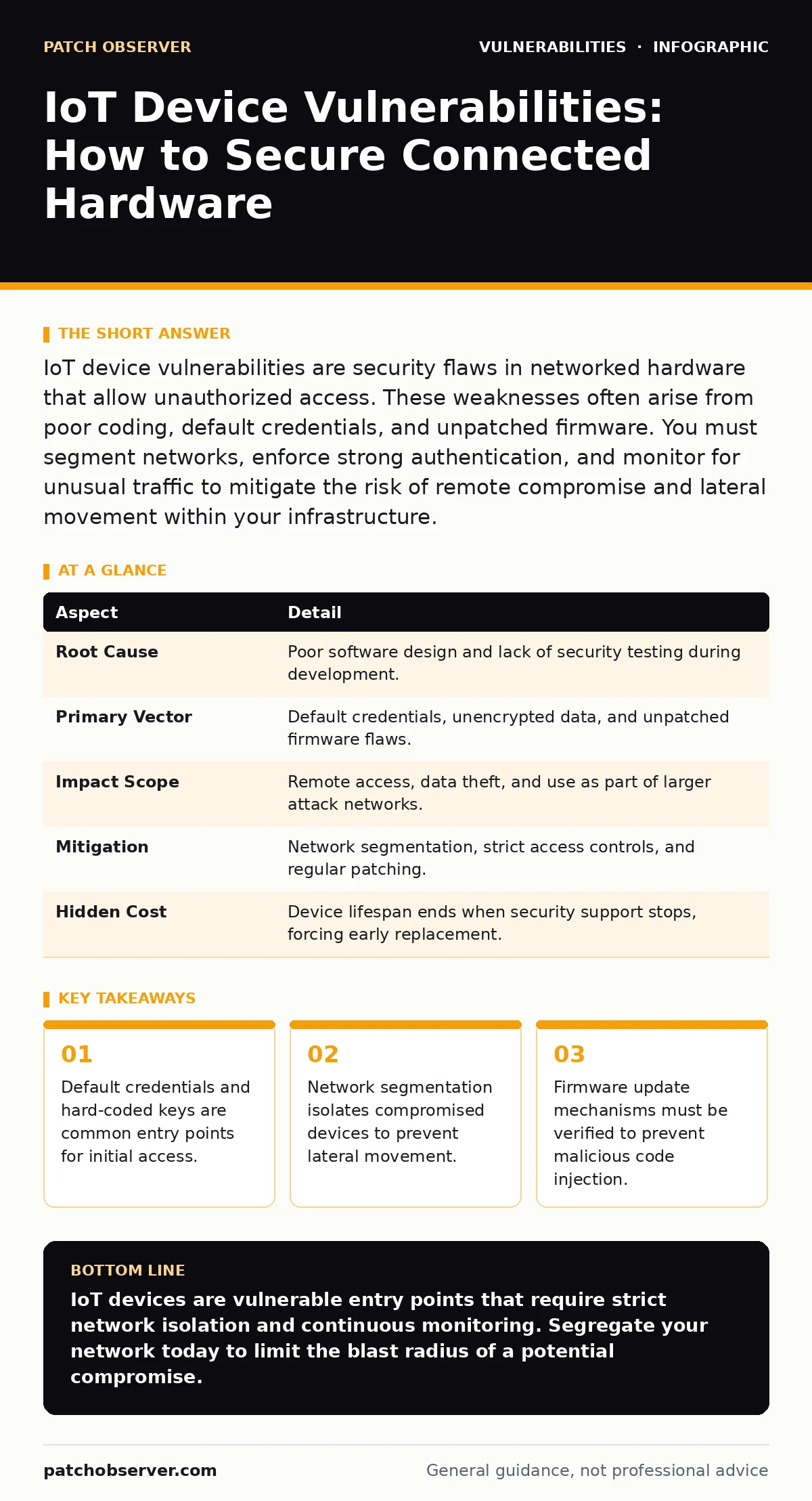
IoT device vulnerabilities are security flaws in networked hardware that allow unauthorized access. These weaknesses often arise from poor coding, default credentials, and unpatched firmware. You must segment networks, enforce strong authentication, and monitor for unusual traffic to mitigate the risk of remote compromise and lateral movement within your infrastructure.
Everyday Analogy for Connected Hardware Risks
Imagine a smart lock on your front door. You install it to keep intruders out. Now suppose the lock manufacturer shipped it with the same combination code for every unit sold. Worse, the lock has a small hole that lets anyone push a pin through to jam the mechanism or force it open from the street. This is how many IoT devices operate. They connect to the internet for convenience but often lack basic security controls. An attacker does not need to pick the lock. They simply try the universal code or use the physical flaw to gain entry.
| Aspect | Detail |
|---|---|
| Root Cause | Poor software design and lack of security testing during development. |
| Primary Vector | Default credentials, unencrypted data, and unpatched firmware flaws. |
| Impact Scope | Remote access, data theft, and use as part of larger attack networks. |
| Mitigation | Network segmentation, strict access controls, and regular patching. |
| Hidden Cost | Device lifespan ends when security support stops, forcing early replacement. |
What Are IoT Device Vulnerabilities
IoT device vulnerabilities are weaknesses in internet-connected hardware that allow attackers to manipulate the device, steal data, or use it to attack other systems. These flaws exist in the software running on the device, the communication protocols it uses, and the physical hardware itself. Unlike a standard computer, an IoT device often runs a simplified operating system with limited resources. This constraint leads developers to skip security features like encryption or memory protection to save processing power. You face risks when these devices connect to your network without proper isolation.
The definition covers any connected device, from smart thermostats to industrial sensors. The vulnerability is not just a bug. It is a gap in the security model that an attacker can exploit. These gaps allow unauthorized code execution or data interception. You must understand that the device is not just a tool. It is a potential entry point into your broader digital environment. The risk increases when the device communicates with cloud services or other devices on the same network.
How Exploitation Works in Practice
Attackers exploit these weaknesses by scanning for devices that use default settings or known vulnerable firmware versions. Once they identify a target, they send malicious commands over the network. If the device does not verify the source of the command, it executes the instructions. This can allow the attacker to take control of the device. They can then use it to spy on users, steal credentials, or join a botnet. A botnet is a network of compromised devices controlled by an attacker to launch larger attacks.
The exploitation often relies on the device’s trust model. Many devices trust any device on the local network by default. This means if one device is compromised, the attacker can move laterally to other systems. Suppose you have a smart camera on your Wi-Fi. If an attacker compromises the camera, they can scan your network for other devices. They might then target your computer or file server. The initial breach was small, but the consequence is a full network compromise. This chain of events is an exploit chain that turns a minor flaw into a major incident.
Who Is Affected by These Flaws
You are affected if you use any device that connects to the internet. This includes consumer electronics, industrial equipment, and medical devices. The impact varies based on the device’s function and its placement in your network. Consumer devices pose a risk to personal privacy and home security. Industrial devices can disrupt operations and cause physical damage. Medical devices threaten patient safety and confidentiality.
Managed service providers face unique challenges. You must secure devices for multiple clients with varying levels of technical expertise. You cannot rely on end-users to patch devices or change default passwords. The responsibility often falls on you to implement network-level controls. This adds complexity to your service offerings. You must balance security with usability. If security measures are too strict, users may disable them or find workarounds that create new risks.
Common Misconceptions About Device Security
Many people believe that if a device is not directly connected to the internet, it is safe. This is incorrect. Local network attacks are common. Attackers can compromise a device through the local Wi-Fi or Bluetooth connections. Another misconception is that firmware updates fix all security issues. Updates often introduce new bugs. They may also break compatibility with existing systems. You must test updates before deploying them.
Some users think that strong passwords are enough. While weak password policies are a major risk, they are not the only one. Devices often have other flaws, such as insecure boot processes or lack of hardware security modules. These flaws allow attackers to bypass password protections entirely. You need a defense-in-depth strategy. This means using multiple layers of security to protect against different types of attacks. Refer to our guide on weak password policies for more on authentication best practices.
See also: How a Wi-Fi Security System Works and What It Protects · Wi-Fi Security Checklist: Hardening Wireless Infrastructure
Mitigation Strategies for Connected Hardware
Start by segmenting your network. Place IoT devices on a separate virtual local network. This isolates them from your critical systems. If a device is compromised, the attacker cannot easily reach your main computers or servers. Next, enforce strong authentication. Change default passwords immediately. Use unique, complex passwords for each device. Enable multi-factor authentication where available.
Monitor network traffic for anomalies. Look for devices communicating with unknown external servers. This could indicate a compromised device sending data to an attacker. Regularly review device configurations. Disable unnecessary features like unused ports or services. Finally, ensure you have a plan for firmware updates. Check for backported security fixes that address known vulnerabilities without requiring a full system upgrade. Understanding vulnerability prioritization helps you focus on the most critical patches first.
The Lifecycle of Device Security
Security is not a one-time task. It is a continuous process that spans the entire lifecycle of the device. From design to disposal, each stage presents opportunities for risk reduction. Manufacturers must build security into the design phase. They should use secure coding practices and conduct rigorous testing. Users must maintain the device with regular updates and configuration reviews.
Eventually, the device will reach end-of-life. The manufacturer will stop providing security patches. At this point, the device becomes a liability. You must replace it or isolate it from the network. Keeping an unpatched device connected is dangerous. It serves as a permanent entry point for attackers. Plan for replacement before the device becomes obsolete. This proactive approach reduces the risk of a breach due to outdated software. For more on managing complex software risks, see our guide on vulnerabilities in self-hosted GitLab.
Key takeaways
- Default credentials and hard-coded keys are common entry points for initial access.
- Network segmentation isolates compromised devices to prevent lateral movement.
- Firmware update mechanisms must be verified to prevent malicious code injection.
IoT devices are vulnerable entry points that require strict network isolation and continuous monitoring. Segregate your network today to limit the blast radius of a potential compromise.
Frequently asked questions
How do I know if my IoT device has been hacked?
Look for unusual network traffic, unexpected changes in device settings, or performance issues. These signs often indicate unauthorized access or malicious activity.
Can I secure an IoT device that no longer receives updates?
You can isolate it on a separate network and disable remote access. This limits the risk, but it does not eliminate the vulnerability. Replacement is the only complete fix.
What is the biggest risk of using default passwords?
Default passwords are publicly known. Attackers use automated tools to find devices using these credentials. This allows immediate unauthorized access to your network and data.
Do I need to update firmware manually?
Many devices support automatic updates, which is recommended. If manual updates are required, schedule them regularly. Ensure you verify the authenticity of the update source before installing.
How this guide was produced: written by the Patch Observer editorial team with AI assistance, checked against the public references listed below, and reviewed when the facts change. See our editorial policy or report an error.