Smart home security system project planning for real networks
Building a smart home security system project exposes internal networks to external control points that bypass traditional perimeter defenses.
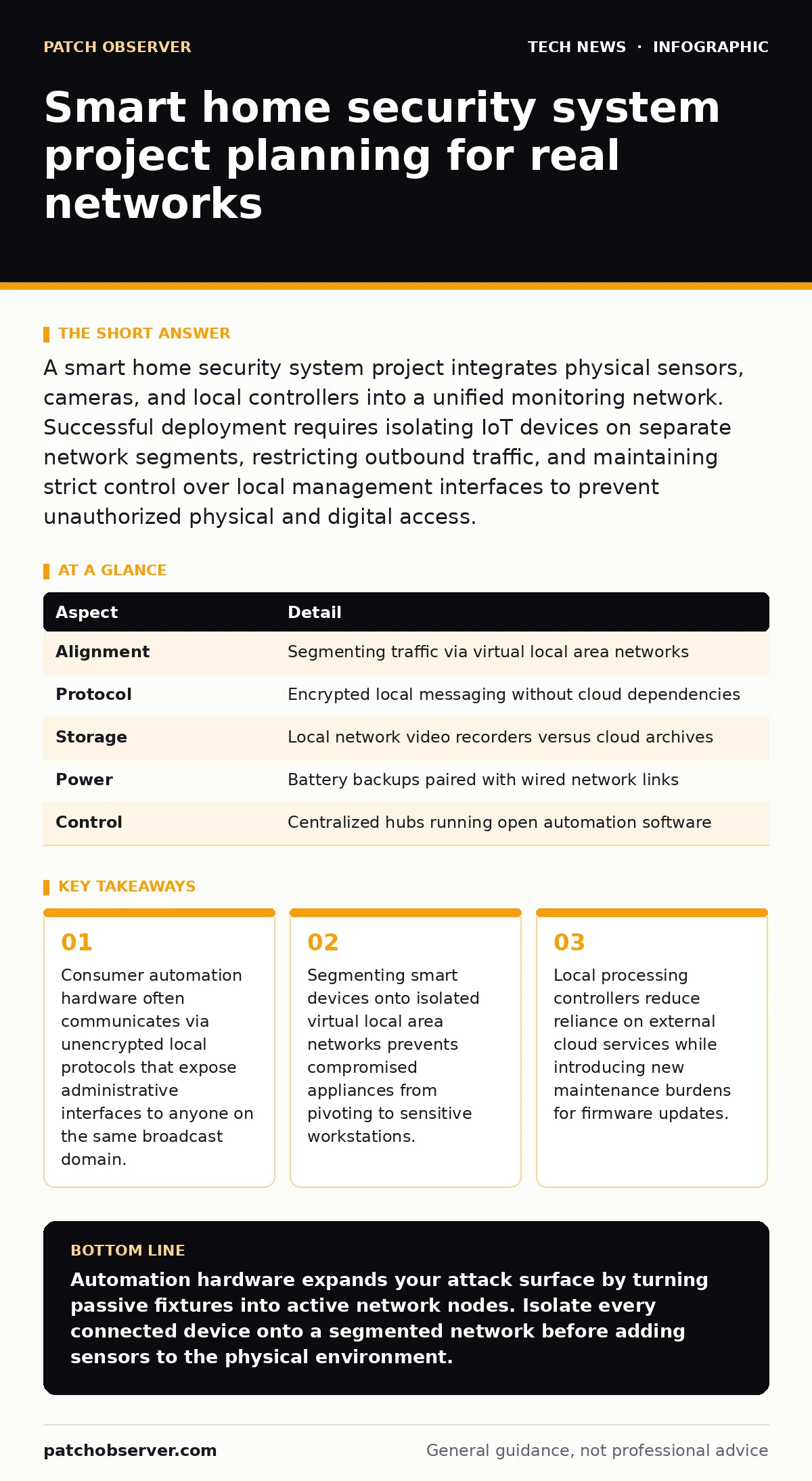
A smart home security system project integrates physical sensors, cameras, and local controllers into a unified monitoring network. Successful deployment requires isolating IoT devices on separate network segments, restricting outbound traffic, and maintaining strict control over local management interfaces to prevent unauthorized physical and digital access.
Defining the smart home security system project
A smart home security system project connects physical sensors, digital cameras, and automated actuators to a centralized controller for remote monitoring and response. This undertaking transforms passive living spaces into active nodes on a digital network. Physical security merges directly with network architecture, creating a unified topology where a failure in software translation exposes physical doors and windows.
Deploying these systems involves balancing convenience with continuous surveillance. Every microphone, lens, and lock added to the environment creates a new telemetry stream that must be processed, stored, and protected. Understanding this architecture requires looking beyond the sleek plastic enclosures and examining the underlying communication channels that bind the components together.
How consumer automation networks operate
Smart devices rely on a mix of local radio frequencies and Internet Protocol networks to transmit status updates and receive commands. Sensors broadcast state changes to a hub, which translates these signals into machine-readable data payloads. This data often travels through standard Wi-Fi security frameworks that protect the wireless airwaves from casual eavesdropping but offer little defense against compromised internal clients.
Controllers frequently maintain persistent outbound connections to manufacturer servers, allowing remote access via smartphone applications without requiring complex firewall configuration. This outbound tunneling punches a logical hole through traditional perimeter defenses. If an attacker gains control of a single connected bulb or plug, that device serves as a permanent bridge into the local network environment.
| Aspect | Detail |
|---|---|
| Alignment | Segmenting traffic via virtual local area networks |
| Protocol | Encrypted local messaging without cloud dependencies |
| Storage | Local network video recorders versus cloud archives |
| Power | Battery backups paired with wired network links |
| Control | Centralized hubs running open automation software |
Hidden trade-offs in automated defense
Adding automated monitoring to a residential or small office space introduces unexpected maintenance obligations and privacy liabilities. Many modern devices download automatic updates without user confirmation, occasionally introducing regressions that break local integrations or alter privacy settings. These background updates mimic the behavior managed in smartphone security updates, requiring constant oversight to ensure device stability.
Relying on manufacturer-hosted cloud platforms means your private video feeds and occupancy patterns traverse third-party servers outside your jurisdiction. Even when encryption protects data in transit, metadata exposure reveals when rooms are occupied, when doors open, and when occupants sleep. Managing these risks demands strict adherence to network access control principles that limit what external servers can observe.
What people usually get wrong about IoT isolation
Many installers believe that hiding network service set identifiers or enabling wireless encryption provides adequate isolation for sensitive automation hardware. This assumption ignores the reality of local network trust relationships, where devices on the same subnet often possess implicit authorization to communicate with one another. A compromised streaming device can easily scan adjacent IP addresses and exploit unpatched management interfaces on automation hubs.
Another common error involves trusting local device pairing mechanisms that lack cryptographic verification. If an adversary can spoof the identity of a legitimate sensor during the initial setup phase, they can inject false trigger events or suppress real alarms indefinitely. True isolation requires hardware-level segmentation and firewall rules that drop unauthorized east-west traffic between appliances.
Steps for building a resilient automation topology
- Map every connected device and document its required communication ports and external server destinations.
- Create dedicated network segments that separate automation hardware from personal computers and file storage.
- Disable Universal Plug and Play on your primary router to prevent devices from automatically opening inbound ports.
- Configure local controllers to operate entirely offline where possible, eliminating cloud dependencies for core security logic.
See also: How a Wi-Fi Security System Works and What It Protects
Managing firmware lifecycles and vendor dependencies
Hardware longevity represents a silent failure point in most residential automation deployments. Manufacturers frequently abandon device support after a few years, leaving deployed sensors and cameras vulnerable to unpatched software flaws. When local APIs undergo undocumented changes during routine updates, custom integrations fail unexpectedly and require manual reconfiguration.
Evaluating a device purchase must include investigating the manufacturer's update history and vulnerability disclosure policy. Devices that require constant internet access merely to function locally create an unacceptable operational dependency. Prioritizing open protocols that integrate with local network ports and protocols ensures your deployment survives corporate acquisitions and discontinued product lines.
Key takeaways
- Consumer automation hardware often communicates via unencrypted local protocols that expose administrative interfaces to anyone on the same broadcast domain.
- Segmenting smart devices onto isolated virtual local area networks prevents compromised appliances from pivoting to sensitive workstations.
- Local processing controllers reduce reliance on external cloud services while introducing new maintenance burdens for firmware updates.
Automation hardware expands your attack surface by turning passive fixtures into active network nodes. Isolate every connected device onto a segmented network before adding sensors to the physical environment.
Frequently asked questions
Can I use my main Wi-Fi network for smart home security devices?
Placing smart devices on your primary network exposes personal computers to lateral movement if an automation appliance is compromised. Use a separate virtual local area network for all IoT hardware.
Do smart locks require an active internet connection to function locally?
Most smart locks use local radio frequencies to communicate with a dedicated hub, allowing them to operate during internet outages if the local controller remains powered.
How do I stop my cameras from sending video to foreign cloud servers?
Implement strict egress filtering on your router and configure cameras to stream exclusively to a local network video recorder using open standards.
What happens when a smart home manufacturer goes out of business?
Cloud-dependent devices typically transform into non-functional plastic when company servers shut down, unless local-only control firmware was available.
How this guide was produced: written by the Patch Observer editorial team with AI assistance, checked against the public references listed below, and reviewed when the facts change. See our editorial policy or report an error.