Defense in Depth Layers: How to Stop Attacks When One Control Fails
Defense in depth layers ensure that a single failure does not expose your entire network, forcing attackers to overcome multiple independent barriers to reach sensitive data.

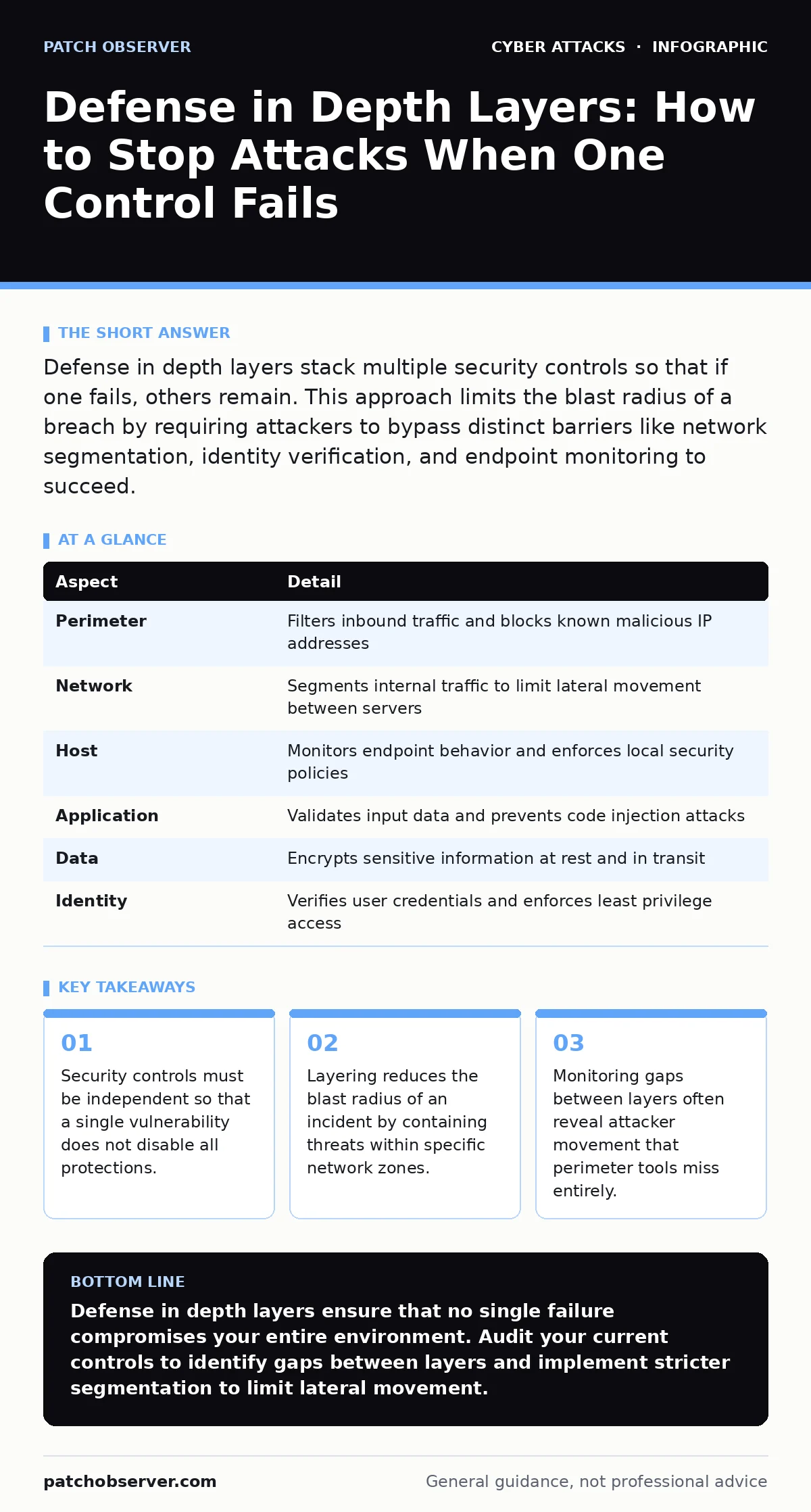
Defense in depth layers stack multiple security controls so that if one fails, others remain. This approach limits the blast radius of a breach by requiring attackers to bypass distinct barriers like network segmentation, identity verification, and endpoint monitoring to succeed.
Why Single Controls Fail
Imagine a medieval castle with only one thick wall. If the wall cracks, the entire kingdom falls. Modern networks rarely have such obvious weaknesses, but they do have single points of failure. A firewall might block external scans, yet it cannot stop an insider with valid credentials. An antivirus engine might catch known malware, but it often misses new fileless attacks that run directly in memory.
Defense in depth layers address this fragility. You stack controls so they cover different attack vectors. When one control fails, the next layer detects or blocks the threat. This structure forces attackers to work harder and makes their presence more visible. You do not rely on luck or a single vendor to keep your data safe.
How Defense in Depth Layers Work
Defense in depth layers operate by creating distinct barriers between an attacker and your critical assets. Each layer serves a specific purpose and operates independently. You might place a perimeter firewall to filter traffic, an intrusion detection system to analyze packets, and an endpoint detection platform to monitor process behavior.
The goal is not to make every layer impenetrable. The goal is to ensure that bypassing one layer does not grant immediate access to sensitive data. Attackers must adapt their tactics for each new barrier. This adaptation takes time and leaves digital footprints. Your monitoring systems can then detect these anomalies and trigger alerts.
| Aspect | Detail |
|---|---|
| Perimeter | Filters inbound traffic and blocks known malicious IP addresses |
| Network | Segments internal traffic to limit lateral movement between servers |
| Host | Monitors endpoint behavior and enforces local security policies |
| Application | Validates input data and prevents code injection attacks |
| Data | Encrypts sensitive information at rest and in transit |
| Identity | Verifies user credentials and enforces least privilege access |
The Hidden Cost of Complexity
Adding more controls creates management overhead. Each layer requires configuration, monitoring, and regular updates. You must ensure that these layers do not conflict with each other. A strict firewall rule might block legitimate application traffic, causing downtime. An overly aggressive antivirus policy might delete critical system files.
You also face the risk of alert fatigue. More layers generate more logs and alerts. If your team cannot distinguish between noise and genuine threats, they will miss real attacks. You need clear procedures for investigating alerts from each layer. Prioritize alerts that indicate movement between layers, as this suggests an attacker has bypassed initial controls.
What People Usually Get Wrong
Many organizations treat defense in depth layers as a checklist. They install a firewall, add antivirus, and enable multi-factor authentication, then assume they are secure. This approach ignores the need for integration. Controls must share context. If the identity provider flags a suspicious login, the network layer should restrict that user’s access immediately.
Another common error is focusing only on external threats. Internal users and compromised accounts often bypass perimeter defenses. You must apply the same rigor to internal traffic as you do to external traffic. Network segmentation and strict access controls prevent lateral movement once an attacker is inside.
Identity as the New Perimeter
Traditional security focused on the network edge. Modern threats often start with stolen credentials. Phishing simulations help users recognize social engineering attempts, but they do not stop attackers who obtain valid login details. Credential stuffing attacks use leaked passwords from other breaches to gain access.
You must treat identity verification as a core defense in depth layers component. Enforce multi-factor authentication for all users, especially those with administrative privileges. Monitor for unusual login patterns, such as access from new locations or at odd hours. Integrate identity logs with your security information and event management system to detect anomalies quickly.
See also: IoT Device Vulnerabilities: How to Secure Connected Hardware · How a Wi-Fi Security System Works and What It Protects
Limiting the Blast Radius
When an attack succeeds, the damage depends on how far the attacker can move. Network segmentation limits this movement by dividing your infrastructure into smaller zones. If an attacker compromises a web server, they cannot easily reach the database server if proper segmentation is in place.
You must also manage the blast radius of configuration errors. A misconfigured cloud storage bucket can expose millions of records. Regular audits and automated compliance checks help catch these errors before attackers exploit them. Secure email gateways can also reduce the risk of initial compromise by filtering malicious attachments and links.
Monitoring the Gaps
Attackers often exploit the gaps between layers. They might bypass the firewall using a legitimate application protocol, then move laterally through the network using stolen credentials. Your monitoring must cover these transitions. Look for unusual connections between servers that rarely communicate.
Integrate logs from all layers into a central platform. Correlate events across different data sources. A failed login attempt combined with a sudden spike in outbound traffic might indicate data exfiltration. Regularly test your detection capabilities with red team exercises to ensure your monitoring covers all critical paths.
Maintaining Your Layers
Security controls degrade over time. Rules become outdated, software falls behind on patches, and configurations drift from best practices. You must regularly review and update each layer. Remove unnecessary rules and tighten access controls.
Automate where possible. Use configuration management tools to enforce consistent security settings across all endpoints. Monitor for changes to critical systems and alert on unauthorized modifications. Regular maintenance ensures that your defense in depth layers remain effective against evolving threats.
Key takeaways
- Security controls must be independent so that a single vulnerability does not disable all protections.
- Layering reduces the blast radius of an incident by containing threats within specific network zones.
- Monitoring gaps between layers often reveal attacker movement that perimeter tools miss entirely.
Defense in depth layers ensure that no single failure compromises your entire environment. Audit your current controls to identify gaps between layers and implement stricter segmentation to limit lateral movement.
Frequently asked questions
How many defense in depth layers do I need?
There is no fixed number. You need enough layers to cover your critical assets and address your specific risk profile. Focus on quality and integration rather than quantity.
Does defense in depth replace other security measures?
No, it complements them. It structures your existing controls to provide overlapping protection. You still need strong passwords, regular backups, and user training.
How do I detect attacks that bypass the first layer?
Monitor for lateral movement and unusual behavior. Look for connections between systems that do not normally communicate and analyze logs for signs of privilege escalation.
Is defense in depth effective against insider threats?
Yes, when properly implemented. Strict access controls, network segmentation, and behavioral monitoring help detect and limit the damage caused by malicious insiders.
How this guide was produced: written by the Patch Observer editorial team with AI assistance, checked against the public references listed below, and reviewed when the facts change. See our editorial policy or report an error.