Social Engineering Tactics: How Attackers Bypass Technical Defenses
Technical controls fail when attackers exploit human psychology, making behavioral awareness the primary defense against manipulation.

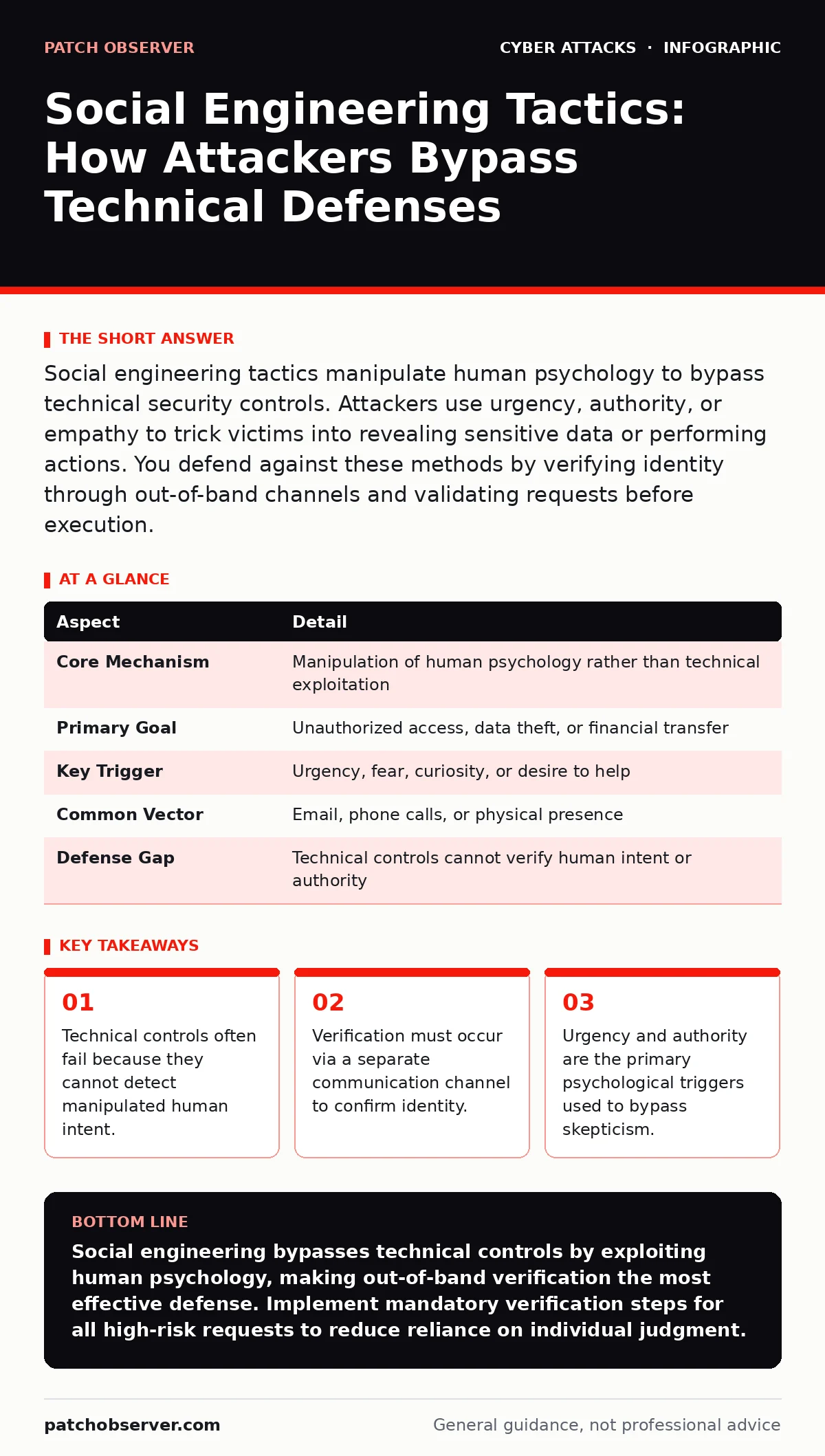
Social engineering tactics manipulate human psychology to bypass technical security controls. Attackers use urgency, authority, or empathy to trick victims into revealing sensitive data or performing actions. You defend against these methods by verifying identity through out-of-band channels and validating requests before execution.
The Psychology of Trust Exploitation
Imagine handing your house keys to a stranger who claims to be the landlord's nephew. You comply because the situation feels urgent and the person appears authoritative. Social engineering operates on this same principle of misplaced trust. It is the art of manipulating people into breaking normal security procedures or best practices.
Attackers do not hack computers directly. They hack the humans who control them. This distinction changes how you must approach defense. Technical solutions like firewalls and encryption protect data in transit and at rest. They do not protect the decision-making process that releases that data.
| Aspect | Detail |
|---|---|
| Core Mechanism | Manipulation of human psychology rather than technical exploitation |
| Primary Goal | Unauthorized access, data theft, or financial transfer |
| Key Trigger | Urgency, fear, curiosity, or desire to help |
| Common Vector | Email, phone calls, or physical presence |
| Defense Gap | Technical controls cannot verify human intent or authority |
Understanding Social Engineering Tactics
When you search for social engineering tactics, you are looking for the specific methods attackers use to gain leverage. These methods rely on cognitive biases. A cognitive bias is a pattern of deviation from rational judgment. Attackers exploit these biases to make victims act without thinking.
The most common tactic involves creating a false sense of urgency. The attacker tells you that your account will be locked in minutes. You panic. You stop verifying the source. You click the link. The second tactic involves impersonation. The attacker poses as IT support, a senior executive, or a vendor. You assume the person has authority. You grant access.
A third tactic is the "helpful" approach. The attacker claims to have found a problem with your system. They offer a solution. You trust the helper. You install the tool. This tool is malware. Understanding these tactics requires recognizing that the goal is not to convince you logically, but to bypass your logic entirely.
Who Is Targeted and Why
Social engineering affects everyone. It does not discriminate by technical skill level. In fact, highly technical users are often easier targets. They trust their tools. They assume their email client filters out threats. They forget that the human element remains the weakest link.
Attackers target individuals with access to sensitive data. These individuals include finance staff, system administrators, and HR personnel. However, attackers also target regular employees. A regular employee can provide credentials that allow lateral movement. Once inside the network, the attacker moves from a low-privilege account to a high-privilege one.
The target is not the data itself. The target is the trust relationship. The attacker wants you to believe they are someone you should trust. This trust allows them to bypass multi-factor authentication. It allows them to bypass password policies. It allows them to bypass encryption.
Common Misconceptions About Defense
Many organizations believe that training solves the problem. They run annual seminars on security awareness. They show videos of phishing emails. This approach has hidden costs. It creates a false sense of security. Employees feel they are protected because they attended training. They become complacent.
Training rarely changes behavior in high-pressure situations. When an attacker creates urgency, the victim reverts to instinct. Instinct overrides training. You need more than knowledge. You need process. You need verification steps that are easy to follow even under stress.
Another misconception is that technology can stop social engineering. Secure email gateways filter malicious content. They check for known bad domains. They scan for malware. They cannot read the context of a conversation. They cannot tell if a request for a password is legitimate. They cannot detect if an employee is being coerced.
Verifying Identity and Intent
The primary defense against social engineering is verification. You must verify the identity of the requester. You must verify the intent of the request. This verification must happen out-of-band. Out-of-band means using a different communication channel than the one used for the request.
If you receive an email asking for a password reset, do not reply to the email. Call the IT department using a known phone number. If you receive a call from a vendor asking for a payment change, email the vendor using a saved address. Do not use the contact information provided in the suspicious message.
This step adds friction. It slows down the process. This friction is intentional. It gives you time to think. It allows you to check facts. It breaks the urgency loop created by the attacker. You must build this friction into your standard operating procedures.
See also: How Smishing Works: The Step-by-Step Attack Lifecycle · CI/CD Pipeline Breach Response: Steps to Contain and Recover
Integrating Broader Security Controls
Social engineering does not exist in isolation. It often precedes other attack methods. An attacker might use social engineering to obtain credentials. They then use those credentials for password spraying. Password spraying is an attack where the attacker tries a few common passwords against many accounts.
Once inside, the attacker may deploy malware. This malware can lead to website defacement. It can steal data. It can disrupt operations. A cyber incident response team must be ready to handle these scenarios. They need to know that the initial entry point was likely human manipulation.
You should also consider DMARC. DMARC is an email authentication protocol. It helps prevent email spoofing. It reduces the likelihood that an attacker can successfully impersonate your domain. While it does not stop all social engineering, it raises the barrier for entry. It makes it harder for attackers to create convincing fake emails.
Building Resilience Through Process
Resilience means recovering from an attack. It means limiting the damage. You cannot prevent every social engineering attempt. You will be targeted. You will be tricked. The goal is to minimize the impact.
Start by mapping your critical processes. Identify where human judgment is required. Add verification steps to these processes. Automate where possible. Remove human decision-making from high-risk actions. Use systems that enforce policies rather than relying on individual memory.
Conduct regular phishing simulations. These simulations test your employees' ability to recognize attacks. They provide feedback. They help identify gaps in your defense. However, simulations are only effective if they are part of a broader strategy. They must be combined with clear policies and easy-to-use verification tools.
The Human Element Remains Critical
Technology evolves. Protocols improve. Defenses strengthen. But human psychology remains constant. Attackers will continue to exploit trust, urgency, and authority. You must accept this reality. You must design your security around it.
Do not blame individuals for falling victim. Blame the process that allowed the attack to succeed. Fix the process. Add verification. Reduce reliance on memory. Increase reliance on systems. This approach builds a culture of security. It creates an environment where asking questions is normal. It makes it safe to pause and verify.
Your defense is not a wall. It is a series of checkpoints. Each checkpoint slows the attacker down. Each checkpoint gives you time to react. Each checkpoint increases the cost of the attack. Make social engineering too difficult and too expensive for the attacker to succeed.
Key takeaways
- Technical controls often fail because they cannot detect manipulated human intent.
- Verification must occur via a separate communication channel to confirm identity.
- Urgency and authority are the primary psychological triggers used to bypass skepticism.
Social engineering bypasses technical controls by exploiting human psychology, making out-of-band verification the most effective defense. Implement mandatory verification steps for all high-risk requests to reduce reliance on individual judgment.
Frequently asked questions
How do I distinguish between a legitimate urgent request and a social engineering attempt?
Legitimate requests rarely demand immediate action without allowing time for verification. If a request creates panic or bypasses standard procedures, treat it as suspicious and verify through a separate channel.
Can multi-factor authentication stop social engineering?
Multi-factor authentication adds a layer of security but does not stop social engineering. Attackers can trick users into bypassing MFA or stealing the second factor. Verification of intent remains necessary.
What is the difference between phishing and social engineering?
Phishing is a specific type of social engineering that uses electronic communication, typically email. Social engineering is the broader category that includes phone calls, physical presence, and other manipulation techniques.
Should I report every suspicious request?
Yes. Reporting suspicious requests helps your security team identify trends and improve defenses. Even if the request turns out to be legitimate, reporting it creates a record that aids in future investigations.
How this guide was produced: written by the Patch Observer editorial team with AI assistance, checked against the public references listed below, and reviewed when the facts change. See our editorial policy or report an error.