DMARC Misconceptions: Why Your Policy Fails Without These Fixes
DMARC does not block email by itself; it tells receivers how to handle messages that fail authentication checks, creating a feedback loop that requires careful tuning.

DMARC does not stop spoofing alone. It relies on SPF and DKIM to verify sender identity. Misunderstanding this leads to broken workflows or weak policies. Fix your alignment, monitor reports, and use quarantine before rejecting to avoid blocking legitimate mail.
Misreading: DMARC blocks spoofed email automatically
Correct reading: DMARC does not block anything on its own. It is a policy record that instructs receiving mail servers on what action to take when a message fails authentication. The actual blocking happens at the receiver’s end, based on the policy you publish. If your SPF or DKIM records are misconfigured, DMARC has no mechanism to intervene. The protocol only evaluates whether the authenticated identity matches the visible sender address. Without proper underlying authentication, DMARC remains silent.
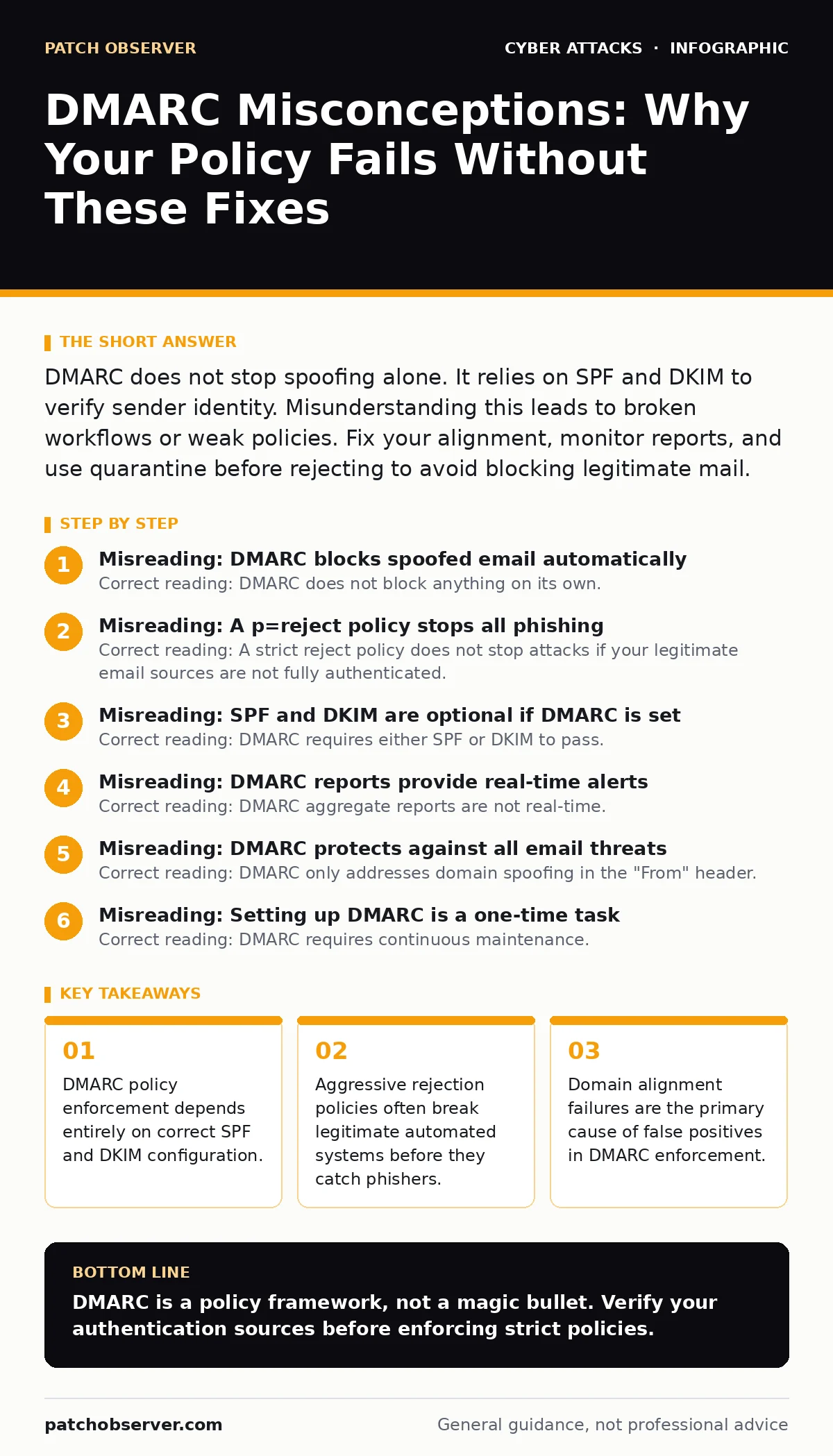
Misreading: A p=reject policy stops all phishing
Correct reading: A strict reject policy does not stop attacks if your legitimate email sources are not fully authenticated. Many organizations enable rejection too early, before they have mapped all third-party vendors, marketing platforms, and automated systems. This creates a high rate of false positives. Legitimate transactional emails get dropped, frustrating customers and support teams. You must first achieve near-perfect alignment across all sending sources. Only then does a reject policy become effective against spoofing without harming your own operations.
Misreading: SPF and DKIM are optional if DMARC is set
Correct reading: DMARC requires either SPF or DKIM to pass. It does not perform authentication itself. SPF (Sender Policy Framework) verifies that the sending server is authorized. DKIM (DomainKeys Identified Mail) adds a cryptographic signature to the message header. DMARC checks if the domain in these mechanisms aligns with the "From" address seen by the user. If both SPF and DKIM fail, DMARC triggers the policy action. You cannot rely on DMARC alone. It is a coordination layer, not an authentication engine. Weakness in SPF or DKIM renders DMARC useless.
Misreading: DMARC reports provide real-time alerts
Correct reading: DMARC aggregate reports are not real-time. They are XML files sent by receiving providers, often with a delay of 24 hours or more. These reports summarize what happened over a period, showing which IPs sent mail and how it authenticated. They are useful for trend analysis and identifying new sending sources. They do not alert you to an active attack as it happens. For immediate detection, you need separate monitoring tools. Relying solely on DMARC reports for incident response leaves a dangerous blind spot during active campaigns.
Misreading: DMARC protects against all email threats
Correct reading: DMARC only addresses domain spoofing in the "From" header. It does not protect against content-based attacks, such as malicious attachments or links. It does not stop social engineering where the attacker uses a completely different, look-alike domain. It also does not prevent business email compromise if the attacker gains access to a legitimate account. The protection is limited to identity verification. You still need robust filtering, user training, and other controls to handle the broader threat surface. DMARC is one layer in a larger strategy.
See also: Email Account Compromise: 6 Myths That Leave You Exposed · Secure Email Gateway Best Practices for Deep Inspection
Misreading: Setting up DMARC is a one-time task
Correct reading: DMARC requires continuous maintenance. New vendors, marketing campaigns, and internal tools often introduce new sending IPs or change authentication methods. If you do not update your SPF or DKIM records, these new sources will fail DMARC checks. Over time, your environment drifts from your published policy. Regular review of aggregate reports ensures your policy remains accurate. You must monitor for alignment failures and adjust your records accordingly. Neglecting this maintenance leads to increased false positives and reduced trust from receiving providers.
Misreading: DMARC replaces the need for user training
Correct reading: Users can still be tricked by emails that pass DMARC checks. If an attacker compromises a legitimate account, the email will authenticate correctly. DMARC verifies the domain, not the intent. Phishing simulations help users recognize suspicious content regardless of authentication status. Training reduces the success rate of attacks that bypass technical controls. DMARC and user awareness are complementary, not interchangeable. Ignoring training leaves you vulnerable to attacks that exploit human psychology rather than technical flaws.
Misreading: DMARC works perfectly with all email clients
Correct reading: Not all email clients or providers respect DMARC policies equally. Some smaller providers may ignore DMARC records or implement them incorrectly. This means an attacker might still deliver spoofed mail to users on those platforms. You cannot control how receivers interpret your records. Your job is to publish correct records and monitor compliance. Expect some variance in enforcement across the internet. Do not assume universal protection. Focus on major providers and monitor reports for anomalies from smaller ones.
Key takeaways
- DMARC policy enforcement depends entirely on correct SPF and DKIM configuration.
- Aggressive rejection policies often break legitimate automated systems before they catch phishers.
- Domain alignment failures are the primary cause of false positives in DMARC enforcement.
DMARC is a policy framework, not a magic bullet. Verify your authentication sources before enforcing strict policies.
Frequently asked questions
How long does it take to implement DMARC safely?
Implementation varies by organization size. Small domains may achieve full alignment in weeks. Larger organizations with many third-party integrations may need months to map and authenticate all sources. Start with monitoring mode to avoid disruption.
Can DMARC help with domain takeover attacks?
DMARC can indicate unauthorized sending if an attacker gains control of a subdomain and sends unauthenticated mail. However, it does not prevent the takeover itself. Regular monitoring of DNS records and DMARC reports helps detect such anomalies early.
What is the difference between SPF and DMARC?
SPF lists authorized sending IPs for a domain. DMARC uses SPF and DKIM to check if the authenticated domain matches the visible sender. SPF is a permission list. DMARC is a policy for handling mismatches.
Does DMARC improve email deliverability?
Yes, consistent DMARC alignment signals trust to receiving providers. This can improve inbox placement over time. However, it does not guarantee delivery. Content quality and sender reputation also play significant roles.
How this guide was produced: written by the Patch Observer editorial team with AI assistance, checked against the public references listed below, and reviewed when the facts change. See our editorial policy or report an error.