Password Spraying Explained: How Attackers Bypass Account Lockouts
This technique avoids detection by trying one common password across thousands of accounts, keeping each account under its lockout threshold while still gaining access.

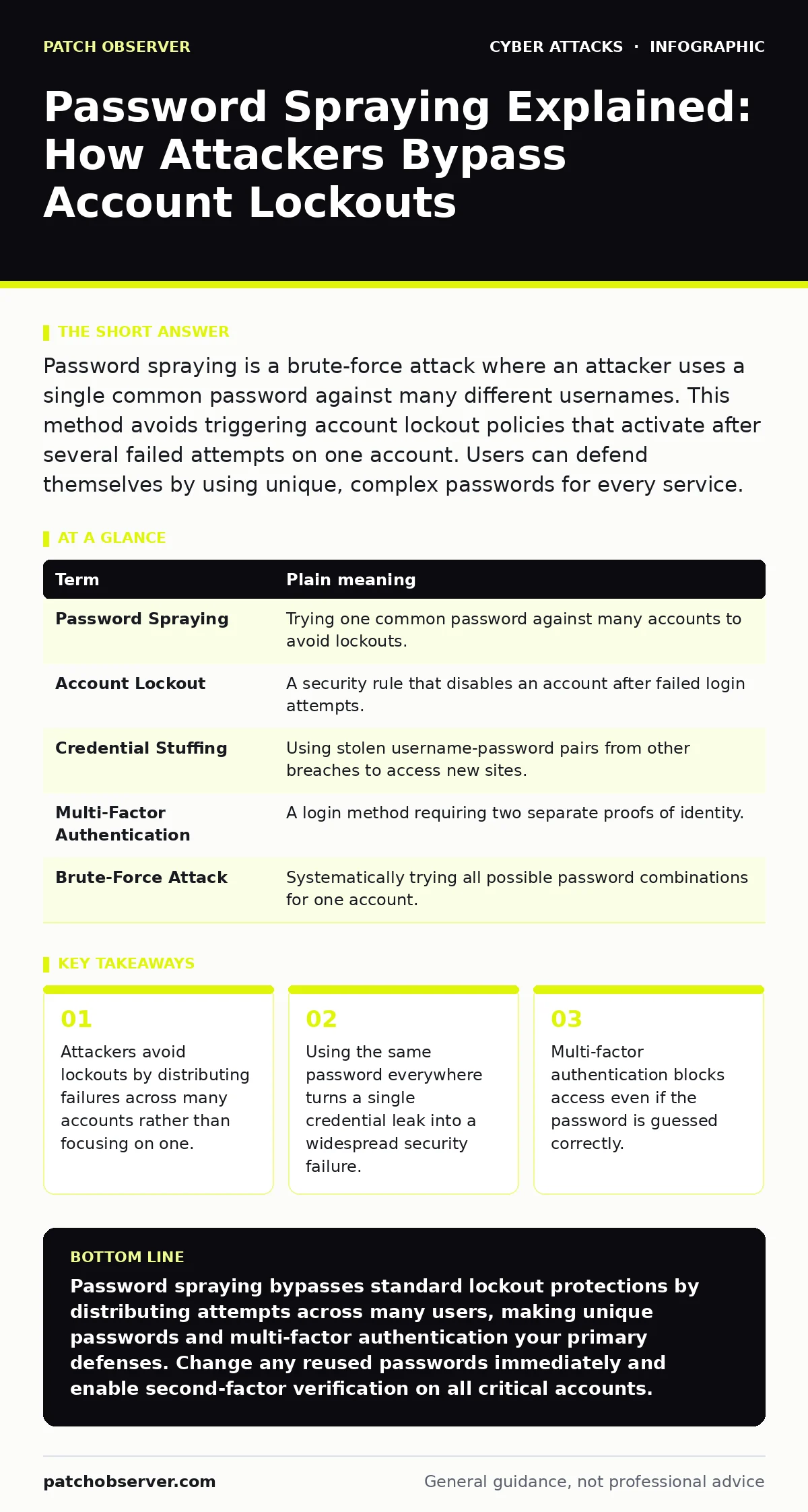
Password spraying is a brute-force attack where an attacker uses a single common password against many different usernames. This method avoids triggering account lockout policies that activate after several failed attempts on one account. Users can defend themselves by using unique, complex passwords for every service.
The Mailroom Strategy
Imagine a building with hundreds of offices. Each office has a sturdy lock that jams permanently after five wrong key attempts. A thief cannot simply try every key on one door until it opens, because the lock would jam after five tries, alerting security. Instead, the thief takes one common key shape and tries it on every door in the building. They might succeed on only a few doors, but they never trigger the jam mechanism on any single lock. This is the core mechanic of password spraying, a technique that exploits the gap between security controls and human habits.
Why Single-Account Lockouts Fail
Most organizations configure account lockout policies to disable an account after a specific number of failed login attempts. This protects against brute-force attacks that target one user with many passwords. Password spraying reverses this dynamic. The attacker selects one or two highly probable passwords, such as "Password1" or "Summer2023". They then attempt these passwords against thousands of usernames. Because each individual account receives only one or two failed attempts, the lockout threshold is never reached. The attacker remains invisible to the monitoring systems that watch for high-volume failures on a single identity.
| Term | Plain meaning |
|---|---|
| Password Spraying | Trying one common password against many accounts to avoid lockouts. |
| Account Lockout | A security rule that disables an account after failed login attempts. |
| Credential Stuffing | Using stolen username-password pairs from other breaches to access new sites. |
| Multi-Factor Authentication | A login method requiring two separate proofs of identity. |
| Brute-Force Attack | Systematically trying all possible password combinations for one account. |
The Difference From Credential Stuffing
It is easy to confuse password spraying with credential stuffing, but the data sources differ. Credential stuffing relies on lists of usernames and passwords that were already leaked from other breaches. The attacker knows the password works for that user somewhere, so they try it here. Password spraying does not require prior leaks. The attacker guesses a password that many users are likely to use. This makes spraying dangerous even if your credentials have never been part of a public data breach. Your habits, not your past exposure, are the vulnerability.
What This Means For You
If you use the same password for your email, banking, and work accounts, you are vulnerable to both spraying and stuffing. When an attacker sprays a common password, they are banking on the statistical likelihood that some users chose that exact string. If you are one of them, they gain immediate access. This access can lead to business email compromise if the account is used for professional communication. The attacker can impersonate you to request payments or sensitive data. The speed of the attack means you may not notice the intrusion until damage is done.
Simple Safety Habits
The most effective defense is to ensure no common password works for your accounts. Use a password manager to generate long, random strings for every service. These strings are unlikely to appear in any attacker's list of common guesses. Enable multi-factor authentication on every account that supports it. Even if an attacker sprays your password successfully, they cannot log in without the second factor, such as a code from your phone. This stops the attack at the final door.
See also: MFA for Cloud Accounts: Secure Small Business Access Without Complexity
Checking Your Exposure
You should assume that common passwords are being tested regularly. Do not wait for a breach alert to change your habits. Regularly review your account security settings. Look for options to disable legacy protocols that send passwords in plain text. Ensure that your organization or service provider enforces complexity requirements. These measures raise the difficulty for attackers without adding friction for legitimate users.
Try This Now
- [ ] Generate a unique, random password for your primary email account using a password manager.
- [ ] Enable multi-factor authentication on that account, preferring an authenticator app over SMS.
- [ ] Check if your work or school email allows for conditional access policies that block logins from unusual locations.
Monitoring For Signs
While you cannot see the spray attempts directly, you can look for the results. Unexpected password reset emails indicate someone tried to access your account. Logins from unfamiliar devices or countries are strong indicators of compromise. If you see these signs, change your password immediately and re-enable multi-factor authentication. Security operations centers often track these anomalies to identify large-scale spraying campaigns before they succeed.
Key takeaways
- Attackers avoid lockouts by distributing failures across many accounts rather than focusing on one.
- Using the same password everywhere turns a single credential leak into a widespread security failure.
- Multi-factor authentication blocks access even if the password is guessed correctly.
Password spraying bypasses standard lockout protections by distributing attempts across many users, making unique passwords and multi-factor authentication your primary defenses. Change any reused passwords immediately and enable second-factor verification on all critical accounts.
Frequently asked questions
Does changing my password every month stop password spraying?
Changing passwords frequently helps, but using a unique password for every account is more effective. Attackers spray common passwords, so uniqueness matters more than frequency.
Can multi-factor authentication be bypassed during a password spray attack?
Standard multi-factor authentication stops the login even if the password is correct. However, if an attacker uses social engineering to trick you into bypassing it, the protection fails.
Why don't account lockouts catch all password spraying attempts?
Lockouts trigger only after multiple failures on one account. Spraying limits failures to one or two per account, staying below the threshold.
Is password spraying legal?
No, unauthorized access to computer systems is illegal in most jurisdictions. Attempting to log in to accounts you do not own constitutes a criminal offense.
How this guide was produced: written by the Patch Observer editorial team with AI assistance, checked against the public references listed below, and reviewed when the facts change. See our editorial policy or report an error.