Exploit Chains Explained: How Attackers String Vulnerabilities Together
Attackers rarely succeed with a single flaw; they connect minor weaknesses into a sequence that bypasses individual defenses and reaches critical data.

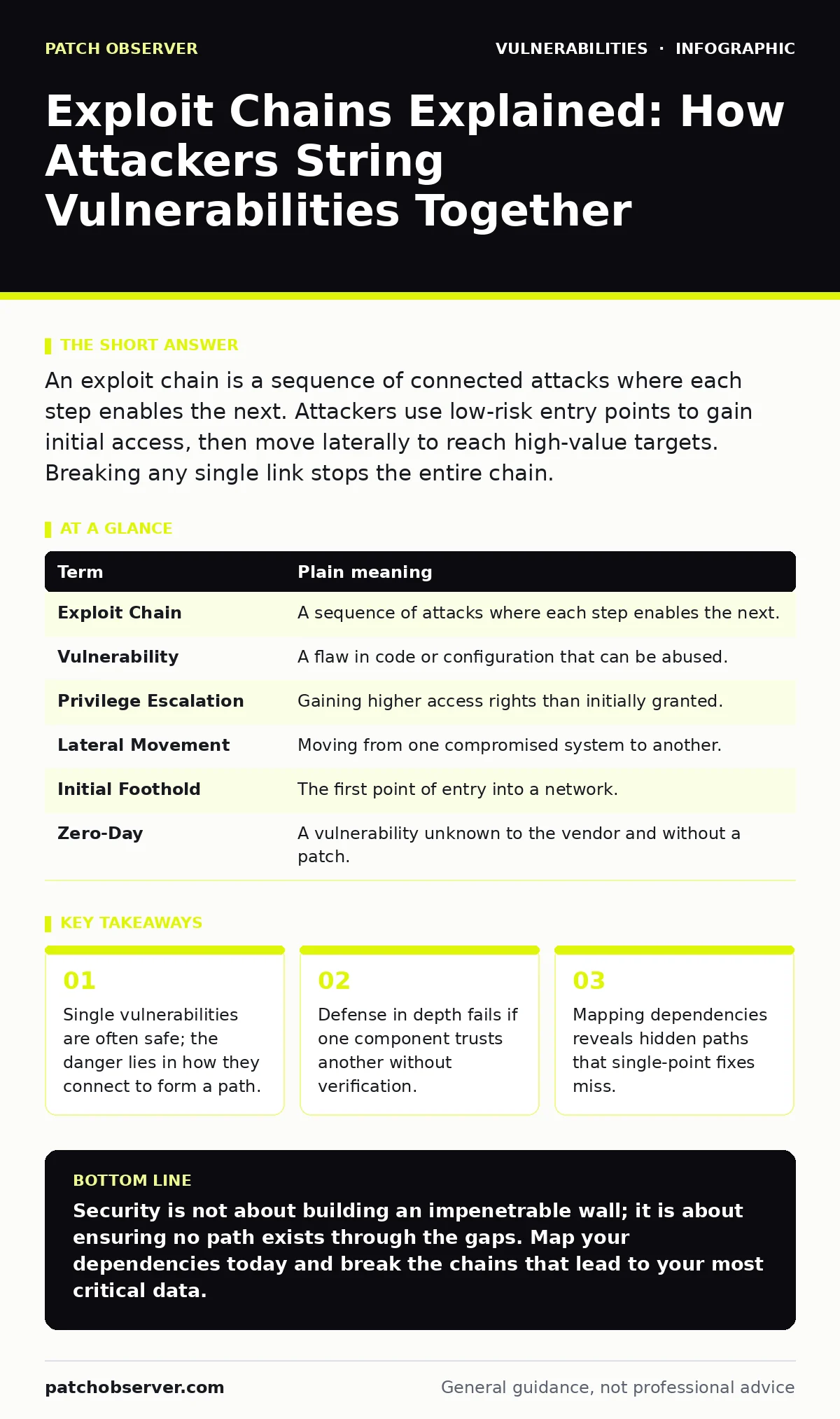
An exploit chain is a sequence of connected attacks where each step enables the next. Attackers use low-risk entry points to gain initial access, then move laterally to reach high-value targets. Breaking any single link stops the entire chain.
The House Key Analogy
Imagine a house with a solid front door. The lock is excellent, and the frame is reinforced. You sleep soundly because the door seems impenable. Now imagine the backyard fence has a loose gate. It does not open into the house, but it allows someone to step onto the porch. From the porch, they can reach the kitchen window, which lacks a lock. They push it open, enter, and steal your valuables.
The front door never failed. The kitchen window was the weak point, but it was only reachable because the fence failed first. In cybersecurity, this sequence is an exploit chain. It is not one big attack. It is a series of small, often minor, failures that link together to create a path to your data.
Breaking Down the Links
An exploit chain relies on progression. The attacker starts with a vulnerability, which is a flaw in software or configuration that can be abused. They use an exploit, which is the specific code or technique used to take advantage of that flaw. This grants them an initial foothold, a limited presence in your network.
From this foothold, they perform privilege escalation. This is the process of gaining higher access rights, such as moving from a guest user to an administrator. Finally, they achieve their objective, such as stealing data or installing ransomware. Each step depends on the previous one. If you block the first step, the chain breaks.
Why Single Fixes Fail
Many organizations focus on fixing individual vulnerabilities in isolation. They patch a specific bug and consider the problem solved. This approach ignores the structural reality of lateral movement. Lateral movement is the act of moving from one compromised system to another within the same network.
Suppose you patch the web server that had the initial flaw. The attacker may still have access to the internal file server because they moved there before you applied the patch. Or they may have used a different, unpatched service to reach the same destination. Fixing one link does not erase the path already traveled or the alternative paths that remain open. This is why vulnerability prioritization matters more than patching speed alone. You must prioritize based on reachability and impact, not just severity scores.
The Hidden Cost of Trust
A major point of confusion for beginners is the role of trust. Modern networks rely on services trusting other services. A web application trusts the database. The database trusts the operating system. The operating system trusts the firmware updates that control the hardware.
When you fail to verify that trust at each boundary, you create a chain. An attacker does not need to break the strongest lock. They only need to find the weakest link in the trust chain. This is often where server-side template injection becomes dangerous. It allows an attacker to execute code on the server by manipulating inputs that the server trusts. If that server has access to internal systems, the chain extends inward.
Common Misconceptions
Many believe that complex attack chains require sophisticated, zero-day exploits. This is false. Most chains rely on known, patched vulnerabilities that were simply not addressed. The complexity lies in the combination, not the individual components.
Another misconception is that perimeter security stops these chains. A firewall blocks external traffic, but it cannot stop an attacker who has already entered through a legitimate user’s device. This is where IoT device vulnerabilities often serve as the initial foothold. A smart thermostat or printer may have weak security, allowing an attacker to enter the network. Once inside, the perimeter firewall is irrelevant. The attacker is already home.
Mapping Your Own Chains
You cannot protect against what you cannot see. Start by mapping your critical assets. Identify what data is most valuable. Then, trace the path an attacker would take to reach it. Look for services that have direct access to these assets.
Check for unnecessary connections. Does the marketing website need access to the financial database? If not, remove that connection. This breaks the chain. Implement responsible disclosure processes so that researchers can report these paths before attackers do. This turns external eyes into an early warning system.
| Term | Plain meaning |
|---|---|
| Exploit Chain | A sequence of attacks where each step enables the next. |
| Vulnerability | A flaw in code or configuration that can be abused. |
| Privilege Escalation | Gaining higher access rights than initially granted. |
| Lateral Movement | Moving from one compromised system to another. |
| Initial Foothold | The first point of entry into a network. |
| Zero-Day | A vulnerability unknown to the vendor and without a patch. |
Try This Now
- Identify your crown jewel data and list every service that can access it.
- Review the trust relationships between these services and remove any that are unnecessary.
- Simulate an attack path from the internet to that data and document where the chain is weakest.
Key takeaways
- Single vulnerabilities are often safe; the danger lies in how they connect to form a path.
- Defense in depth fails if one component trusts another without verification.
- Mapping dependencies reveals hidden paths that single-point fixes miss.
Security is not about building an impenetrable wall; it is about ensuring no path exists through the gaps. Map your dependencies today and break the chains that lead to your most critical data.
Frequently asked questions
How do I know if I have an exploit chain?
You likely do not know until you map your network dependencies. Look for services with broad access to critical assets and unpatched software that connects to them.
Is patching enough to stop exploit chains?
Patching removes specific links, but it does not fix the structural trust issues. You must also limit lateral movement and verify trust between services.
What is the difference between an exploit and an exploit chain?
An exploit is a single technique to abuse a flaw. An exploit chain is a sequence of exploits and movements used to reach a final goal.
Can firewalls prevent exploit chains?
Firewalls help prevent initial entry, but they cannot stop chains that start from inside the network or use legitimate user access.
How this guide was produced: written by the Patch Observer editorial team with AI assistance, checked against the public references listed below, and reviewed when the facts change. See our editorial policy or report an error.