Blast Radius: 6 Common Misreadings That Expand Your Attack Surface
Treating blast radius as a static metric ignores how lateral movement amplifies initial access into systemic failure.

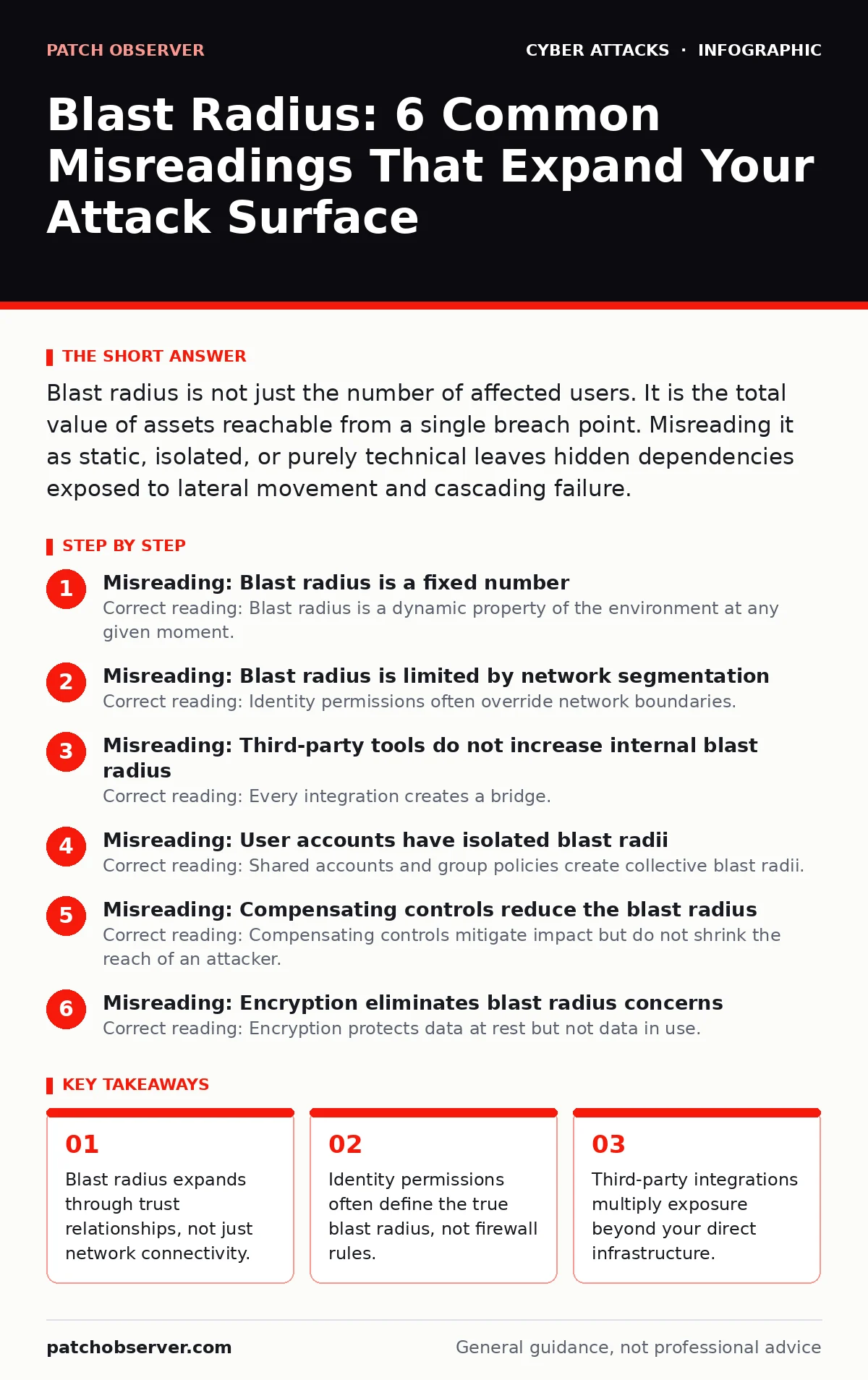
Blast radius is not just the number of affected users. It is the total value of assets reachable from a single breach point. Misreading it as static, isolated, or purely technical leaves hidden dependencies exposed to lateral movement and cascading failure.
Misreading: Blast radius is a fixed number
Correct reading: Blast radius is a dynamic property of the environment at any given moment. It shifts as permissions change, software updates deploy, and new integrations go live.
You might view the blast radius as a static inventory count. Suppose you have fifty servers. You assume the maximum damage is limited to those fifty units. This view ignores the state of those servers. A server running outdated software has a different blast radius than one that is patched.
The radius expands when temporary access is granted and never revoked. It contracts when least-privilege principles are enforced. You cannot measure the blast radius once and file it away. It requires continuous monitoring of permission states.
Static views create a false sense of security. You believe you have contained the risk because the asset list has not changed. In reality, the pathways between those assets have widened. This misreading prevents you from seeing the immediate impact of a single configuration error.
Misreading: Blast radius is limited by network segmentation
Correct reading: Identity permissions often override network boundaries. If a service account has excessive privileges, network segmentation becomes irrelevant.
You may rely on subnets and firewalls to contain breaches. This approach assumes that an attacker must cross network boundaries to move laterally. Modern attacks often bypass this by exploiting trust relationships.
Imagine an attacker compromises a low-level workstation. They do not need to traverse the network to reach a database server. Instead, they use the credentials of a service account that has access to both zones. The network segmentation held, but the identity layer failed.
This is where the concept of trust propagation matters. Trust is transitive. If System A trusts User B, and User B trusts System C, then System A effectively trusts System C.
Your defensive posture must account for identity sprawl. Reviewing firewall rules is not enough. You must audit what each identity can do across all segments. This connects directly to the principles of a cyber incident response team, which must understand these trust paths to contain outbreaks.
Misreading: Third-party tools do not increase internal blast radius
Correct reading: Every integration creates a bridge. A breach in a vendor’s system can become a breach in yours if trust is established.
You might view your environment as a closed loop. This ignores the reality of modern supply chains. You likely use applications that integrate with your core systems. These integrations require credentials or API keys.
Suppose a marketing plugin has access to your customer database. You assume the plugin vendor is secure. You do not consider the blast radius of a breach at that vendor. If the vendor is compromised, the attacker holds the keys to your kingdom.
This is similar to the risk profile of business email compromise. The initial breach is external, but the impact is internal. The blast radius includes all data the third party can access.
You must treat third-party access as high-risk internal access. Limit the scope of what each integration can read or write. Assume that any vendor you trust is a potential entry point for an attacker.
Misreading: User accounts have isolated blast radii
Correct reading: Shared accounts and group policies create collective blast radii. One compromised account can expose all members of that group.
You may think of each user as an independent entity. This fails when users belong to shared groups. If a security group has access to a critical file share, every member of that group is a potential entry point.
Imagine a junior employee’s account is compromised via password spraying. The attacker checks the group memberships. They find the employee is in the "Finance Read-Only" group. The blast radius is no longer just that one user’s laptop. It is the entire finance department’s data.
Group permissions amplify the impact of a single compromise. The more permissions a group has, the larger the blast radius for any member.
You must audit group memberships regularly. Remove users who no longer need access. Break up large groups into smaller, more specific roles. This reduces the number of assets exposed when one identity is lost.
Misreading: Compensating controls reduce the blast radius
Correct reading: Compensating controls mitigate impact but do not shrink the reach of an attacker. They are speed bumps, not walls.
You might install a monitoring tool and assume it reduces the blast radius. It does not. The attacker can still reach every asset. The tool only alerts you after the fact.
Suppose you enable two-factor authentication. This stops some initial access attempts. It does not change what the attacker can do if they bypass it or if they steal an existing session token. The blast radius remains the same. The likelihood of entry changes, not the scope of the breach.
This distinction is vital for risk assessment. You must separate entry prevention from impact limitation. Secure email gateways filter malicious content, but they do not change what happens if a user clicks a link that is not blocked.
Relying on compensating controls to define your blast radius leads to underestimation. You believe you are protected, but you are merely detected later. True reduction comes from removing access, not just watching it.
Misreading: Encryption eliminates blast radius concerns
Correct reading: Encryption protects data at rest but not data in use. An attacker with access to the system can read unencrypted data in memory.
You may assume that encrypted disks mean a limited blast radius. This is a common error. Encryption is a lock on the door. It does not stop someone who is already inside.
Imagine an attacker gains access to a virtual machine. The disk is encrypted. However, the operating system has decrypted the data to process it. The attacker can dump the memory and read the data. The blast radius includes all data currently being processed.
This is why the concept of smishing is relevant. A SMS message might lead to a credential theft. Once the attacker has the credentials, encryption on the server side does not help. They are accessing the data as a legitimate user.
Encryption is a control for loss prevention, not access control. It does not shrink the blast radius of an active intrusion. You must still limit who can access the system where the data is decrypted.
Key takeaways
- Blast radius expands through trust relationships, not just network connectivity.
- Identity permissions often define the true blast radius, not firewall rules.
- Third-party integrations multiply exposure beyond your direct infrastructure.
- Static asset inventories fail to capture dynamic runtime privileges.
Frequently asked questions
How do I calculate the blast radius for a specific server?
Identify all users and services with access to that server. Then, identify what those users and services can access elsewhere. The sum of those reachable assets is the blast radius.
Does multi-factor authentication reduce the blast radius?
No. MFA reduces the probability of unauthorized entry. It does not change the number of assets an attacker can reach if they successfully authenticate or steal a valid session.
Can I reduce the blast radius without removing permissions?
No. The blast radius is defined by what is accessible. To reduce it, you must remove access paths. Compensating controls like logging or monitoring do not remove access.
How does this relate to Bluetooth attacks?
Bluetooth attacks** can provide initial access to a device. Once inside, the blast radius is determined by the device’s permissions and trust relationships with other systems, not the Bluetooth protocol itself. BOTTOM LINE: Blast radius is defined by trust and permission paths, not just network topology. Map these paths to understand your true exposure.
How this guide was produced: written by the Patch Observer editorial team with AI assistance, checked against the public references listed below, and reviewed when the facts change. See our editorial policy or report an error.