Vulnerability Prioritization: How to Rank Risks Without Wasting Time
Not all software flaws carry equal weight; you must weigh code context and attacker effort to fix what actually matters before resources run out.

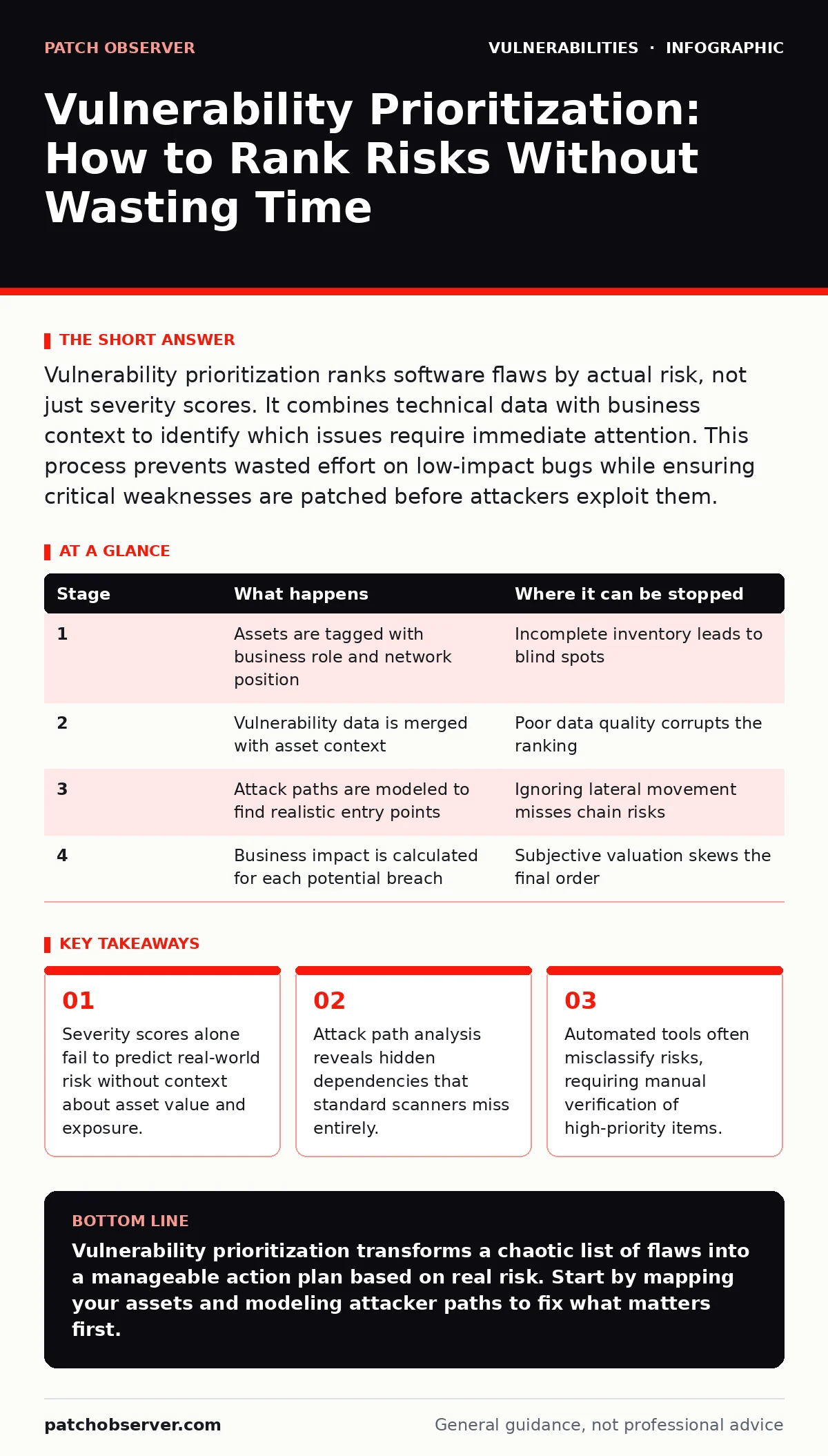
Vulnerability prioritization ranks software flaws by actual risk, not just severity scores. It combines technical data with business context to identify which issues require immediate attention. This process prevents wasted effort on low-impact bugs while ensuring critical weaknesses are patched before attackers exploit them.
The Failure of Raw Severity Scores
Standard vulnerability scanners report issues using standardized scoring systems. These systems assign a numerical value based on theoretical impact and exploitability. You see a high number and assume the issue is urgent. This assumption leads to burnout and missed threats. A high score means the flaw is technically severe if exploited. It does not mean an attacker can reach it.
Imagine a server with a critical flaw in an internal service. That service has no external access. The score remains high, but the risk is near zero. Conversely, a medium-score flaw in a public-facing login page might be trivial to exploit. Prioritization begins by stripping away the noise of raw scores. You must look at where the flaw lives and who can reach it.
Stage 1: Asset Inventory and Context
The first step maps vulnerabilities to specific assets. You cannot prioritize what you do not know you have. This stage requires a complete inventory of hardware, software, and configurations. Each asset is tagged with its role in the business. A development server holds different value than a production database.
Behind the scenes, this data merges with network topology maps. You identify which systems communicate with each other. If System A is compromised, what does it touch? This context transforms a list of broken things into a map of dependencies. Without this map, you are guessing at impact.
| Stage | What happens | Where it can be stopped |
|---|---|---|
| 1 | Assets are tagged with business role and network position | Incomplete inventory leads to blind spots |
| 2 | Vulnerability data is merged with asset context | Poor data quality corrupts the ranking |
| 3 | Attack paths are modeled to find realistic entry points | Ignoring lateral movement misses chain risks |
| 4 | Business impact is calculated for each potential breach | Subjective valuation skews the final order |
Modeling the Attacker Path
Standard scanners treat every vulnerability as an isolated island. Attackers do not work this way. They move laterally, chaining small wins into a major breach. This stage models how an adversary moves from an entry point to a target. You look for exploit chains that connect multiple weaknesses.
Consider exploit chains where a minor flaw allows an attacker to steal credentials. Those credentials then grant access to a system with a more severe vulnerability. The first flaw is the key. The second is the door. Prioritization must identify the key, not just the locked door. This requires simulating movement across your network map.
Stage 2: Exposure and Attack Surface Analysis
You evaluate which assets are visible to external attackers. This includes public IP addresses, open ports, and exposed APIs. You also consider semi-public zones like partner networks or remote access portals. The goal is to identify the initial footholds.
Automated tools scan for open ports and services. Manual review checks for misconfigurations that expose sensitive data. You must also consider human factors. Phishing often bypasses technical controls entirely. This stage defines the starting line for any potential attack. If an asset is not reachable, its vulnerabilities are dormant.
Calculating Business Impact
Technical severity does not equal business damage. A crash in a non-critical reporting tool is a nuisance. A crash in a payment processing system is catastrophic. This stage translates technical outcomes into business terms. You assign a value to the confidentiality, integrity, and availability of each asset.
This calculation is subjective but necessary. You must ask what happens if this data is stolen. What happens if this service stops for an hour? For some organizations, a few minutes of downtime costs more than a data breach. For others, reputation loss is the primary concern. These values drive the final ranking.
Stage 3: Contextual Risk Scoring
You combine the technical score, the exposure level, and the business impact into a single risk rating. This rating reflects the likelihood of exploitation and the consequence of success. Tools may use algorithms to weight these factors. Human judgment often overrides the algorithm for edge cases.
This step requires reviewing the output for anomalies. A high-risk score on a decommissioned server is a false positive. A low-risk score on a primary database is a dangerous oversight. You must verify that the context matches reality. This verification is where most automation fails.
Refining with Threat Intelligence
Not all vulnerabilities are actively exploited in the wild. Some remain theoretical curiosities. This stage checks whether attackers are currently using specific flaws. If an exploit exists and is being distributed, the priority rises. If no exploit code exists, the priority may drop.
This information comes from threat intelligence feeds. These feeds track hacker discussions, proof-of-concept code releases, and active campaigns. You must filter this noise to find what matters to your environment. A flaw in a software library you do not use is irrelevant. A flaw in your core database is urgent.
Stage 4: Exploitability Verification
You verify whether the reported vulnerability is actually present and exploitable. Many scanners report false positives. They detect a version number and assume the flaw exists. You must confirm the specific configuration triggers the issue. This saves time by removing phantom risks from the queue.
This step often involves manual testing or specialized validation tools. You check if the patch is already applied but misreported. You check if the vulnerable feature is disabled. This verification ensures your team works on real problems. It prevents the waste of effort on non-issues.
The Limits of Automation
Automated prioritization tools provide speed and scale. They process thousands of assets in minutes. They apply consistent rules across the organization. However, they lack nuance. They cannot understand the subtle interplay of legacy systems and custom code.
Human oversight remains necessary. You must interpret the results in the context of current operations. You must decide when to accept risk and when to mitigate it. Automation supports the decision; it does not make it. The best systems combine machine speed with human judgment.
See also: Attack Vectors in CVSS: What Small Businesses Need to Know · Exploit Chains Explained: How Attackers String Vulnerabilities Together
Integrating with Remediation
Prioritization is useless if it does not lead to action. The final step connects the risk ranking to your remediation workflow. High-risk items go to immediate patching or mitigation. Lower-risk items go into the regular maintenance cycle.
This integration requires clear communication. Developers need to know why their bug is urgent. Operations teams need to know which systems to monitor. You must track the resolution of each item. If a high-risk item remains open, the risk persists. Closing the loop ensures the process delivers actual security improvements.
Continuous Improvement
Vulnerability prioritization is not a one-time event. New flaws appear daily. New assets are added. Business priorities shift. You must repeat the process regularly. The frequency depends on your risk tolerance and resource availability.
Daily reviews catch critical issues. Weekly reviews handle significant risks. Monthly reviews ensure overall alignment. You must also review the process itself. Are you missing classes of vulnerabilities? Is the scoring model accurate? Continuous refinement keeps the system effective over time.
Key takeaways
- Severity scores alone fail to predict real-world risk without context about asset value and exposure.
- Attack path analysis reveals hidden dependencies that standard scanners miss entirely.
- Automated tools often misclassify risks, requiring manual verification of high-priority items.
Vulnerability prioritization transforms a chaotic list of flaws into a manageable action plan based on real risk. Start by mapping your assets and modeling attacker paths to fix what matters first.
Frequently asked questions
How do I prioritize vulnerabilities without a dedicated security team?
Focus on external-facing assets and critical business functions. Use automated tools to flag high-severity issues on public systems. Patch these first to reduce the most immediate exposure.
Can I rely entirely on automated prioritization tools?
No. Automated tools provide a baseline but miss context. They cannot account for unique business processes or complex network interactions. Manual review is necessary to validate high-priority items.
How often should I update my vulnerability priorities?
Update priorities whenever new critical vulnerabilities are disclosed or significant changes occur in your infrastructure. Regular weekly or monthly reviews help maintain an accurate risk picture.
What is the difference between severity and risk?
Severity measures the technical impact of a flaw if exploited. Risk combines severity with the likelihood of exploitation and the business impact. A high-severity flaw on an isolated system has low risk.
How this guide was produced: written by the Patch Observer editorial team with AI assistance, checked against the public references listed below, and reviewed when the facts change. See our editorial policy or report an error.