Responsible Disclosure Checklist: Verify, Report, and Manage Risk
The most dangerous phase of responsible disclosure occurs after the researcher submits the report, when internal miscommunication delays mitigation and leaves the asset exposed.

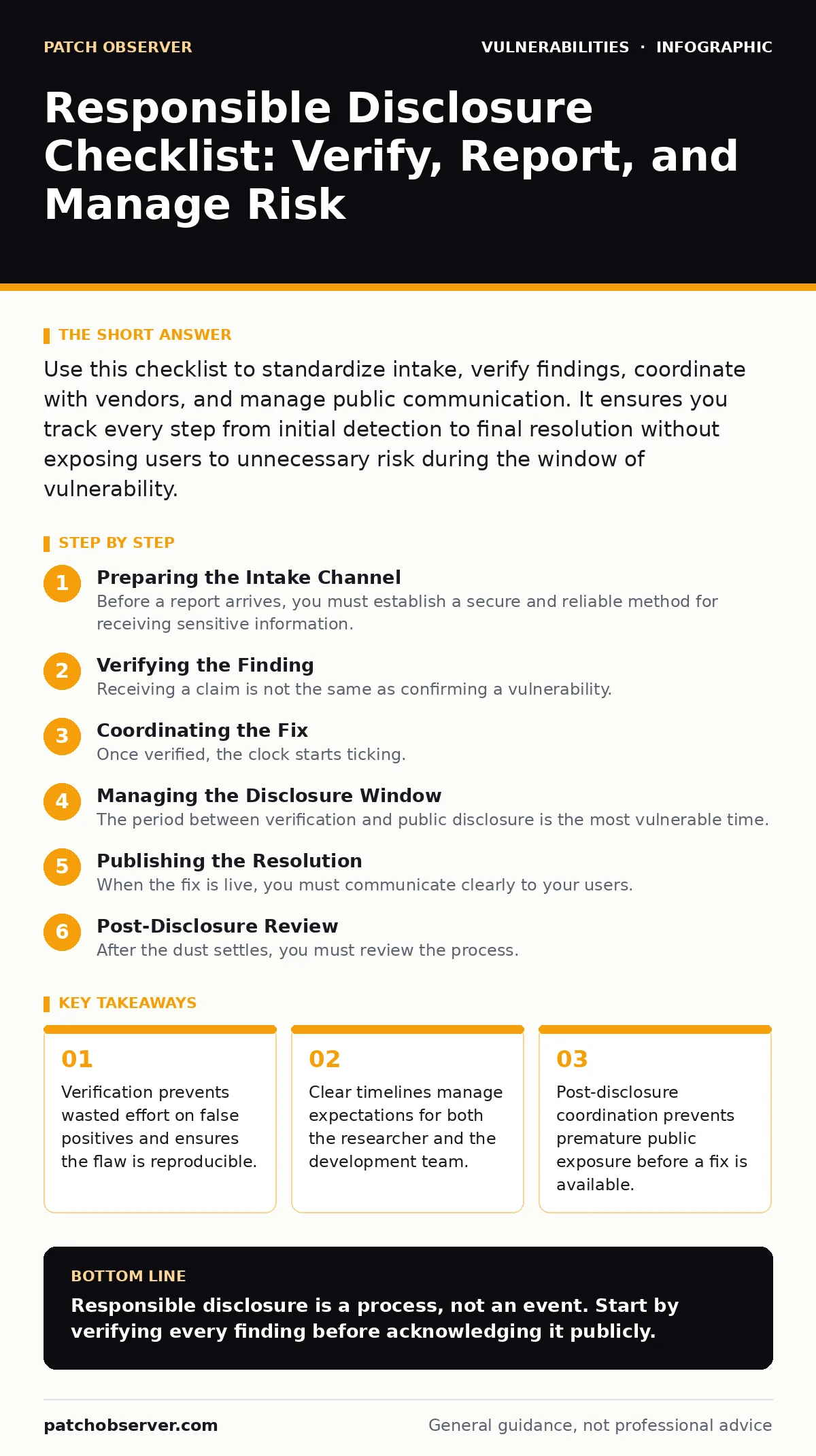
Use this checklist to standardize intake, verify findings, coordinate with vendors, and manage public communication. It ensures you track every step from initial detection to final resolution without exposing users to unnecessary risk during the window of vulnerability.
Preparing the Intake Channel
Before a report arrives, you must establish a secure and reliable method for receiving sensitive information. If researchers cannot trust that their data is safe, they may bypass your process entirely. This channel must be distinct from general support lines to ensure immediate attention.
- Dedicated email address: Ensures reports are not lost in general support queues.
- PGP key publication: Allows researchers to encrypt sensitive details before transmission.
- Clear scope definition: Prevents out-of-bounds testing that could violate laws.
- Safe harbor statement: Legally protects researchers who act in good faith.
Verifying the Finding
Receiving a claim is not the same as confirming a vulnerability. You must reproduce the issue in a controlled environment to understand its impact. This step separates noise from genuine threats and helps you determine the severity. Rushing to acknowledge without verification can lead to reputational damage if the claim turns out to be invalid.
- Reproduce in isolated environment: Confirms the issue exists without affecting production systems.
- Assess severity level: Determines the urgency and resource allocation needed for the fix.
- Check for false positives: Ensures the tool or method used did not misinterpret normal behavior.
- Document reproduction steps: Creates a clear path for developers to understand and fix the issue.
If you find that the issue relates to exploit chains, where multiple flaws combine to create a greater risk, you must document each component separately. This complexity often requires deeper analysis than a single-point failure.
Coordinating the Fix
Once verified, the clock starts ticking. You must work with your development or engineering team to create a patch. This phase requires clear communication to avoid misunderstandings about deadlines. If the vulnerability involves complex configurations, such as server-side template injection, the fix may require more than a simple code change.
- Assign internal owner: Ensures accountability for the investigation and remediation.
- Set internal deadline: Provides a clear target for the development team to meet.
- Communicate with researcher: Keeps the reporter informed of progress and expected timelines.
- Plan for patch testing: Ensures the fix does not introduce new issues or break existing functionality.
Managing the Disclosure Window
The period between verification and public disclosure is the most vulnerable time. You must manage the information flow carefully to prevent leaks. If the flaw is critical, you may need to coordinate with other vendors or platforms. This coordination is especially vital if the vulnerability affects firmware updates, where the fix cycle is often slower and more complex.
- Request confidentiality: Ask the researcher to withhold public details until the fix is deployed.
- Monitor for public mentions: Check if the issue has already been discussed elsewhere.
- Prepare advisory draft: Have the public statement ready to release immediately after the fix.
- Coordinate with partners: If the issue affects multiple systems, ensure all parties are aligned.
If you are dealing with IoT device vulnerabilities, the hardware constraints may limit how quickly you can deploy a fix. In such cases, the disclosure window may need to be longer to allow for physical updates or factory resets.
Publishing the Resolution
When the fix is live, you must communicate clearly to your users. The disclosure should be factual, calm, and helpful. It should explain what happened, what was fixed, and what users need to do. Avoid technical jargon that might confuse non-technical readers. This step restores trust and demonstrates your commitment to security.
- Release public advisory: Informs users of the issue and the available fix.
- Thank the researcher: Acknowledges the contributor, if they agree to be named.
- Update documentation: Ensures future users are aware of the change and its implications.
- Monitor for follow-up issues: Checks if the fix introduced any new problems.
See also: GitLab Vulnerability Response: Containment and Recovery Steps · Attack Vectors in CVSS: What Small Businesses Need to Know
Post-Disclosure Review
After the dust settles, you must review the process. This helps you identify gaps in your detection, response, or communication. Continuous improvement is key to building a resilient security posture. If you find that vulnerability prioritization was difficult, you may need to refine your risk assessment models.
- Conduct post-mortem: Identifies what went well and what could be improved.
- Update policies: Incorporates lessons learned into future processes.
- Review detection methods: Ensures similar issues are caught earlier next time.
- Train staff: Ensures the team is prepared for future incidents.
If you discover that weak password policies contributed to the issue, you must address that separately. This systemic change is part of the broader security improvement process.
Key takeaways
- Verification prevents wasted effort on false positives and ensures the flaw is reproducible.
- Clear timelines manage expectations for both the researcher and the development team.
- Post-disclosure coordination prevents premature public exposure before a fix is available.
Responsible disclosure is a process, not an event. Start by verifying every finding before acknowledging it publicly.
Frequently asked questions
How long should I wait before disclosing a vulnerability publicly?
Wait until a fix is available and widely deployable. If no fix is possible, disclose when the risk is deemed acceptable.
What if the researcher refuses to keep the finding confidential?
Acknowledge the report and prepare for immediate public disclosure. Mitigate the risk as best you can internally.
Should I always reward researchers for their findings?
It is not required, but it encourages continued cooperation. Consider a bug bounty program if resources allow.
How do I handle a false positive report?
Respond politely, explain why it is not a vulnerability, and thank them for their attention. This maintains a good relationship.
How this guide was produced: written by the Patch Observer editorial team with AI assistance, checked against the public references listed below, and reviewed when the facts change. See our editorial policy or report an error.