Weak Password Policies: The Hidden Risks and Fixes
Weak password policies often force users to adopt predictable patterns that sophisticated cracking tools exploit faster than complex, random strings.

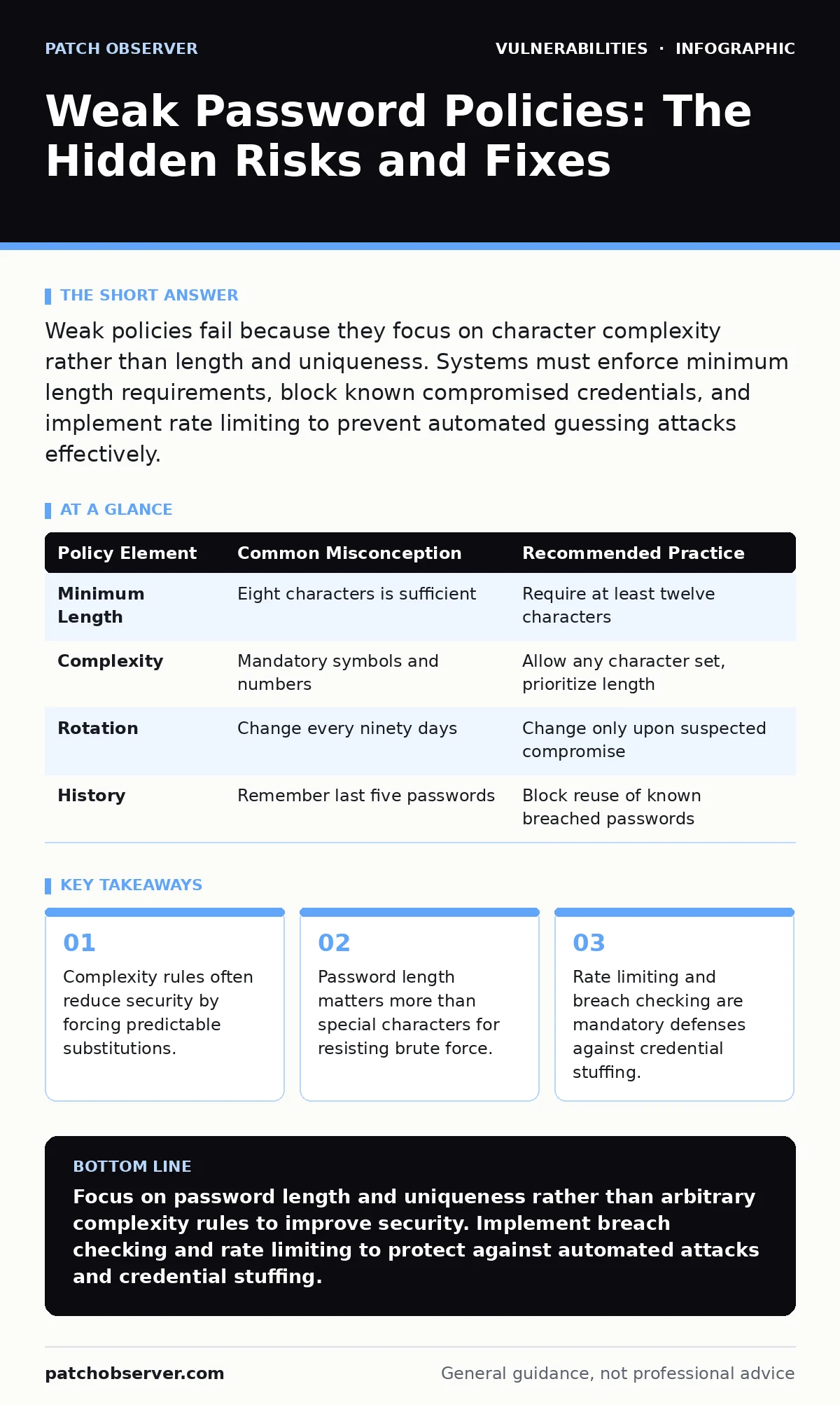
Weak policies fail because they focus on character complexity rather than length and uniqueness. Systems must enforce minimum length requirements, block known compromised credentials, and implement rate limiting to prevent automated guessing attacks effectively.
Why do complexity rules hurt security?
Complexity requirements often drive users toward predictable substitution patterns. When a system demands a special character, a number, and an uppercase letter, users frequently replace vowels with numbers or symbols in a standardized way. Attackers know these patterns and prioritize them in their cracking dictionaries. This makes a "complex" password easier to guess than a long, simple passphrase. You should prioritize length over mandatory character types.
Is length really more important than complexity?
Yes, because entropy increases exponentially with each additional character. A twelve-character password using only lowercase letters offers more combinations than an eight-character password with mixed types. Cracking tools calculate the number of possible combinations, not the difficulty of typing. Longer passwords take significantly more time to brute force. Aim for a minimum of twelve characters to raise the barrier for attackers.
How do systems stop automated guessing attacks?
Rate limiting restricts the number of login attempts from a single source within a time window. If a user fails multiple times, the system delays further attempts or locks the account temporarily. This slows down automated scripts that try thousands of passwords per minute. Without rate limiting, even strong passwords can be guessed eventually. You must configure your authentication server to enforce these delays.
What is credential stuffing and how does it work?
Credential stuffing uses username and password pairs stolen from other data breaches. Attackers automate login attempts across many services because users often reuse passwords. If a user’s email and password were exposed elsewhere, the attacker tries them on your service. This bypasses the need to crack passwords locally. You must check submitted credentials against known breach databases.
Should you force regular password changes?
No, because frequent changes lead to predictable iteration patterns. Users often change "Password123" to "Password124" when forced to rotate credentials monthly. This reduces the effective entropy of the password over time. Instead, change passwords only when there is evidence of compromise.
How do you detect reused or compromised passwords?
You integrate a breach checking service that hashes passwords before sending them out. This service compares the hash against a database of known compromised credentials. If a match is found, the system rejects the password without ever seeing the plain text. This protects user privacy while ensuring the password has not been exposed. Never store plain text passwords on your servers.
| Policy Element | Common Misconception | Recommended Practice |
|---|---|---|
| Minimum Length | Eight characters is sufficient | Require at least twelve characters |
| Complexity | Mandatory symbols and numbers | Allow any character set, prioritize length |
| Rotation | Change every ninety days | Change only upon suspected compromise |
| History | Remember last five passwords | Block reuse of known breached passwords |
What happens when a password policy is too strict?
Users create workarounds that bypass security controls entirely. They might write passwords on sticky notes, share them via insecure channels, or use the same password everywhere. Strict policies increase support tickets and reduce productivity. The cost of helping users reset forgotten passwords often exceeds the cost of a minor security incident. Balance security requirements with user experience.
How do you handle legacy systems with weak policies?
You must isolate these systems from the broader network and monitor them closely. Legacy applications often cannot support modern authentication standards or long passwords. Use a gateway or proxy to enforce stronger controls before traffic reaches the legacy system. Consider decommissioning these systems if they cannot be secured adequately. This approach prevents a weak link from compromising the entire environment.
Can you trust a password that passes all rules?
No, because rules check format, not history or context. A password can meet all complexity and length requirements and still be common. Attackers use probabilistic models to guess passwords that fit specific rules. You must combine policy enforcement with real-time breach checking. This ensures the password is unique and not previously exposed. Security is a process, not a one-time configuration.
Key takeaways
- Complexity rules often reduce security by forcing predictable substitutions.
- Password length matters more than special characters for resisting brute force.
- Rate limiting and breach checking are mandatory defenses against credential stuffing.
Focus on password length and uniqueness rather than arbitrary complexity rules to improve security. Implement breach checking and rate limiting to protect against automated attacks and credential stuffing.
Frequently asked questions
What is the best way to store passwords in a database?
Use a modern hashing algorithm like Argon2 or bcrypt with a unique salt for each password. Never store plain text or use reversible encryption for password storage.
How does multi-factor authentication help with weak passwords?
It adds a second verification step that an attacker cannot bypass with just the password. This protects the account even if the password is compromised or guessed.
Should I ban common passwords like "password123"?
Yes, you should maintain and enforce a blocklist of commonly used and previously breached passwords. This prevents users from selecting credentials that are easily guessable.
What is the impact of weak passwords on IoT devices?
Default or weak passwords on IoT devices allow attackers to gain
How this guide was produced: written by the Patch Observer editorial team with AI assistance, checked against the public references listed below, and reviewed when the facts change. See our editorial policy or report an error.