Responsible Disclosure: Answers to 8 Critical Security Questions
Responsible disclosure balances public safety against system risk by establishing a structured timeline for vendors to patch vulnerabilities before public exploitation details emerge.

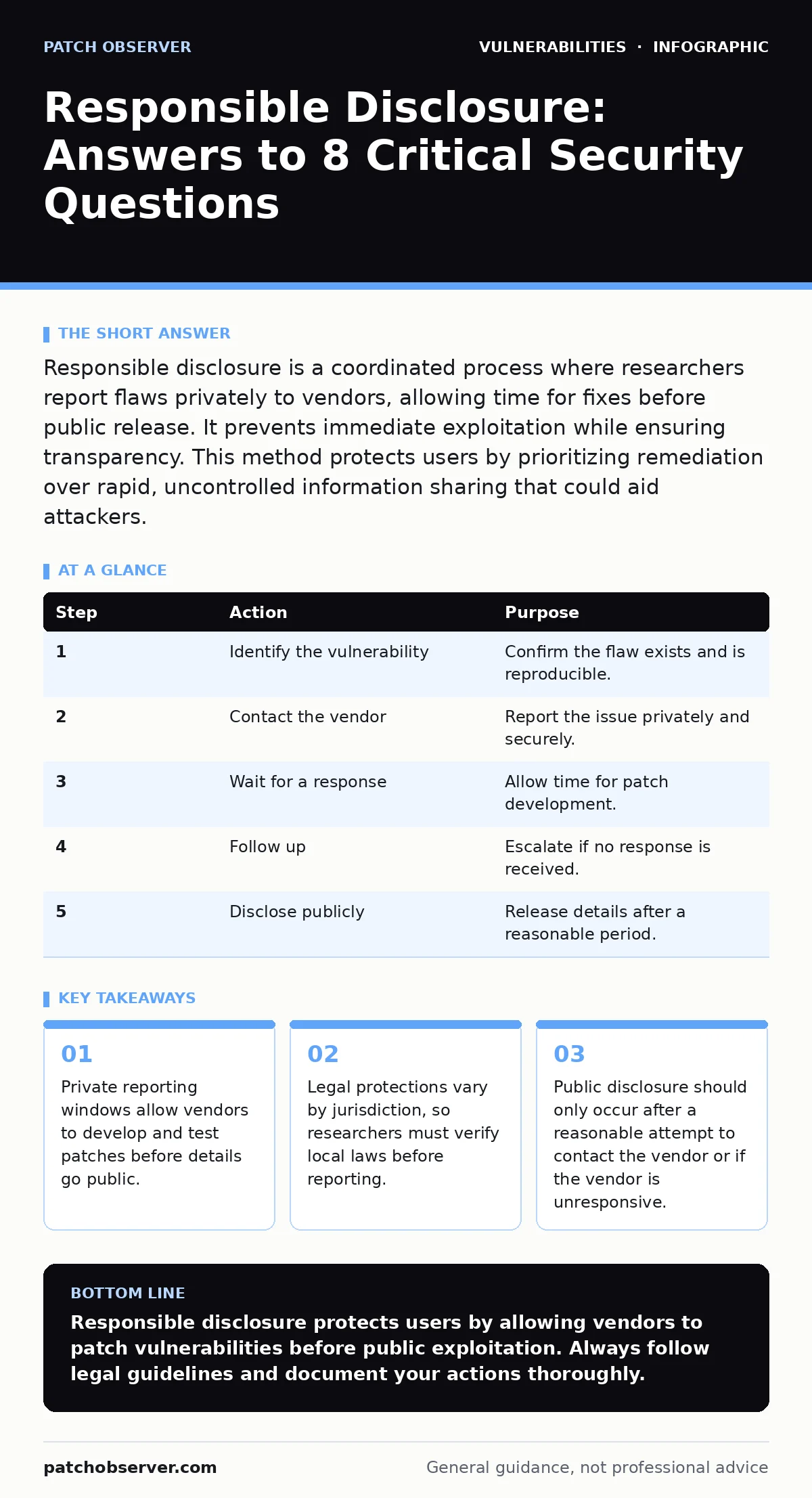
Responsible disclosure is a coordinated process where researchers report flaws privately to vendors, allowing time for fixes before public release. It prevents immediate exploitation while ensuring transparency. This method protects users by prioritizing remediation over rapid, uncontrolled information sharing that could aid attackers.
What exactly is responsible disclosure?
Responsible disclosure is a coordinated process where security researchers report vulnerabilities to vendors privately before making details public. This approach allows the vendor to develop and deploy a fix, reducing the window of opportunity for attackers. It differs from full disclosure, which releases details immediately, and private disclosure, which may never become public. The goal is to balance user safety with the need for transparency.
Why not just publish the details immediately?
Immediate publication gives attackers a head start before users can patch their systems. When details are public, automated tools can scan for affected systems and exploit them within minutes. Responsible disclosure creates a buffer period for remediation. This delay reduces the overall damage and gives organizations time to prepare incident response plans.
How do I find the right contact for reporting?
Start by checking the vendor’s security page, website footer, or documentation for a security.txt file. This standard file provides contact information for security issues. If no specific contact exists, look for a general support email or a bug bounty program. Avoid using customer support channels meant for billing or technical help, as these may not reach the security team.
What should I include in my initial report?
Your report must contain a clear description of the vulnerability, steps to reproduce it, and the potential impact. Include technical details like proof-of-concept code if safe to share, but avoid including sensitive data. Specify the affected versions and any mitigations you have identified. Clear, concise information helps the vendor prioritize and fix the issue faster.
What if the vendor ignores my report?
If the vendor does not respond within a reasonable timeframe, you may escalate the issue. Document all attempts to contact them, including dates and methods. You can then consider disclosing the vulnerability publicly or through a third-party coordination center. This step ensures that users are informed and can take protective action.
How long should I wait before going public?
The waiting period depends on the severity of the vulnerability and the vendor’s response time. Critical issues may require a shorter window, while lower-risk issues can wait longer. Aim for a reasonable period that allows for patch development and deployment. Communicate your intended disclosure date to the vendor to encourage urgency.
Are there legal risks for researchers?
Yes, unauthorized testing can violate computer fraud laws or terms of service. Ensure you have explicit permission to test the system or operate within the bounds of a bug bounty program. Some jurisdictions offer safe harbor protections for good-faith reporting. Consult legal counsel if you are unsure about the legality of your actions.
How does this relate to exploit chains?
An exploit chain combines multiple vulnerabilities to bypass security controls. Responsible disclosure helps break these chains by fixing individual components before they can be linked. If you discover a chain, report each component separately or as a coordinated set. This approach prevents attackers from assembling a more powerful attack vector.
What is the role of a coordination center?
A coordination center facilitates communication between researchers and vendors when direct contact fails. These centers help manage the disclosure process and ensure that all parties follow best practices. They can also provide legal guidance and mediate disputes. Using a coordination center adds a layer of professionalism and accountability to the process.
| Step | Action | Purpose |
|---|---|---|
| 1 | Identify the vulnerability | Confirm the flaw exists and is reproducible. |
| 2 | Contact the vendor | Report the issue privately and securely. |
| 3 | Wait for a response | Allow time for patch development. |
| 4 | Follow up | Escalate if no response is received. |
| 5 | Disclose publicly | Release details after a reasonable period. |
How does this impact vulnerability prioritization?
Vendors use responsible disclosure reports to prioritize fixes based on severity and impact. Critical vulnerabilities that affect many users are addressed first. This process ensures that resources are allocated efficiently. Researchers can help by providing clear impact assessments in their reports.
What if the vulnerability is in firmware updates?
Firmware vulnerabilities are particularly dangerous because they are hard to patch and persist across reboots. Responsible disclosure is critical here to ensure that manufacturers release secure firmware. Test carefully to avoid bricking devices. Provide detailed information to help the manufacturer understand the hardware implications.
How does this compare to web cache poisoning?
Web cache poisoning exploits caching mechanisms to serve malicious content. Responsible disclosure helps fix the caching configuration before attackers can exploit it at scale. Report these issues promptly to prevent widespread impact. The vendor can adjust cache headers to mitigate the risk.
What about IoT device vulnerabilities?
IoT devices often lack secure update mechanisms, making them vulnerable to persistent attacks. Responsible disclosure is vital to ensure that manufacturers can patch these devices. Test safely to avoid disrupting critical infrastructure. Provide clear instructions for mitigation if a patch is not immediately available.
How does this relate to server-side template injection?
Server-side template injection allows attackers to execute arbitrary code. Responsible disclosure helps fix the template engine configuration before it is exploited. Report these issues with proof-of-concept code to demonstrate the risk. The vendor can restrict template access to mitigate the vulnerability.
What if the vendor claims the issue is not a bug?
Disagreements about the severity of a vulnerability can occur. Provide clear evidence and references to industry standards to support your claim. If the vendor still disagrees, you may choose to disclose the issue publicly. Document the disagreement to maintain transparency.
How does this impact weak password policies?
Weak password policies are a common vulnerability that can be exploited through brute force attacks. Responsible disclosure helps vendors implement stronger authentication mechanisms. Report these issues to encourage better security practices. The vendor can enforce password complexity and multi-factor authentication.
Key takeaways
- Private reporting windows allow vendors to develop and test patches before details go public.
- Legal protections vary by jurisdiction, so researchers must verify local laws before reporting.
- Public disclosure should only occur after a reasonable attempt to contact the vendor or if the vendor is unresponsive.
Responsible disclosure protects users by allowing vendors to patch vulnerabilities before public exploitation. Always follow legal guidelines and document your actions thoroughly.
Frequently asked questions
What if I find a vulnerability in a government system?
Report it through official channels, such as a national cyber security agency. Government systems often have specific protocols for handling security issues.
Can I get paid for responsible disclosure?
Some vendors offer bug bounty programs that pay for valid reports. Check the vendor’s website for details on their reward structure.
What if I accidentally expose data during testing?
Stop testing immediately and notify the vendor. Document the incident and cooperate with any investigation.
How do I know if a vulnerability is critical?
Critical vulnerabilities allow remote code execution or data theft. Assess the impact and likelihood of exploitation to determine severity.
How this guide was produced: written by the Patch Observer editorial team with AI assistance, checked against the public references listed below, and reviewed when the facts change. See our editorial policy or report an error.