How HTTP Request Smuggling Works: Step-by-Step Mechanics
Divergent parsing of request boundaries allows attackers to bypass security controls by inserting hidden requests into legitimate traffic streams.

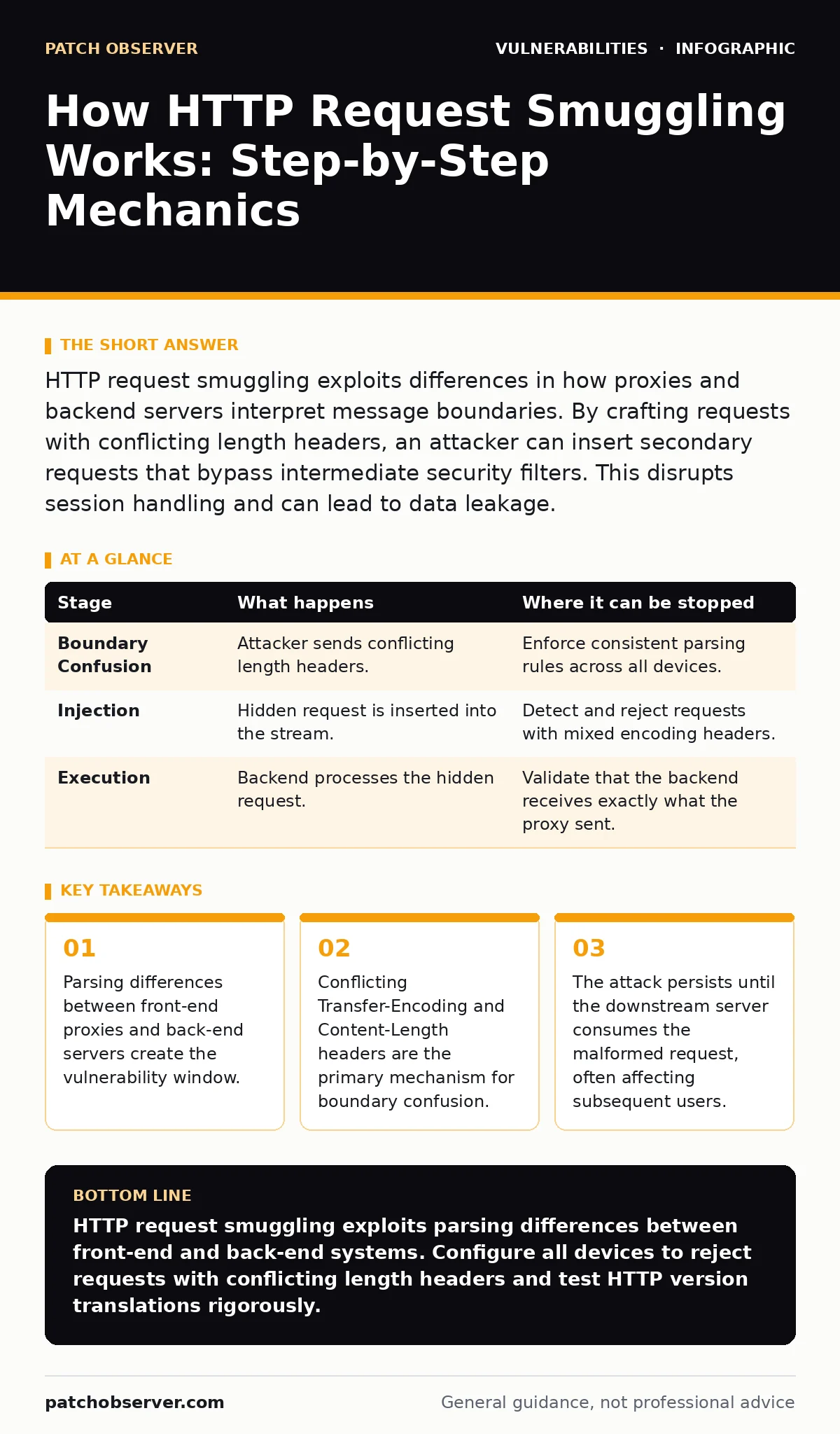
HTTP request smuggling exploits differences in how proxies and backend servers interpret message boundaries. By crafting requests with conflicting length headers, an attacker can insert secondary requests that bypass intermediate security filters. This disrupts session handling and can lead to data leakage.
The Parsing Divergence Problem
HTTP request smuggling relies on a fundamental disagreement about where one request ends and the next begins. The Hypertext Transfer Protocol is stateless, meaning each request must stand alone with clear boundaries. Intermediate devices, such as reverse proxies or load balancers, parse these boundaries to route traffic. Backend application servers perform their own parsing to process the data. When these two systems interpret the same bytes differently, a gap opens.
This gap allows an attacker to inject data that the front-end device ignores but the back-end device executes. The front-end sees a single, clean request. The back-end sees that request plus a hidden, secondary command. This discrepancy is the core of the vulnerability. It does not require a software bug in the traditional sense, but rather a misconfiguration or strict adherence to different parsing rules.
Stage 1: Boundary Confusion
The attacker begins by crafting a request that contains conflicting instructions about its length. The protocol defines two ways to specify how much data follows the headers: the Content-Length header and the Transfer-Encoding header. These headers tell the server when to stop reading the current request. If both are present, the protocol specifies which one takes precedence. However, different software implementations often follow different precedence rules.
Imagine a proxy that prioritizes Transfer-Encoding while the backend server prioritizes Content-Length. The attacker sends a request with a short Content-Length but a long Transfer-Encoding chunk. The proxy reads only the short amount defined by the transfer encoding logic. The backend server, trusting the content length, reads further into the stream. The bytes remaining in the stream are now orphaned.
Stage 2: Injection of the Secondary Request
Once the boundary is confused, the attacker inserts a second HTTP request into the stream. This secondary request sits in the buffer that the front-end device has already considered "finished" but the backend device is still reading. Because the front-end device believes the connection is ready for the next client, it may assign the remaining socket to a new user.
The backend server, however, is still processing the original connection. It reads the injected request as if it were part of the original transaction. This request can contain any valid HTTP method, such as GET or POST. It can target any endpoint the server hosts. The injected request bypasses the front-end security controls because those controls only inspected the first, visible request.
Stage 3: Bypassing Security Controls
Intermediate security devices, like web application firewalls, sit in front of the application server. They inspect traffic for malicious patterns. When the attacker sends the smuggled request, the firewall sees only the legitimate outer request. It approves the traffic and forwards it. The firewall never sees the hidden inner request.
This blind spot allows the attacker to reach resources that are otherwise protected. The backend server processes the hidden request with the privileges of the original connection. This can lead to unauthorized access to administrative interfaces or sensitive data. The attack succeeds not by breaking encryption, but by hiding in plain sight within the protocol structure.
| Stage | What happens | Where it can be stopped |
|---|---|---|
| Boundary Confusion | Attacker sends conflicting length headers. | Enforce consistent parsing rules across all devices. |
| Injection | Hidden request is inserted into the stream. | Detect and reject requests with mixed encoding headers. |
| Execution | Backend processes the hidden request. | Validate that the backend receives exactly what the proxy sent. |
The Role of HTTP Versions
The complexity of smuggling increases when HTTP/1.1 and HTTP/2 interact. HTTP/1.1 uses plain text streams, while HTTP/2 uses binary multiplexed frames. When a proxy converts HTTP/2 to HTTP/1.1 for backend compatibility, the translation process can introduce parsing errors. The proxy may split a single HTTP/2 stream into multiple HTTP/1.1 requests incorrectly.
This translation layer creates new opportunities for boundary confusion. An attacker can craft HTTP/2 frames that, when translated, produce malformed HTTP/1.1 requests. The backend server then processes these malformed requests. This vector is particularly dangerous because many organizations assume HTTP/2 is inherently safer. It is not. The translation process introduces its own set of risks.
Stage 4: Session Hijacking and Data Leakage
When the backend server processes the hidden request, it may associate it with the wrong user session. If the front-end device has already assigned the connection to a new user, the backend might still be using the session cookie of the original user. This results in session mixing.
The attacker can view the responses intended for the victim. This allows for data leakage. The attacker sees private emails, financial records, or account settings. This is not just a theoretical risk. It is a common consequence of failed boundary parsing. The attacker does not need to guess credentials. They simply ride the coattails of a legitimate session.
Mitigation and Detection
Stopping HTTP request smuggling requires strict enforcement of parsing rules. All devices in the request chain must agree on how to handle conflicting headers. The most effective defense is to reject any request that contains both Transfer-Encoding and Content-Length headers. If one is present, the other must be absent.
Additionally, ensure that your proxy and backend server are configured to handle HTTP/2 to HTTP/1.1 translation correctly. Test this translation thoroughly. Many default configurations are vulnerable to this specific type of smuggling. Regular testing is necessary to identify these parsing differences.
Consider the impact on web cache poisoning. If a cache stores a response to a smuggled request, that response may be served to other users. This amplifies the damage. The cache becomes a vector for delivering malicious content to innocent users. Clearing the cache after a suspected attack is often necessary.
The Hidden Cost of Parsing
The hidden cost of this vulnerability is the complexity of defense. It is not enough to patch a single component. You must ensure consistency across every device that touches the traffic. This includes load balancers, firewalls, proxies, and application servers. A single misconfigured device can undermine the entire security posture.
This complexity makes vulnerability prioritization difficult. Smuggling vulnerabilities are often rated as high severity because of their potential impact, but they are hard to detect automatically. Dynamic testing is required to confirm the presence of parsing differences. Static analysis tools often miss these issues because they do not simulate the interaction between devices.
Integrating with Security Workflows
Effective defense against smuggling requires integration into your broader security workflow. This includes regular patch testing to ensure that updates to proxies and servers do not introduce new parsing errors. It also involves monitoring for unusual traffic patterns that might indicate an ongoing attack.
When an attack is detected, the response must be swift. The backend server may be processing stale data. You must restart the server or clear the buffers to ensure that no hidden requests remain. This is a operational burden that many teams underestimate. The attack does not just affect the current request; it can poison the connection for future requests.
Understanding the mechanics of exploit chains is also relevant here. Smuggling is often the first step in a larger attack. Once the attacker has bypassed the firewall, they can inject other payloads. This could include server-side template injection if the backend processes user input in templates. The smuggling attack opens the door; the secondary payload walks through it.
See also: Server-Side Template Injection Warning Signs and Immediate Response
Final Considerations for Defense
The defense against HTTP request smuggling is not a single tool or setting. It is a combination of strict configuration, consistent parsing, and rigorous testing. You must ensure that your entire infrastructure speaks the same language when it comes to HTTP boundaries. Any divergence is a potential entry point for an attacker.
Regular audits of your proxy and server configurations are necessary. Look for mixed headers, inconsistent HTTP version handling, and default settings that may be vulnerable. By understanding the step-by-step mechanics of the attack, you can build a more resilient defense. The goal is to eliminate the parsing gap that allows the hidden request to exist.
Key takeaways
- Parsing differences between front-end proxies and back-end servers create the vulnerability window.
- Conflicting Transfer-Encoding and Content-Length headers are the primary mechanism for boundary confusion.
- The attack persists until the downstream server consumes the malformed request, often affecting subsequent users.
HTTP request smuggling exploits parsing differences between front-end and back-end systems. Configure all devices to reject requests with conflicting length headers and test HTTP version translations rigorously.
Frequently asked questions
How do I know if my server is vulnerable to HTTP request smuggling?
Look for configurations that allow both Transfer-Encoding and Content-Length headers. Test with specialized tools that send conflicting headers to see if the backend processes hidden data.
Can a Web Application Firewall prevent HTTP request smuggling?
Standard WAFs often miss smuggling attacks because they only inspect the visible request. You need a WAF that can detect conflicting headers and understand the backend parsing logic.
What is the difference between HTTP request smuggling and cache poisoning?
Smuggling is about bypassing security controls by hiding requests. Cache poisoning is about storing malicious content in the cache. Smuggling can be used to achieve cache poisoning, but they are distinct concepts.
Does using HTTPS prevent HTTP request smuggling?
No. HTTPS encrypts the traffic, but the proxy and server still decrypt and parse it. The parsing differences remain. Encryption does not fix protocol-level inconsistencies.
How this guide was produced: written by the Patch Observer editorial team with AI assistance, checked against the public references listed below, and reviewed when the facts change. See our editorial policy or report an error.