How Data Scraping Works: The Mechanism Behind Unauthorized Harvesting
Automated scripts bypass standard user interfaces to harvest structured data from public web pages, often evading basic access controls by mimicking legitimate browser behavior.

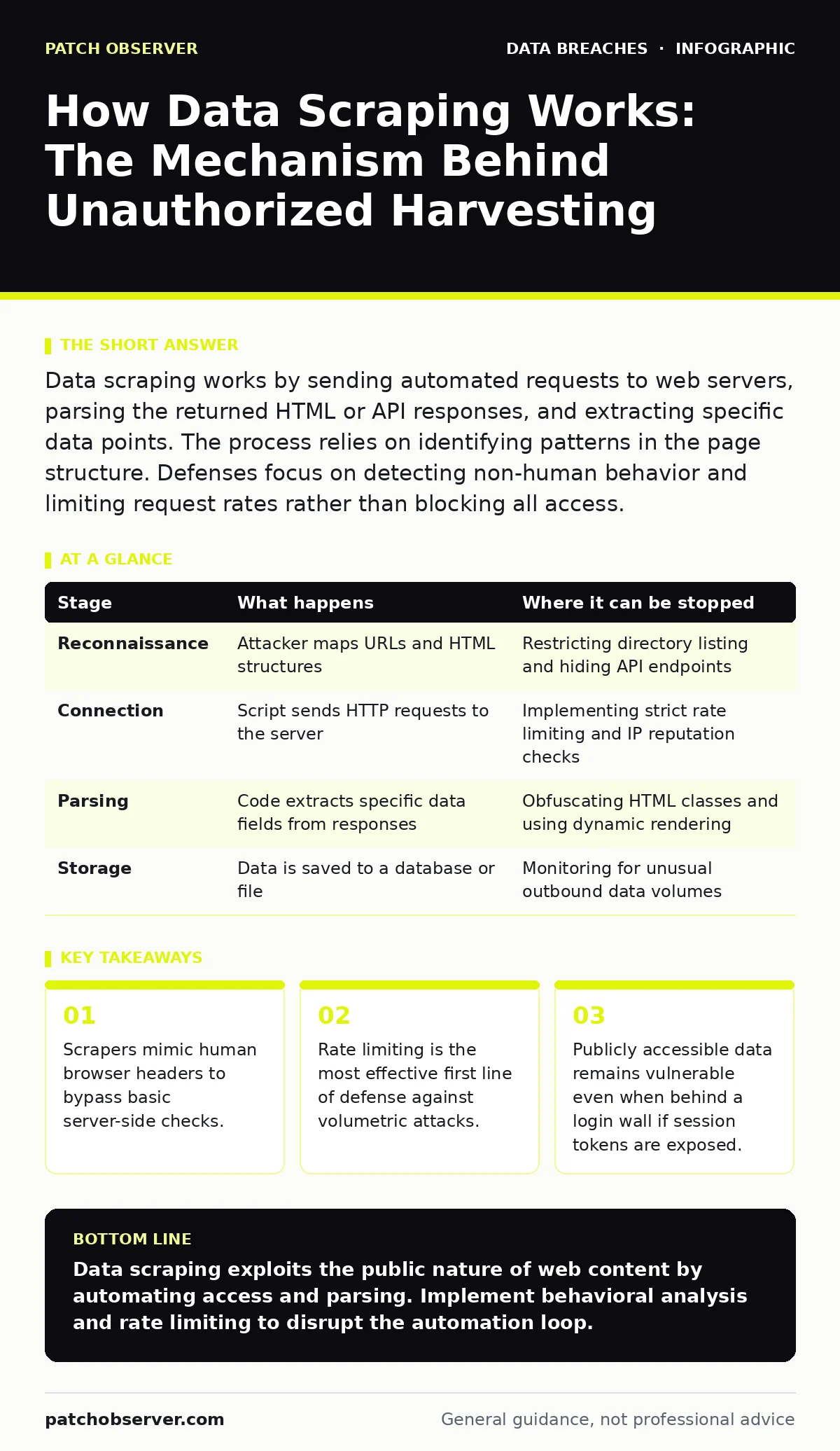
Data scraping works by sending automated requests to web servers, parsing the returned HTML or API responses, and extracting specific data points. The process relies on identifying patterns in the page structure. Defenses focus on detecting non-human behavior and limiting request rates rather than blocking all access.
How does data scraping work
Data scraping works by automating the retrieval and parsing of information from web sources. A scraper sends a request to a server, receives the raw code of a web page, and extracts specific values like prices, emails, or inventory levels. This process happens faster than any human could read. The scraper ignores images, styling, and layout. It targets the underlying structure. You must understand the technical flow to defend against it. The mechanism relies on the public nature of the web. If a browser can see it, a script can likely harvest it.
Stage 1: Reconnaissance and Target Selection
Stage 1: Reconnaissance and Target Selection
The attacker begins by mapping the target environment. They identify which URLs contain the desired data. They analyze the HTML structure to find unique identifiers for each data point. This is not random guessing. It is a systematic examination of the Document Object Model. The scraper looks for classes, IDs, or patterns that repeat across pages. If the site uses a JavaScript framework, the attacker may inspect the network traffic to find API endpoints. These endpoints often return cleaner JSON data than the rendered HTML. Finding these APIs reduces the processing load for the scraper.
| Stage | What happens | Where it can be stopped |
|---|---|---|
| Reconnaissance | Attacker maps URLs and HTML structures | Restricting directory listing and hiding API endpoints |
| Connection | Script sends HTTP requests to the server | Implementing strict rate limiting and IP reputation checks |
| Parsing | Code extracts specific data fields from responses | Obfuscating HTML classes and using dynamic rendering |
| Storage | Data is saved to a database or file | Monitoring for unusual outbound data volumes |
Stage 2: Connection and Request Simulation
Stage 2: Connection and Request Simulation
The scraper initiates a connection to the target server. It sends an HTTP request that mimics a real user. The request includes headers that identify the browser type, operating system, and language settings. This is called spoofing. If the headers look like a script, the server may reject the connection. The scraper rotates these headers to appear as different users. It may also rotate IP addresses using a proxy network. This makes the traffic look like it comes from many different locations. The goal is to blend in with normal traffic.
Stage 3: Payload Delivery and Parsing
Stage 3: Payload Delivery and Parsing
The server responds with the requested content. This is usually HTML, XML, or JSON. The scraper receives this payload. It then runs a parser. The parser reads the raw text and looks for the patterns identified during reconnaissance. It extracts the values inside specific tags. For example, it might grab the text inside a price tag or an email link. It discards everything else. This step is purely computational. It does not require visual rendering. However, if the site relies on client-side JavaScript to load data, the scraper must use a headless browser. This browser renders the page like a human would, then extracts the data. This is slower but more effective for complex sites.
Stage 4: Data Structuring and Storage
Stage 4: Data Structuring and Storage
The extracted fragments are raw and unstructured. The scraper cleans this data. It removes whitespace, converts formats, and standardizes fields. It then saves the data to a structured format like a CSV file or a database. This makes the data usable for the attacker. They might use it for competitive analysis, lead generation, or training artificial intelligence models. The speed of this stage depends on the volume of data. High-volume scrapers process thousands of records per minute. The final output is a clean dataset that mirrors the original source but is easily searchable and analyzable.
See also: API Security Checklist: Verify Access, Data, and Rate Limits
Where the Mechanism Fails
Where the Mechanism Fails
Scraping is not infallible. It fails when the target structure changes unexpectedly. If a website updates its CSS class names, the scraper’s parser breaks. It starts returning empty values or errors. This is known as a brittle dependency. Another failure point is authentication. If the data is behind a login, the scraper must maintain valid session tokens. If the server detects unusual token usage, it revokes access. CAPTCHAs also disrupt the flow. They require human interaction to solve. While automated solvers exist, they add cost and latency. These friction points reduce the efficiency of the scraping operation.
Defense Strategies for Infrastructure
Defense Strategies for Infrastructure
You can stop scraping by adding friction. Rate limiting restricts the number of requests from a single IP address. This slows down the scraper. Behavioral analysis detects non-human patterns. Humans move mice and click randomly. Scripts follow precise mathematical paths. Analyzing these patterns helps identify bots. You can also use device fingerprinting. This creates a unique ID for each browser instance. If the same fingerprint makes too many requests, it gets blocked. Another method is to serve different HTML to bots and humans. This confuses the parser. These measures protect the infrastructure without blocking legitimate users.
Related Security Controls
Related Security Controls
Data scraping often leads to broader security concerns. If the scraped data includes sensitive information, it may trigger the GDPR breach notification rule. You must assess whether the exposed data constitutes a personal data breach. Implementing data loss prevention tools can help monitor and block the exfiltration of sensitive files. Encryption in transit ensures that even if traffic is intercepted, the content remains unreadable.
However, encryption does not prevent scraping of publicly accessible pages. Accidental data disclosure often occurs when developers leave debug endpoints open. Regular audits prevent this. SOC 2 compliance requires controls over data access and integrity. Data breaches resulting from scraping can damage reputation. Credit monitoring services help individuals detect identity theft. Full disk encryption protects stored data if physical devices are stolen, but it does not stop network-level scraping.
Key takeaways
- Scrapers mimic human browser headers to bypass basic server-side checks.
- Rate limiting is the most effective first line of defense against volumetric attacks.
- Publicly accessible data remains vulnerable even when behind a login wall if session tokens are exposed.
Data scraping exploits the public nature of web content by automating access and parsing. Implement behavioral analysis and rate limiting to disrupt the automation loop.
Frequently asked questions
Can you block all data scraping?
No, because legitimate search engines and users also access public data. You can only slow it down or make it less valuable.
Does HTTPS prevent scraping?
No, HTTPS only encrypts the connection. Once the data is decrypted on the client side, it is accessible to any script running in the browser.
How do scrapers bypass CAPTCHAs?
They use external services with human workers or advanced AI models trained to solve visual puzzles, adding cost to their operation.
Is scraping illegal?
It depends on the jurisdiction and the terms of service. Scraping public data is often legal, but bypassing technical barriers or violating privacy laws is not.
How this guide was produced: written by the Patch Observer editorial team with AI assistance, checked against the public references listed below, and reviewed when the facts change. See our editorial policy or report an error.