Encryption in Transit: Protect Data Moving Across Networks
Encryption in transit secures data while it moves between systems, but it fails to protect information once it reaches its final destination or rests in storage.

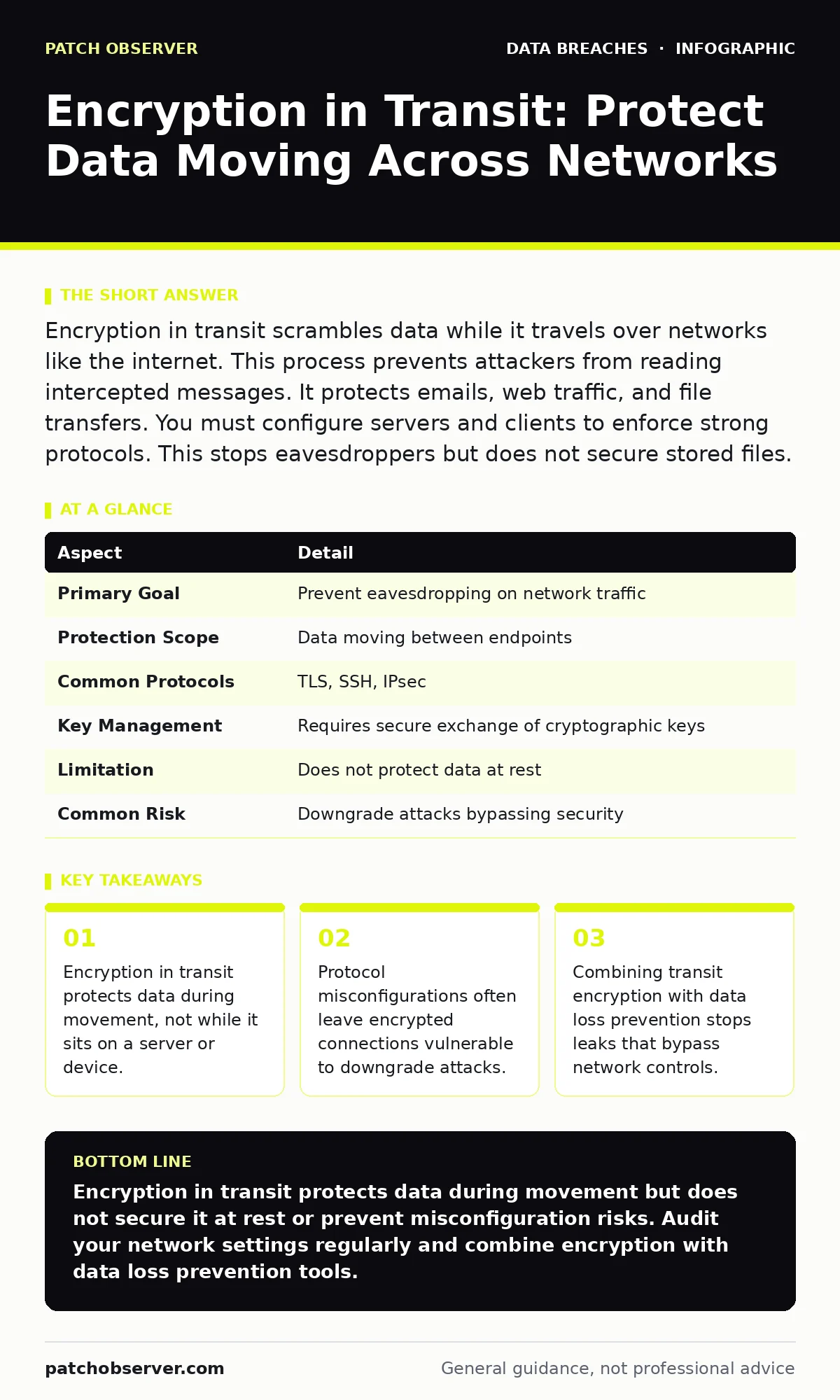
Encryption in transit scrambles data while it travels over networks like the internet. This process prevents attackers from reading intercepted messages. It protects emails, web traffic, and file transfers. You must configure servers and clients to enforce strong protocols. This stops eavesdroppers but does not secure stored files.
What is encryption in transit?
Encryption in transit refers to the process of scrambling data while it moves between two points. This protection applies to information traveling over local networks or the public internet. The goal is to ensure that only the intended recipient can read the message. Without this measure, anyone with access to the network cable or wireless signal can view the raw data. This includes sensitive credentials, financial records, and private communications.
Think of sending a sealed steel briefcase through a crowded train station. Even if someone steals the case, they cannot see the contents without the key. Encryption in transit provides that digital seal. It transforms readable text into unreadable ciphertext before transmission. The receiving system decrypts the data back into its original form. This mechanism is fundamental to modern digital trust and privacy.
| Aspect | Detail |
|---|---|
| Primary Goal | Prevent eavesdropping on network traffic |
| Protection Scope | Data moving between endpoints |
| Common Protocols | TLS, SSH, IPsec |
| Key Management | Requires secure exchange of cryptographic keys |
| Limitation | Does not protect data at rest |
| Common Risk | Downgrade attacks bypassing security |
How encryption in transit works
The system relies on cryptographic algorithms to transform plaintext into ciphertext. When you send a message, your device uses a public key to encrypt the data. The recipient uses a private key to decrypt it. This asymmetric approach solves the problem of sharing secrets over insecure channels. Modern systems often use a hybrid method. They use asymmetric encryption to exchange a session key. That session key then encrypts the actual data flow. This combines security with speed.
The handshake process establishes the security parameters. Both parties agree on the encryption algorithm and the keys. If an attacker interrupts this handshake, they may force a weaker protocol. This is known as a downgrade attack. The connection appears secure but uses outdated standards. Defenders must configure servers to reject older, vulnerable versions. This ensures the highest available security level is always used.
Who encryption in transit affects
Every organization that transmits data across networks relies on this protection. This includes businesses sending invoices, healthcare providers sharing patient records, and government agencies exchanging classified information. Users of online banking and e-commerce platforms depend on it for every transaction. The impact extends to Internet of Things devices. Smart home cameras and industrial sensors send data that requires protection.
Managed service providers face unique challenges. They must ensure encryption across diverse client environments. Legacy systems often lack support for modern protocols. Upgrading these systems requires careful planning and testing. Failure to maintain strong encryption exposes clients to interception risks. This affects reputation and legal compliance. Organizations must audit their network configurations regularly. They must verify that all endpoints support current security standards.
What to do about encryption in transit
Start by inventorying all data flows within your organization. Identify every system that sends or receives sensitive information. Check the configuration of web servers, email servers, and database connections. Ensure that they enforce strong encryption protocols. Disable support for outdated algorithms and weak ciphers. This reduces the attack surface significantly.
Implement certificate management processes. Expired or invalid certificates cause connection failures and security warnings. Users often ignore these warnings, bypassing security controls. Automate certificate renewal to prevent lapses. Monitor network traffic for anomalies. Look for signs of downgrade attempts or unusual data patterns. Integrate these checks into your broader security strategy. Combine network encryption with data loss prevention measures. This layered approach catches threats that slip past network controls.
Common misconceptions about encryption
Many assume that enabling encryption solves all security problems. This is a dangerous oversimplification. Encryption in transit only protects data while it moves. It does not secure the data once it arrives at the server. If the server is compromised, the attacker gets the plaintext. This is why securing endpoints is just as critical as securing the network.
Another myth is that encryption hides the source and destination of traffic. It does not. Network logs and packet headers still reveal who is talking to whom. Metadata remains visible to network observers. This allows attackers to map communication patterns. They can infer sensitive activities based on timing and volume. True anonymity requires additional tools like mix networks or tunnels. Do not confuse confidentiality with anonymity.
See also: Firewall Rules FAQ: Troubleshooting Conflicts and Logic Errors · Data Loss Prevention Explained: Stop Sensitive Info From Leaving
The hidden cost of misconfiguration
Misconfigured encryption is a leading cause of data exposure. Systems often default to supporting older protocols for compatibility. This creates a weak link in the chain. Attackers exploit these weaknesses to intercept traffic. They force the system to use a vulnerable version of the protocol. This bypasses the intended security protections.
Fixing these issues requires ongoing effort. Software updates change default settings. New vulnerabilities emerge constantly. Security teams must stay informed about protocol changes. They must test configurations before deployment. Neglecting this maintenance leads to drift. Systems become less secure over time without active management. This hidden cost includes staff time, testing resources, and potential incident response.
Integrating with broader security measures
Encryption in transit works best as part of a layered defense. Combine it with strong identity management. Verify the identity of users and systems before granting access. Use multi-factor authentication to prevent credential theft. Even if an attacker intercepts traffic, they cannot reuse stolen credentials easily.
Consider the risks of accidental data disclosure. Users may send sensitive files to the wrong recipient. Encryption in transit protects the file during sending. It does not prevent the initial mistake. Implement data loss prevention tools to scan outgoing messages. These tools block sensitive data from leaving the organization. This adds a critical check before encryption occurs.
Related practices enhance this protection. Review guidelines on data encryption to understand storage risks. Understand the implications of misconfigured cloud storage leaks. These vulnerabilities often arise from poor access controls rather than weak encryption. Address email account compromise risks by securing authentication mechanisms. Prevent medical identity theft by verifying patient data handling. Follow the GDPR breach notification rule when incidents occur. Use credit monitoring to detect financial fraud.
Maintaining long-term security
Security is not a one-time setup. It requires continuous monitoring and adjustment. Regular audits identify configuration drift. Penetration testing reveals weaknesses in implementation. Stay updated on cryptographic research. New attacks may break current algorithms. Plan for migration to stronger standards. This forward-looking approach ensures resilience.
Train users to recognize security warnings. They are the first line of defense. Educate them on the risks of ignoring certificate errors. Encourage reporting of suspicious activity. Foster a culture of security awareness. This human element complements technical controls. It reduces the likelihood of successful social engineering attacks.
Final considerations for implementation
Prioritize critical data flows first. Identify the most sensitive information. Apply the strongest encryption to these channels. Gradually extend protections to less critical systems. This phased approach manages risk and resource usage. Document all configurations and changes. Maintain clear records for compliance and troubleshooting.
Review your incident response plans. Include scenarios involving encryption failures. Define steps for key revocation and rotation. Ensure teams know how to react to downgrade attacks. Practice these procedures regularly. Preparedness reduces downtime and data loss. This proactive stance builds trust with clients and partners.
Key takeaways
- Encryption in transit protects data during movement, not while it sits on a server or device.
- Protocol misconfigurations often leave encrypted connections vulnerable to downgrade attacks.
- Combining transit encryption with data loss prevention stops leaks that bypass network controls.
Encryption in transit protects data during movement but does not secure it at rest or prevent misconfiguration risks. Audit your network settings regularly and combine encryption with data loss prevention tools.
Frequently asked questions
Does encryption in transit hide my IP address?
No, encryption in transit scrambles the content of your data but does not hide your IP address or the destination server. Network observers can still see where your traffic is going.
Can attackers break modern encryption in transit?
Breaking modern encryption algorithms is computationally infeasible with current technology. However, attackers often target weak implementations or misconfigurations instead of the math itself.
Is encryption in transit enough for compliance?
Encryption in transit is often a requirement for compliance frameworks like GDPR or HIPAA. However, these frameworks also require data at rest encryption and access controls.
How this guide was produced: written by the Patch Observer editorial team with AI assistance, checked against the public references listed below, and reviewed when the facts change. See our editorial policy or report an error.