Misconfigured Cloud Storage Leaks: Stop Exposed Data Now
Fix permission errors, automate drift detection, and seal gaps that manual audits miss in modern infrastructure.

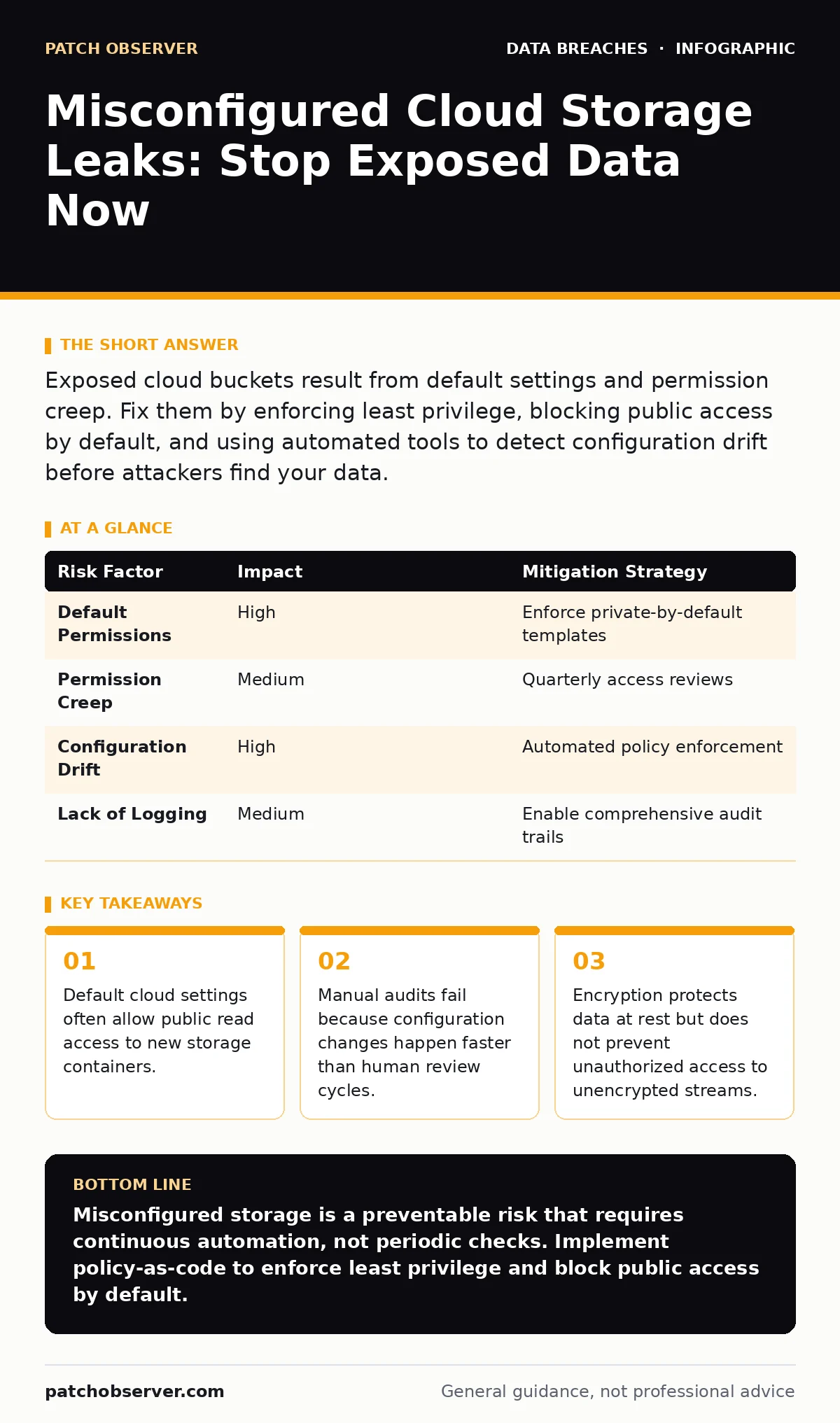
Exposed cloud buckets result from default settings and permission creep. Fix them by enforcing least privilege, blocking public access by default, and using automated tools to detect configuration drift before attackers find your data.
Why do cloud storage buckets become public by default?
Cloud providers prioritize ease of use, so new storage containers often inherit permissive settings. When you create a bucket without explicit restrictions, the system assumes you want immediate access. This convenience creates a security gap where sensitive data sits exposed to the internet. You must treat default configurations as hostile until proven otherwise.
How does permission creep expose internal data?
Permission creep occurs when users retain access rights long after they no longer need them. Over time, these accumulated privileges create a wide attack surface. An attacker who compromises a single low-level account can traverse these loose permissions to reach critical data stores. Regularly auditing access lists removes this silent risk.
What is configuration drift and why does it matter?
Configuration drift is the gradual divergence between your intended security posture and the actual state of your infrastructure. Small, seemingly harmless changes accumulate until security controls are effectively disabled. This happens when developers tweak settings for testing and forget to revert them. Automated monitoring detects this drift before it becomes a breach.
Can encryption alone prevent data leaks from misconfigurations?
Encryption protects data at rest but does not stop unauthorized access to live streams. If an attacker gains valid credentials or exploits a permission error, they can read the data as it transfers. Encryption ensures that stolen files are useless without the key, but it does not stop the theft itself. You need access controls to complement encryption.
Why do manual audits fail to catch these errors?
Manual audits capture a snapshot in time, missing changes that occur between reviews. Human reviewers also suffer from fatigue, leading to overlooked details in complex permission matrices. As infrastructure scales, the volume of configurations exceeds human processing capacity. Automation provides continuous coverage that manual checks cannot match.
See also: CIS Benchmarks for Small Business: Secure Cloud Configs
How do server-side logs help identify exposure?
Server-side logs record every request made to your storage resources, including failed attempts. Analyzing these logs reveals patterns of unauthorized access or scanning activity. You can spot when an external IP tries to list directory contents or download files. This visibility allows you to respond to threats in real time rather than after data loss.
What is the role of least privilege in preventing leaks?
Least privilege ensures that users and services have only the minimum access needed to function. This limits the damage if an account is compromised or a configuration error occurs. Instead of broad read-write access, grant specific permissions to specific objects. This containment strategy prevents lateral movement within your cloud environment.
How can you automate the detection of public endpoints?
Use infrastructure-as-code tools to define and enforce security policies automatically. These tools scan your environment continuously and alert you when a bucket becomes publicly accessible. You can also set rules to block any attempt to enable public access. This proactive approach stops misconfigurations before they expose data.
| Risk Factor | Impact | Mitigation Strategy |
|---|---|---|
| Default Permissions | High | Enforce private-by-default templates |
| Permission Creep | Medium | Quarterly access reviews |
| Configuration Drift | High | Automated policy enforcement |
| Lack of Logging | Medium | Enable comprehensive audit trails |
Why do third-party integrations increase exposure risk?
Third-party services often require broad permissions to function correctly. These services become another entry point for attackers if their own security fails. A misconfigured integration can expose your data even if your primary setup is secure. Regularly review and restrict the permissions granted to external applications.
What is the cost of ignoring these misconfigurations?
The cost extends beyond immediate data loss to include regulatory fines and reputational damage. Rebuilding trust takes longer than fixing the technical error. Attackers use exposed data for extortion, identity theft, or further intrusion. Preventing leaks is far cheaper than responding to a breach.
How do you balance security with developer velocity?
Security controls must integrate into the development workflow to avoid bottlenecks. Use pre-commit hooks to check for misconfigurations before code is deployed. This shifts security left, catching errors early without slowing down release cycles. Developers can fix issues while the context is still fresh.
Key takeaways
- Default cloud settings often allow public read access to new storage containers.
- Manual audits fail because configuration changes happen faster than human review cycles.
- Encryption protects data at rest but does not prevent unauthorized access to unencrypted streams.
Misconfigured storage is a preventable risk that requires continuous automation, not periodic checks. Implement policy-as-code to enforce least privilege and block public access by default.
Frequently asked questions
How do I know if my cloud storage is currently exposed?
Use a cloud security posture management tool to scan for public endpoints and misconfigured permissions.
Can I fix a leak without downtime?
Yes, changing permission settings is instantaneous and does not require service interruption.
Do I need to encrypt all data to prevent leaks?
Encryption protects data at rest but does not prevent access; focus on access controls first.
How often should I review access permissions?
Review permissions quarterly or whenever personnel changes occur to prevent permission creep.
How this guide was produced: written by the Patch Observer editorial team with AI assistance, checked against the public references listed below, and reviewed when the facts change. See our editorial policy or report an error.