CIS Benchmarks for Small Business: Secure Cloud Configs
CIS Benchmarks provide free, actionable security configurations that prevent most common cloud misconfigurations without requiring expensive proprietary tools or dedicated security teams.

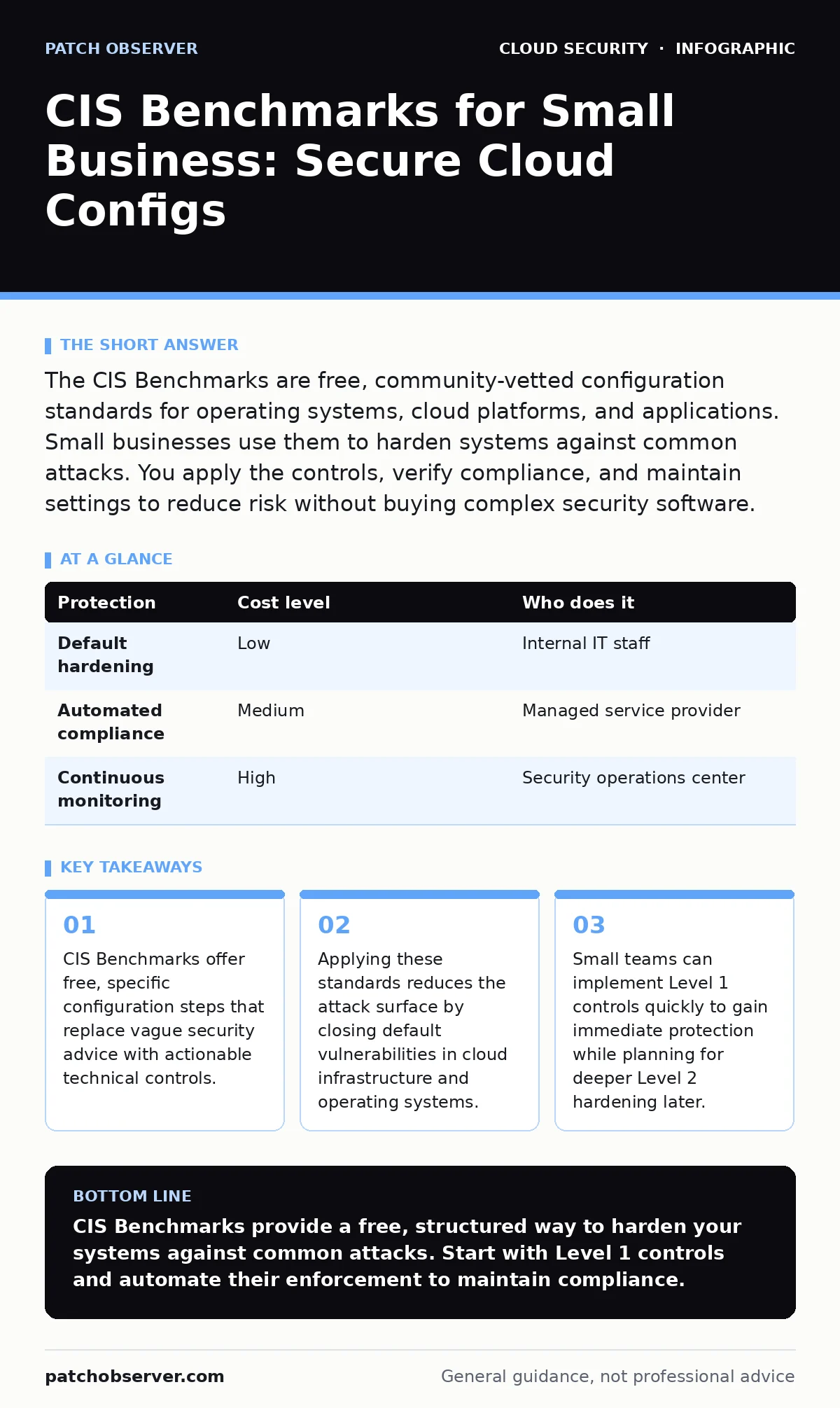
The CIS Benchmarks are free, community-vetted configuration standards for operating systems, cloud platforms, and applications. Small businesses use them to harden systems against common attacks. You apply the controls, verify compliance, and maintain settings to reduce risk without buying complex security software.
Why CIS Benchmarks Matter at Small Scale
The Center for Internet Security (CIS) Benchmarks are detailed configuration standards for operating systems, cloud services, and applications. They translate broad security goals into specific technical settings. Small organizations often lack the budget for large security teams or expensive compliance frameworks. These benchmarks provide a free, structured path to security. They focus on the most common vulnerabilities that attackers exploit first.
Using these standards prevents misconfigurations, which are a leading cause of data breaches. Default settings in cloud platforms prioritize ease of use over security. This trade-off leaves ports open, permissions too broad, and logging disabled. Applying the benchmarks closes these gaps. You gain protection without purchasing additional software. The controls are technology-agnostic and apply to any cloud environment.
Small teams benefit from the prioritized nature of the standards. The benchmarks divide controls into two levels. Level 1 controls provide maximum security with minimum impact on usability. Level 2 controls add layers of defense for higher-risk environments. Starting with Level 1 allows you to secure the majority of your infrastructure quickly. This approach balances security needs with operational constraints.
| Protection | Cost level | Who does it |
|---|---|---|
| Default hardening | Low | Internal IT staff |
| Automated compliance | Medium | Managed service provider |
| Continuous monitoring | High | Security operations center |
What to Do With It in Practice
You cannot apply every control at once. The volume of settings can overwhelm a small team. Start by identifying your critical assets. These are the systems that hold sensitive data or support core business functions. Focus your initial efforts on securing these high-value targets. Ignore less critical systems until you have stabilized the core.
Download the relevant benchmark for your operating system or cloud platform. Read the introduction to understand the scope. Each control includes a description, the security benefit, and the implementation steps. Follow the steps exactly. Do not skip sections unless you have a specific business reason. Document any deviations. This documentation proves due diligence during audits or insurance reviews.
Automate the application of these settings where possible. Manual configuration leads to drift. Drift occurs when systems change over time, re-introducing vulnerabilities. Use configuration management tools to enforce the benchmarks. This ensures that new servers or containers start with the correct settings. Automation reduces human error and saves time. It also provides a consistent baseline across your entire environment.
Understanding the Two Levels of Control
Level 1 controls are the foundation of your security posture. They address the most significant risks with the least disruption. Examples include disabling unused services, enforcing strong password policies, and enabling audit logging. These settings rarely interfere with normal business operations. Implementing them provides immediate value. They stop low-effort attacks that target default configurations.
Level 2 controls add depth and complexity. They might require changes to application logic or network architecture. These controls are necessary for high-security environments. They include advanced encryption requirements and strict access controls. Implementing Level 2 controls takes more time and testing. You must verify that business applications still function correctly. Reserve these for systems handling highly sensitive data.
Choosing between levels depends on your risk tolerance. A small e-commerce site might need Level 2 for its payment processing system. Internal email servers might only require Level 1. Assess each system individually. Do not apply the same standard to every asset. Tailoring your approach ensures you spend resources where they matter most. This targeted strategy maximizes your security investment.
Integrating With Cloud Security Assessments
You should view the benchmarks as a starting point, not the finish line. Regular cloud security assessments validate your configuration. These assessments check for drift and new vulnerabilities. They compare your current state against the benchmark standards. This process identifies gaps that automation might miss. It also highlights areas where business requirements conflict with security settings.
Combine these assessments with infrastructure-as-code scanning. Scanning code before deployment prevents misconfigurations from reaching production. This shift-left approach catches errors early. It is cheaper and faster to fix code than to remediate live systems. Integrate scanning into your development pipeline. This ensures that every new component meets the benchmark standards from day one.
Review your findings regularly. Threats evolve, and so do the benchmarks. New versions address emerging vulnerabilities. Stay updated with the latest releases. Schedule quarterly reviews of your configuration state. This routine maintenance keeps your security posture strong. It also demonstrates a commitment to continuous improvement. Consistency is more valuable than perfection.
What to Ask an IT Provider
If you outsource your IT, your provider must understand these standards. Do not assume they follow best practices by default. Ask specific questions about their implementation process. A vague answer indicates a lack of depth. You need to know how they handle configuration changes. You also need to know how they verify compliance.
- How do you apply CIS Benchmarks to our cloud infrastructure?
- Do you use automation to enforce these settings continuously?
- How do you handle exceptions when business needs conflict with security?
- Can you provide a report showing our current compliance level?
- What is your process for updating controls when benchmarks change?
These questions reveal their methodology. A good provider will explain their tools and processes. They will show you how they monitor for drift. They will also discuss how they test changes before deployment. Avoid providers who promise complete security. No solution is perfect. Look for partners who emphasize continuous monitoring and improvement.
See also: Why Identity and Access Management Matters for Cloud Security
Hidden Costs and Trade-Offs
Implementing these benchmarks has hidden costs. The primary cost is time. Reading, applying, and testing controls takes effort. You must allocate staff hours for this work. Another cost is complexity. Some controls require changes to application code. Developers must understand security requirements. This can slow down feature development.
Performance is another trade-off. Enabling detailed logging consumes storage and bandwidth. Strict access controls might add latency to authentication. You must balance security with user experience. Too much friction drives users to bypass security measures. Find the sweet spot where security does not hinder productivity.
Shadow IT often emerges when security is too restrictive. Employees find easier ways to do their work. This creates unmanaged assets that bypass your controls. Communicate the reasons behind the restrictions. Show users how the benchmarks protect their data. Engagement reduces resistance. It also helps you identify legitimate business needs that require exceptions.
Maintaining Long-Term Compliance
Security is not a one-time project. It is an ongoing process. Systems change. New vulnerabilities appear. Your configuration must adapt. Set up alerts for configuration changes. This helps you detect unauthorized modifications quickly. Investigate any alerts immediately. Determine if the change was intentional or malicious.
Review your access controls regularly. Permissions accumulate over time. Employees change roles. Their access needs change too. Remove unnecessary permissions. This principle of least privilege reduces the impact of compromised accounts. Regular reviews prevent privilege creep. They also simplify auditing.
Document your security policies clearly. Include references to the specific benchmark controls. This documentation guides your team and external auditors. It also helps new employees understand the security expectations. Clear policies reduce confusion and errors. They create a culture of security awareness. Consistency in documentation supports long-term success.
Key takeaways
- CIS Benchmarks offer free, specific configuration steps that replace vague security advice with actionable technical controls.
- Applying these standards reduces the attack surface by closing default vulnerabilities in cloud infrastructure and operating systems.
- Small teams can implement Level 1 controls quickly to gain immediate protection while planning for deeper Level 2 hardening later.
CIS Benchmarks provide a free, structured way to harden your systems against common attacks. Start with Level 1 controls and automate their enforcement to maintain compliance.
Frequently asked questions
Do CIS Benchmarks replace the need for antivirus software?
No, they complement antivirus by hardening the system configuration. They reduce the attack surface but do not detect malware once it enters the system.
How often should I review my CIS Benchmark compliance?
Review compliance quarterly or after any major infrastructure change. Regular checks ensure that settings have not drifted from the desired state.
Can I use CIS Benchmarks for on-premise servers?
Yes, CIS provides benchmarks for Windows, Linux, and other operating systems. The principles apply regardless of where the hardware is located.
What if a benchmark control breaks my application?
Document the exception and implement compensating controls. Test the application in a staging environment before applying changes to production.
How this guide was produced: written by the Patch Observer editorial team with AI assistance, checked against the public references listed below, and reviewed when the facts change. See our editorial policy or report an error.