Why Identity and Access Management Matters for Cloud Security
Identity controls prevent lateral movement by ensuring users hold only the permissions required for their specific tasks, reducing the blast radius of any compromise.

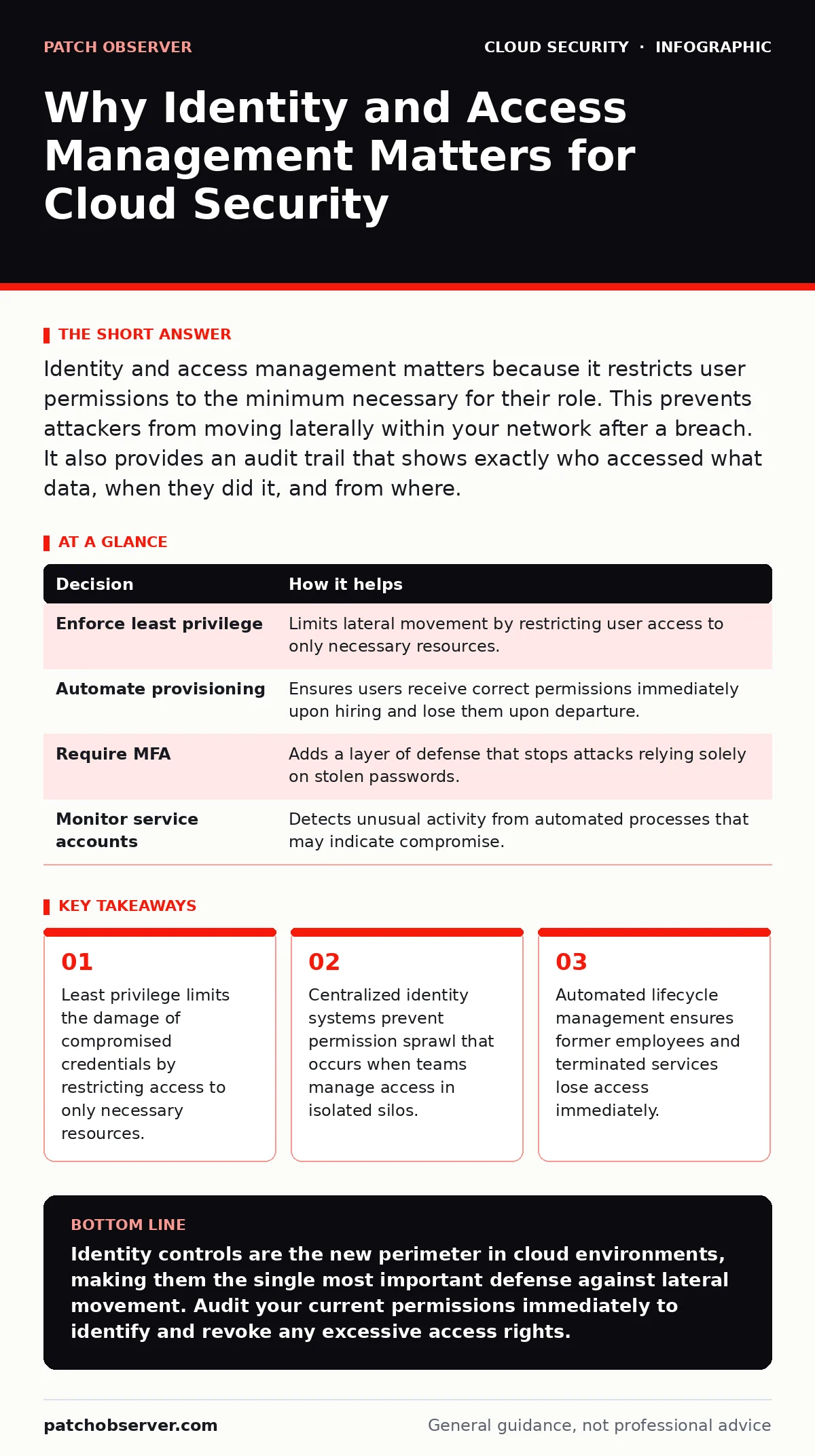
Identity and access management matters because it restricts user permissions to the minimum necessary for their role. This prevents attackers from moving laterally within your network after a breach. It also provides an audit trail that shows exactly who accessed what data, when they did it, and from where.
Why Identity and Access Management Matters
Identity and access management matters because it serves as the primary control plane for your cloud environment. Traditional network perimeters have dissolved in cloud architectures, making the identity of the user or service the new security boundary. Without strict controls, every credential becomes a potential entry point for attackers. You must treat identity as the most critical asset in your infrastructure. This approach shifts security from defending a castle wall to verifying every person and process that enters.
The Weight of Access Control Decisions
Access control decisions carry different weights based on their potential impact. The most significant risk comes from excessive privileges granted to human users. These accounts often have broad access to multiple systems, creating a high-value target for phishing and credential theft. Service accounts present a secondary risk. They run automated processes and often hold persistent, high-privilege tokens that never expire. If an attacker compromises a service account, they gain silent, sustained access to critical infrastructure.
| Decision | How it helps |
|---|---|
| Enforce least privilege | Limits lateral movement by restricting user access to only necessary resources. |
| Automate provisioning | Ensures users receive correct permissions immediately upon hiring and lose them upon departure. |
| Require MFA | Adds a layer of defense that stops attacks relying solely on stolen passwords. |
| Monitor service accounts | Detects unusual activity from automated processes that may indicate compromise. |
What Goes Wrong Without Centralized Identity
Decentralized identity management leads to permission sprawl. When different teams manage their own access controls, users accumulate privileges across multiple systems. Over time, these permissions exceed what is necessary for their current role. This accumulation creates a hidden risk surface. An attacker who compromises a low-level account can exploit leftover permissions from previous projects. You cannot effectively secure an environment where you do not know who has access to what.
The Hidden Cost of Manual Provisioning
Manual identity management introduces human error and delay. When you manually create accounts, you risk typos in permission sets. You might forget to revoke access when an employee changes roles or leaves the organization. These gaps persist until someone notices them, if ever. Automated lifecycle management eliminates this risk. It ties access rights to employment status and job function. When a user’s role changes, the system automatically adjusts their permissions. This reduces the administrative burden and ensures consistency.
Understanding Privilege Escalation Vectors
Attackers often start with low-privilege access and attempt to escalate their permissions. They exploit misconfigurations in identity systems to gain higher-level rights. This is why understanding privilege escalation vectors is critical. You must regularly audit permissions to ensure they align with current job functions. Reviewing access logs helps identify unusual patterns that may indicate an ongoing escalation attempt. Without regular reviews, stale permissions become a permanent vulnerability.
See also: CIS Benchmarks for Small Business: Secure Cloud Configs
Integrating with Broader Security Frameworks
Identity management does not exist in isolation. It must integrate with other security controls to provide effective protection. For instance, OAuth token abuse can occur if identity providers are misconfigured. Ensuring that tokens are short-lived and scoped correctly mitigates this risk. You should also consider how identity controls interact with cloud key management services. Proper integration ensures that only authorized identities can access encryption keys. This layered approach strengthens your overall security posture.
Actionable Steps for Implementation
Start by mapping all identities in your environment. Identify human users, service accounts, and automated processes. Assign each identity a specific role with defined permissions. Implement multi-factor authentication for all privileged accounts. This adds a critical layer of defense against credential theft. Regularly review and audit access rights to ensure they remain appropriate. Automate the provisioning and deprovisioning of accounts to reduce human error. These steps create a resilient identity management framework.
| Step | Action |
|---|---|
| 1 | Inventory all identities and their current permissions. |
| 2 | Define roles and assign least-privilege permissions. |
| 3 | Implement MFA for all privileged access. |
| 4 | Automate account lifecycle management. |
| 5 | Conduct regular access reviews and audits. |
The Role of Continuous Monitoring
Continuous monitoring is essential for detecting anomalies in identity behavior. You must track login attempts, permission changes, and resource access. Unusual patterns, such as logins from unexpected locations or times, may indicate compromise. Automated tools can help analyze this data in real-time. They alert you to suspicious activities that require immediate investigation. This proactive approach allows you to respond to threats before they cause significant damage.
Key takeaways
- Least privilege limits the damage of compromised credentials by restricting access to only necessary resources.
- Centralized identity systems prevent permission sprawl that occurs when teams manage access in isolated silos.
- Automated lifecycle management ensures former employees and terminated services lose access immediately.
Identity controls are the new perimeter in cloud environments, making them the single most important defense against lateral movement. Audit your current permissions immediately to identify and revoke any excessive access rights.
Frequently asked questions
How does identity management prevent cloud ransomware?
It limits the scope of damage by ensuring attackers cannot access critical systems or data encryption keys if they compromise a single account.
What is the difference between authentication and authorization?
Authentication verifies who you are, while authorization determines what you are allowed to do within the system.
Can automated tools replace human oversight in identity management?
No, automated tools handle routine tasks, but human oversight is necessary for reviewing complex permission changes and investigating anomalies.
How often should I review user permissions?
You should review permissions regularly, at least quarterly, and immediately whenever an employee changes roles or leaves the organization.
How this guide was produced: written by the Patch Observer editorial team with AI assistance, checked against the public references listed below, and reviewed when the facts change. See our editorial policy or report an error.