Denial-of-Wallet Attack Prevention Checklist
Resource exhaustion attacks bypass traditional firewalls by consuming cloud compute capacity until budgets drain, requiring specific architectural limits rather than mere traffic filtering.

Protect cloud environments from denial-of-wallet attacks by enforcing strict resource quotas, implementing auto-scaling ceilings, and monitoring cost anomalies in real time. These measures prevent attackers from running up bills through legitimate-looking requests that exhaust compute or storage resources.
Understanding Resource Exhaustion Threats
Denial-of-wallet attacks target the financial stability of cloud infrastructure rather than just data confidentiality. Attackers send requests that appear legitimate but require disproportionate compute, storage, or bandwidth resources. Traditional perimeter defenses often allow this traffic because it follows standard protocols. The damage manifests as unexpected billing charges that can exceed organizational budgets within hours. You must treat resource consumption as a security metric alongside intrusion attempts.
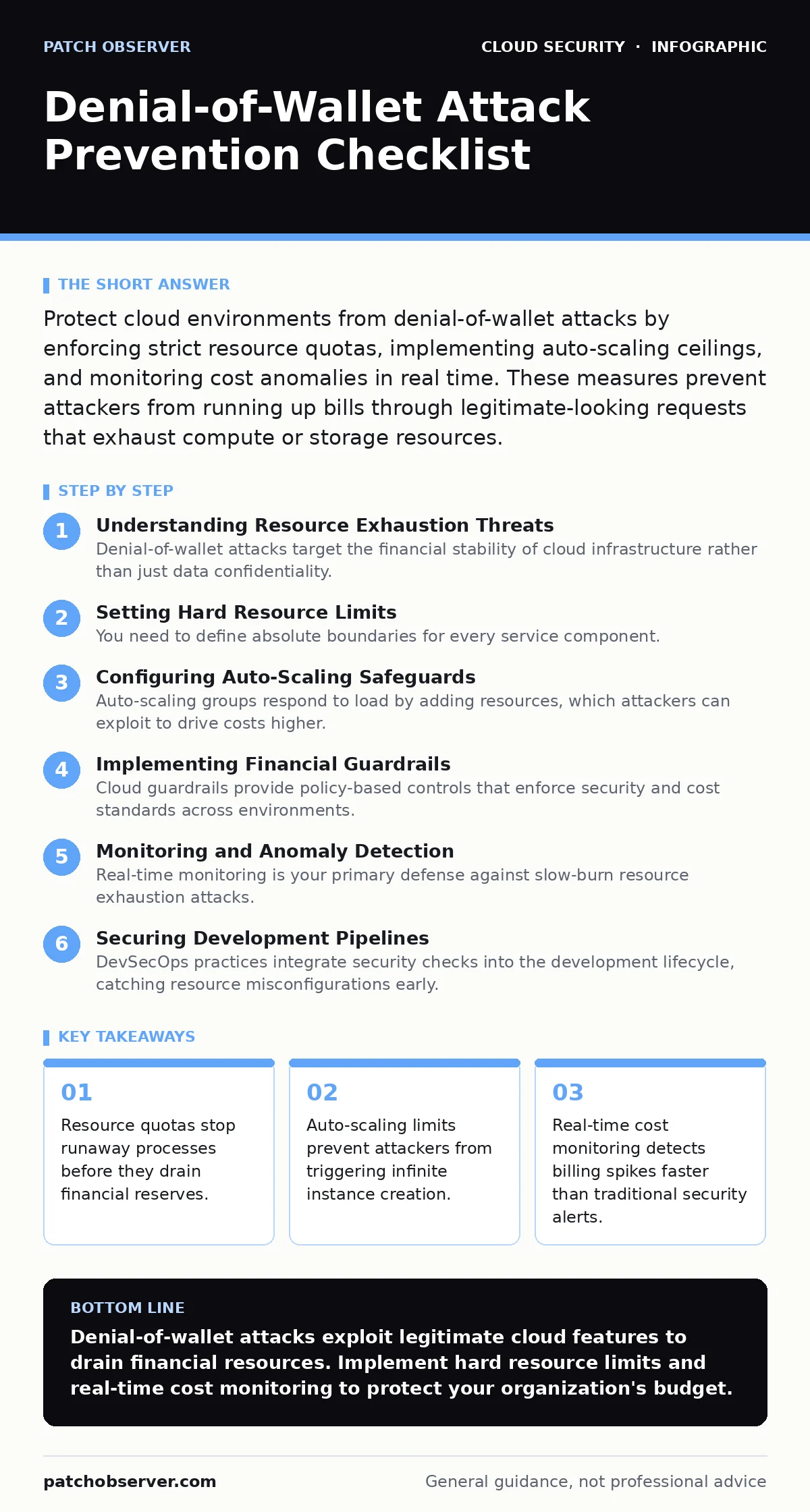
Setting Hard Resource Limits
You need to define absolute boundaries for every service component. These limits act as circuit breakers for financial exposure.
- Enforce per-user API rate limits: Prevents single accounts from triggering massive resource allocation.
- Set maximum instance counts per region: Stops attackers from spawning thousands of compute nodes.
- Cap storage write throughput: Limits the cost of data injection attacks that fill storage buckets.
- Define network bandwidth ceilings: Prevents bandwidth-heavy attacks from incurring egress charges.
Configuring Auto-Scaling Safeguards
Auto-scaling groups respond to load by adding resources, which attackers can exploit to drive costs higher. Misconfigured scaling policies create a feedback loop of expensive resource creation. You must configure scaling rules to prioritize stability over unlimited growth. Review your scaling triggers to ensure they require sustained load before adding capacity. This prevents transient spikes from triggering expensive long-term resource commitments.
- Set hard maximums on scaling groups: Prevents infinite instance creation during attack spikes.
- Use cooldown periods between scale events: Stops rapid oscillation that accumulates charges quickly.
- Require manual approval for large scale-ups: Adds a human check before significant cost increases.
Implementing Financial Guardrails
Cloud guardrails provide policy-based controls that enforce security and cost standards across environments. These policies apply automatically and reduce the risk of human error. You should integrate these policies into your deployment pipeline to catch issues before resources are provisioned. Infrastructure-as-code scanning helps identify misconfigurations that could lead to resource exhaustion. This proactive approach reduces the window of exposure.
- Enable billing alerts for unusual spend: Provides early warning of potential attack activity.
- Set hard budget limits with auto-shutdown: Stops resources automatically when costs exceed thresholds.
- Use reserved instances for predictable workloads: Reduces the impact of spot price fluctuations and overage.
Monitoring and Anomaly Detection
Real-time monitoring is your primary defense against slow-burn resource exhaustion attacks. You need to track resource usage patterns and detect deviations from normal behavior. Cloud key management services help secure the credentials that attackers might try to exploit. Identity and access management ensures that only authorized users can trigger expensive operations. Regular audits of access permissions reduce the attack surface.
- Monitor CPU and memory utilization spikes: Identifies compute-heavy attacks that drain resources.
- Track API call frequency and types: Detects patterns indicative of automated resource requests.
- Alert on unusual geographic access patterns: Flags potential compromise of credentials used for attacks.
See also: Why Identity and Access Management Matters for Cloud Security
Securing Development Pipelines
DevSecOps practices integrate security checks into the development lifecycle, catching resource misconfigurations early. You must treat infrastructure code as security code and review it for potential resource exhaustion vectors. Virtual private clouds should be configured with strict network segmentation to limit the blast radius of an attack. This containment strategy prevents lateral movement that could lead to broader resource consumption.
- Review deployment scripts for unbounded loops: Prevents code errors from triggering resource exhaustion.
- Validate resource tagging for cost allocation: Ensures you can identify and isolate expensive resources quickly.
- Test scaling policies under load conditions: Verifies that safeguards activate before costs spiral out of control.
Addressing Shadow IT and Misconfigurations
Shadow IT introduces unmanaged resources that lack proper security controls and cost monitoring. These assets are particularly vulnerable to denial-of-wallet attacks because they operate outside organizational oversight. Kubernetes misconfigurations often expose cluster resources to external manipulation, allowing attackers to request excessive compute. Regular discovery and remediation of unauthorized resources are necessary to maintain a secure posture. You must enforce consistent policies across all environments, including development and testing stages.
- Discover and inventory all cloud resources: Identifies unmanaged assets that lack cost controls.
- Enforce consistent tagging policies: Enables accurate cost tracking and anomaly detection.
- Regularly audit permission sets: Prevents excessive privileges that could be exploited for resource abuse.
Key takeaways
- Resource quotas stop runaway processes before they drain financial reserves.
- Auto-scaling limits prevent attackers from triggering infinite instance creation.
- Real-time cost monitoring detects billing spikes faster than traditional security alerts.
Denial-of-wallet attacks exploit legitimate cloud features to drain financial resources. Implement hard resource limits and real-time cost monitoring to protect your organization's budget.
Frequently asked questions
How do I distinguish between a denial-of-wallet attack and a legitimate traffic spike?
Legitimate spikes usually correlate with known business events and show gradual growth. Attacks often involve rapid, uniform resource requests from diverse sources without corresponding business justification.
Can auto-scaling policies themselves cause financial damage?
Yes, if scaling policies lack maximum instance limits or cooldown periods, attackers can trigger continuous resource creation that accumulates significant charges before safeguards activate.
Do traditional DDoS protections stop denial-of-wallet attacks?
No, DDoS protections focus on bandwidth and connection limits. Denial-of-wallet attacks often use low-volume, high-compute requests that bypass these controls while still incurring significant costs.
How often should I review resource quotas and cost policies?
Review them quarterly or after any major infrastructure change. Regular reviews ensure that quotas align with current business needs and evolving attack techniques.
How this guide was produced: written by the Patch Observer editorial team with AI assistance, checked against the public references listed below, and reviewed when the facts change. See our editorial policy or report an error.