How Cloud Guardrails Work: The Mechanics Behind Policy Enforcement
Cloud guardrails enforce rules by intercepting API calls before they execute, shifting security from post-incident forensics to real-time prevention of configuration drift.

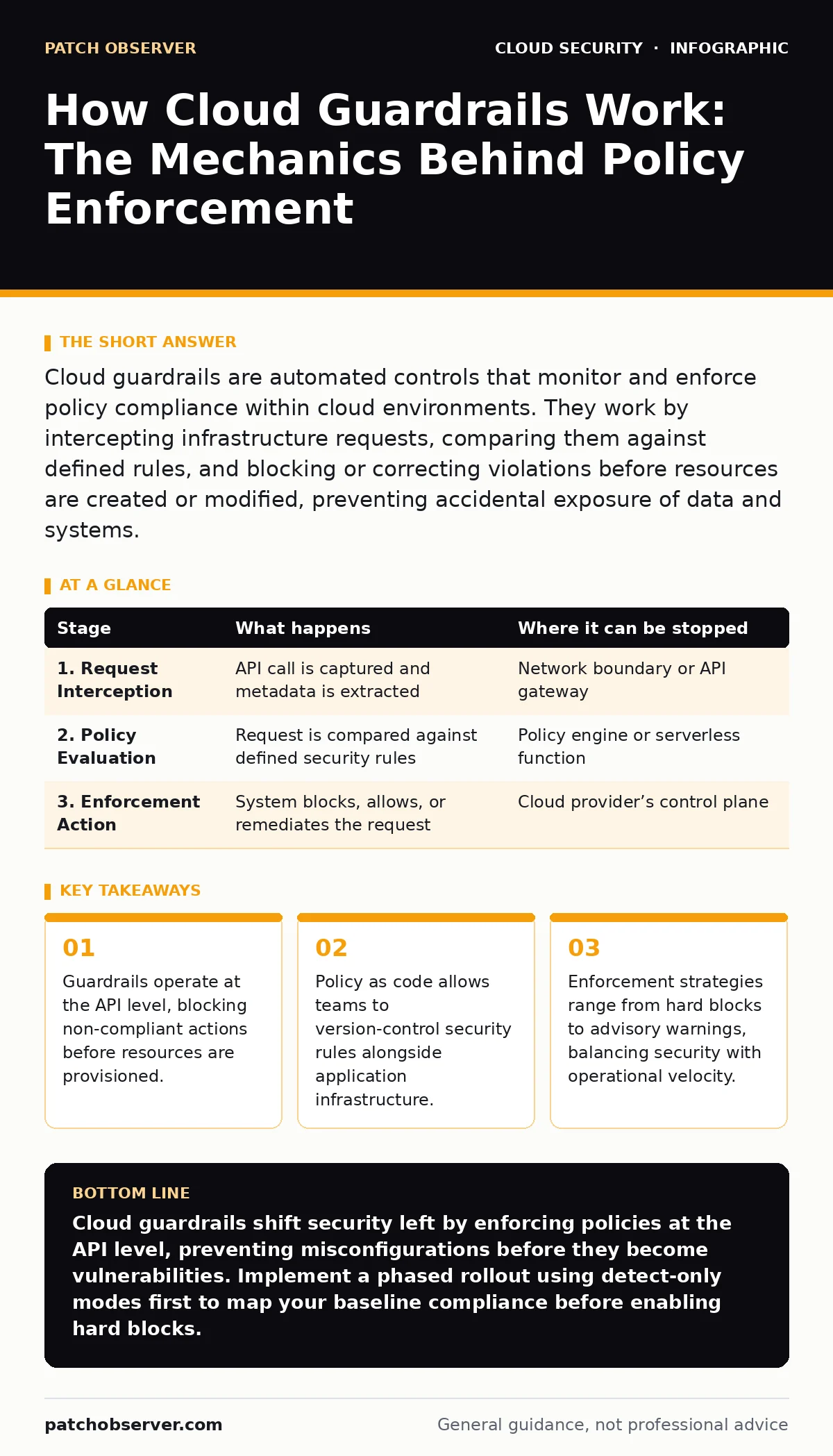
Cloud guardrails are automated controls that monitor and enforce policy compliance within cloud environments. They work by intercepting infrastructure requests, comparing them against defined rules, and blocking or correcting violations before resources are created or modified, preventing accidental exposure of data and systems.
The Architecture of Automated Control
Cloud environments change faster than human oversight can track. Manual checks fail because infrastructure exists as ephemeral code rather than static hardware. Guardrails solve this by embedding security logic directly into the deployment pipeline. They act as a filter between your intent and the cloud provider’s infrastructure.
This mechanism relies on continuous monitoring of infrastructure state. When you request a change, the system evaluates that request against a set of predefined rules. If the request violates a rule, the system intervenes. This intervention happens before the resource is fully created or modified.
Understanding this flow requires looking at the specific stages of enforcement. Each stage offers a different opportunity for security or failure. The timing of the intervention determines whether you prevent an error or merely detect it after the fact.
The Enforcement Lifecycle
Stage 1: Request Interception
The process begins when a user or automated tool sends a request to the cloud provider. This request could be creating a storage bucket, launching a virtual machine, or changing firewall rules. The guardrail system intercepts this API call before it reaches the core infrastructure services.
At this stage, the system captures the payload of the request. It extracts metadata such as the identity of the requester, the intended resource type, and the configuration parameters. This interception is transparent to the user, adding minimal latency to the operation.
| Stage | What happens | Where it can be stopped |
|---|---|---|
| 1. Request Interception | API call is captured and metadata is extracted | Network boundary or API gateway |
| 2. Policy Evaluation | Request is compared against defined security rules | Policy engine or serverless function |
| 3. Enforcement Action | System blocks, allows, or remediates the request | Cloud provider’s control plane |
Stage 2: Policy Evaluation
Once the request is captured, the guardrail engine evaluates it against your security policies. These policies are often written as policy as code, allowing them to be version-controlled and tested like application software. The engine checks if the requested configuration matches allowed patterns.
For example, a policy might state that no storage object can be publicly accessible. The engine parses the request to see if the public-read permission is set. It also checks the context, such as whether the request originates from an approved IP range or service account.
This evaluation is deterministic. The same request with the same context will always yield the same result. This consistency is what allows teams to trust the automation. However, complex policies can introduce latency if the evaluation logic is inefficient.
Stage 3: Enforcement Action
Based on the evaluation, the system takes an action. The most common action is blocking, where the request is rejected and an error message is returned to the user. This prevents the non-compliant resource from being created.
Alternatively, the system can allow the request but log the violation for later review. This "detect-only" mode is useful during initial deployment of new policies. It prevents operational disruption while building a baseline of compliance.
Some advanced systems can remediate the request automatically. If a storage bucket is created with logging disabled, the system can automatically enable logging after creation. This corrective action ensures compliance without requiring manual intervention.
Hidden Costs and Edge Cases
Guardrails are not a silver bullet. They introduce complexity that can impact operational efficiency. The most significant hidden cost is the maintenance burden of policy code. As your infrastructure grows, your policies must evolve to match new use cases without becoming overly restrictive.
Another edge case involves service-to-service communication. Internal services often need broad permissions to function correctly. Overly strict guardrails can block legitimate internal traffic, causing application failures. You must distinguish between external threats and internal operational needs.
Imagine a scenario where a legitimate emergency override is needed. A hard block prevents the action, but the business requires immediate resolution. Without a clear exception process, security becomes a blocker rather than an enabler. This tension requires careful design of exception handling.
Integration with Identity and Access
Guardrails rely heavily on identity context. They need to know who is making the request to apply the correct policies. This is where integration with MFA for cloud accounts becomes relevant. Multi-factor authentication adds a layer of trust to the identity, ensuring that the requester is who they claim to be.
However, identity alone is not enough. Services often use roles rather than individual user accounts. Guardrails must evaluate the permissions associated with these roles. If a role has excessive permissions, the guardrail must enforce the principle of least privilege at the resource level.
This integration also extends to OAuth token abuse prevention. Tokens can be stolen or misused, allowing attackers to impersonate valid services. Guardrails can inspect token scopes and expiration times, blocking requests that use anomalous or expired credentials.
Remediation and Drift Detection
Not all violations occur at creation time. Existing resources can drift from compliance due to manual changes or configuration updates. Guardrails must continuously monitor the state of deployed infrastructure to detect this drift.
When drift is detected, the system can trigger remediation workflows. This might involve automatically correcting the configuration or alerting the responsible team. Continuous monitoring ensures that compliance is maintained over time, not just at the moment of deployment.
This process ties into broader cloud security assessments. Regular assessments validate that the guardrails themselves are functioning correctly and that no new vulnerabilities have emerged in the policy logic.
See also: CIS Benchmarks for Small Business: Secure Cloud Configs
Limits of Automation
Guardrails cannot protect against every threat. They are ineffective against social engineering attacks that trick users into making compliant-looking requests. They also cannot prevent data exfiltration if the data itself is allowed to move.
Furthermore, guardrails rely on the integrity of the underlying cloud provider. If the provider suffers an outage or security breach, the guardrails may fail. You must assume that no single control is sufficient.
This is why defense in depth remains necessary. Guardrails should be combined with other controls such as cloud key management services for encryption and secure access service edge (SASE) for network protection.
Key takeaways
- Guardrails operate at the API level, blocking non-compliant actions before resources are provisioned.
- Policy as code allows teams to version-control security rules alongside application infrastructure.
- Enforcement strategies range from hard blocks to advisory warnings, balancing security with operational velocity.
Cloud guardrails shift security left by enforcing policies at the API level, preventing misconfigurations before they become vulnerabilities. Implement a phased rollout using detect-only modes first to map your baseline compliance before enabling hard blocks.
Frequently asked questions
Do cloud guardrails slow down deployment pipelines?
Yes, they add latency to API calls due to policy evaluation. However, well-optimized policies minimize this impact to milliseconds, which is usually acceptable for most operations.
Can guardrails protect against insider threats?
They can limit the damage by enforcing least privilege and blocking anomalous actions. However, they cannot stop a malicious insider who has legitimate permissions and follows compliant procedures.
How do guardrails handle legacy infrastructure?
Legacy systems often lack modern tagging or structure. Guardrails can be configured in detect-only mode for legacy resources to identify violations without breaking functionality, allowing for gradual remediation.
Is policy as code better than manual rules?
Policy as code allows for version control, testing, and automation. It reduces human error and ensures consistency across environments, making it superior to manual rule management for scalability.
How this guide was produced: written by the Patch Observer editorial team with AI assistance, checked against the public references listed below, and reviewed when the facts change. See our editorial policy or report an error.