OAuth Token Abuse: Definition, Mechanics, and Mitigation Strategies
Attackers rarely steal credentials directly; they intercept short-lived access tokens to bypass authentication entirely, rendering password strength irrelevant.

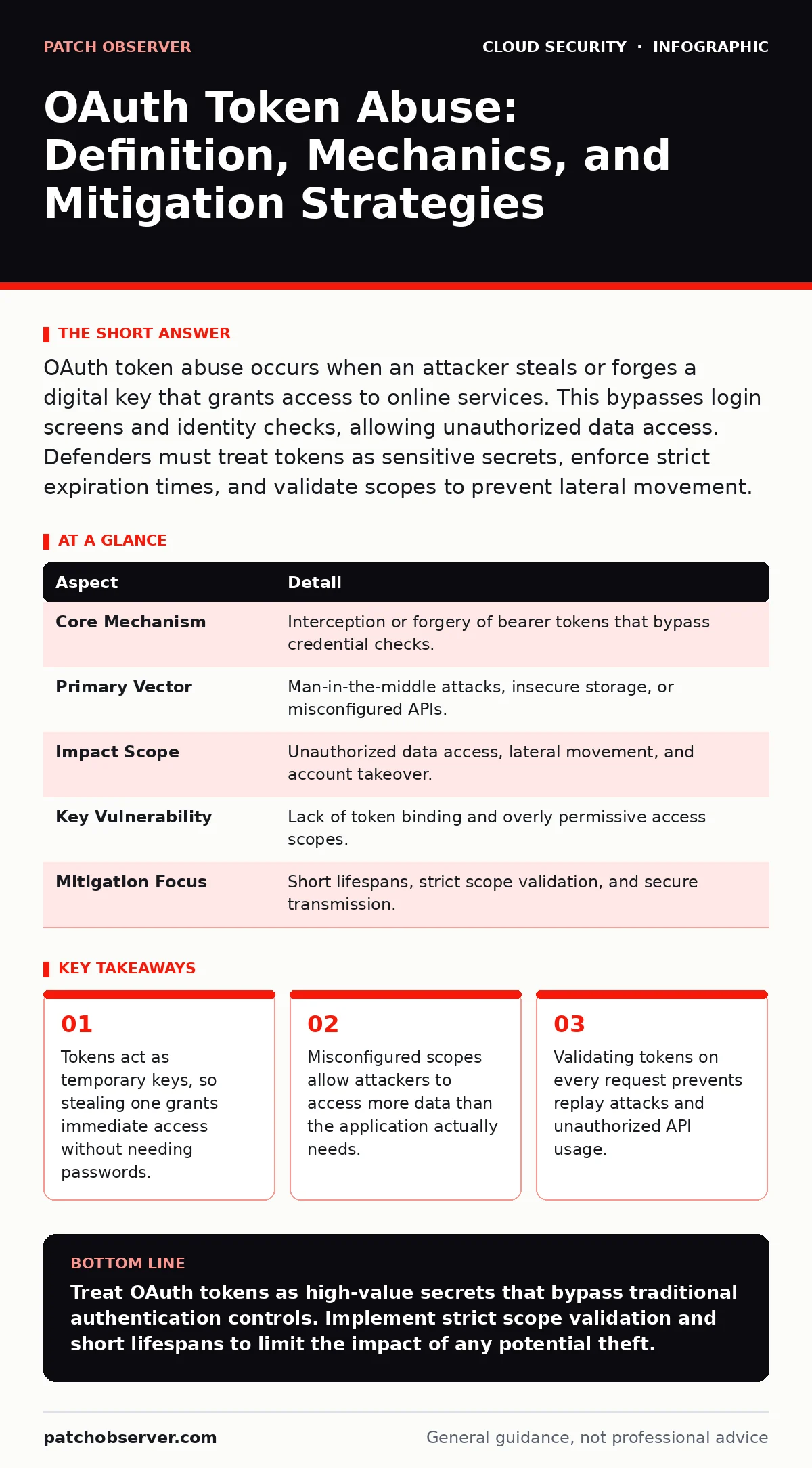
OAuth token abuse occurs when an attacker steals or forges a digital key that grants access to online services. This bypasses login screens and identity checks, allowing unauthorized data access. Defenders must treat tokens as sensitive secrets, enforce strict expiration times, and validate scopes to prevent lateral movement.
The Library Card Analogy
Imagine you hold a library card. The card itself is not your identity; it is a tool that proves you have permission to borrow books. If someone steals that card, they do not need to know your name or your home address. They simply present the card at the desk. The librarian sees the valid card and hands over the books.
In digital systems, the OAuth token functions exactly like that library card. It is a string of characters that proves you have authenticated and are authorized to access specific resources. The system does not re-check your password every time you make a request. It checks the token. If the token is valid, the system grants access. This design creates speed and convenience, but it introduces a distinct risk profile.
At a Glance
| Aspect | Detail |
|---|---|
| Core Mechanism | Interception or forgery of bearer tokens that bypass credential checks. |
| Primary Vector | Man-in-the-middle attacks, insecure storage, or misconfigured APIs. |
| Impact Scope | Unauthorized data access, lateral movement, and account takeover. |
| Key Vulnerability | Lack of token binding and overly permissive access scopes. |
| Mitigation Focus | Short lifespans, strict scope validation, and secure transmission. |
How Token Theft Occurs
The abuse of OAuth tokens rarely involves breaking encryption. It usually involves intercepting a valid token after it has been issued. When you log in to an application, the identity provider issues an access token. Your browser or mobile app stores this token and sends it with every subsequent request to the server.
An attacker can capture this token if the transmission channel is insecure. Even on secure networks, poorly written applications may log tokens in debug files or expose them in browser history. Another common vector is cross-site scripting. If an application fails to sanitize user input, a malicious script can run in your browser and read the token from memory before sending it to an attacker.
Once the attacker has the token, they do not need to crack a password. They simply replay the token to the server. The server sees a valid, unexpired token and assumes the request is legitimate. This is why monitoring for unusual access patterns is often more effective than monitoring for login failures.
Common Forms of Abuse
Not all token abuse looks the same. The method depends on where the security control failed. Understanding these forms helps you build better defenses.
- Token Replay: The attacker captures a valid token and uses it within its expiration window. This works best when tokens have long lifespans.
- Scope Escalation: The token grants access to read-only data, but the attacker forces the application to accept the token for write operations. This happens when the resource server fails to validate the requested scope.
- Signature Forgery: The attacker alters the claims inside a JWT (JSON Web Token) and signs it with a stolen or weak secret key. This creates a fraudulent token that the system accepts as genuine.
- Reissuance Abuse: The attacker uses a refresh token to generate new access tokens indefinitely. If the refresh token is not rotated or bound to a specific device, the attacker maintains persistent access.
What People Usually Get Wrong
Many security teams assume that if the user has a strong password, the account is safe. This is incorrect in an OAuth context. The token is the key, not the password. Once the token is issued, the password is irrelevant. Focusing solely on password complexity ignores the window of vulnerability created by active sessions.
Another common misconception is that OAuth is inherently secure because it is a standard. Standards define how to exchange tokens, not how to protect them. Implementing OAuth without proper validation leaves the door open. For instance, using the implicit flow, which places tokens in the browser URL fragment, exposes them to leakage through server logs and browser history. Modern implementations should avoid this flow entirely.
You must also consider the lifespan of the token. A token that lives for an hour is less dangerous than one that lives for a day. However, making tokens too short can degrade user experience. You need to find a balance between security and usability, often by using refresh tokens to extend sessions without re-authenticating the user.
See also: SAML vs OpenID Connect: How to Choose the Right Authentication Protocol · Cloud Migration Security Mistakes and How to Fix Them
Reducing the Risk Profile
Mitigating token abuse requires a layered approach. You must protect the token during transit, storage, and usage. Start by ensuring all communications use HTTPS. This prevents simple eavesdropping. Then, implement token binding. This ties the token to the specific client device or browser session. If an attacker steals the token, they cannot use it from a different device.
Validate the scope of every request. The resource server must check if the token’s permissions match the action being performed. If a token is for reading emails, it should not be accepted for sending emails. This limits the damage if a token is compromised.
Consider how you manage keys and secrets. Weak signing keys allow attackers to forge tokens. Use strong, randomly generated keys and rotate them regularly. For deeper insights into managing these credentials securely, review best practices for cloud key management services.
Integration with Broader Security
OAuth token abuse does not exist in a vacuum. It is often a step in a larger attack chain. An attacker might steal a token to access a single application, then use that access to pivot to other systems. This is why isolating permissions is critical.
When designing your architecture, ensure that applications request only the minimum permissions needed. This is the principle of least privilege. A misconfigured application that requests full administrative access is a high-value target. If that application’s token is stolen, the attacker gains full control.
Review your deployment configurations regularly. Misconfigurations in identity providers are a common source of leakage. Automating these checks reduces human error. For teams managing complex environments, leveraging policy as code can help enforce consistent security standards across all applications.
Validation and Monitoring
You cannot protect what you do not monitor. Implement logging for all token issuance and usage events. Look for anomalies, such as a token being used from two different geographic locations simultaneously. This suggests theft or session hijacking.
Integrate your identity logs with your security information and event management system. Set up alerts for rapid sequential access or unusual data exports. These behaviors often indicate an attacker trying to exfiltrate data before the token expires.
Regularly audit your OAuth clients and applications. Remove unused clients and revoke their tokens. An inactive client with valid tokens is a silent risk. By maintaining a clean inventory of authorized applications, you reduce the attack surface. For a thorough review of your current posture, consider conducting regular cloud security assessments.
Key takeaways
- Tokens act as temporary keys, so stealing one grants immediate access without needing passwords.
- Misconfigured scopes allow attackers to access more data than the application actually needs.
- Validating tokens on every request prevents replay attacks and unauthorized API usage.
Treat OAuth tokens as high-value secrets that bypass traditional authentication controls. Implement strict scope validation and short lifespans to limit the impact of any potential theft.
Frequently asked questions
Is OAuth 2.0 secure against token theft?
OAuth 2.0 defines the protocol for authorization, but it does not automatically prevent token theft. Security depends on how you implement the protocol, including encryption, token binding, and scope validation.
How long should an access token last?
Access tokens should have short lifespans, often minutes or hours. Longer lifespans increase the risk window if the token is stolen. Use refresh tokens to extend sessions securely.
Can I prevent all token abuse?
No security measure guarantees complete protection. However, using short-lived tokens, enforcing least privilege, and monitoring for anomalies significantly reduces the risk and impact of abuse.
What is the difference between access and refresh tokens?
Access tokens grant immediate access to resources and expire quickly. Refresh tokens are used to obtain new access tokens without re-authenticating. Refresh tokens are more valuable to attackers and require stricter protection.
How this guide was produced: written by the Patch Observer editorial team with AI assistance, checked against the public references listed below, and reviewed when the facts change. See our editorial policy or report an error.