How to Prevent OAuth Misconfigurations: Fix Token Leaks
Most OAuth breaches stem from overly permissive scopes and missing state parameters, not stolen credentials or complex exploits.

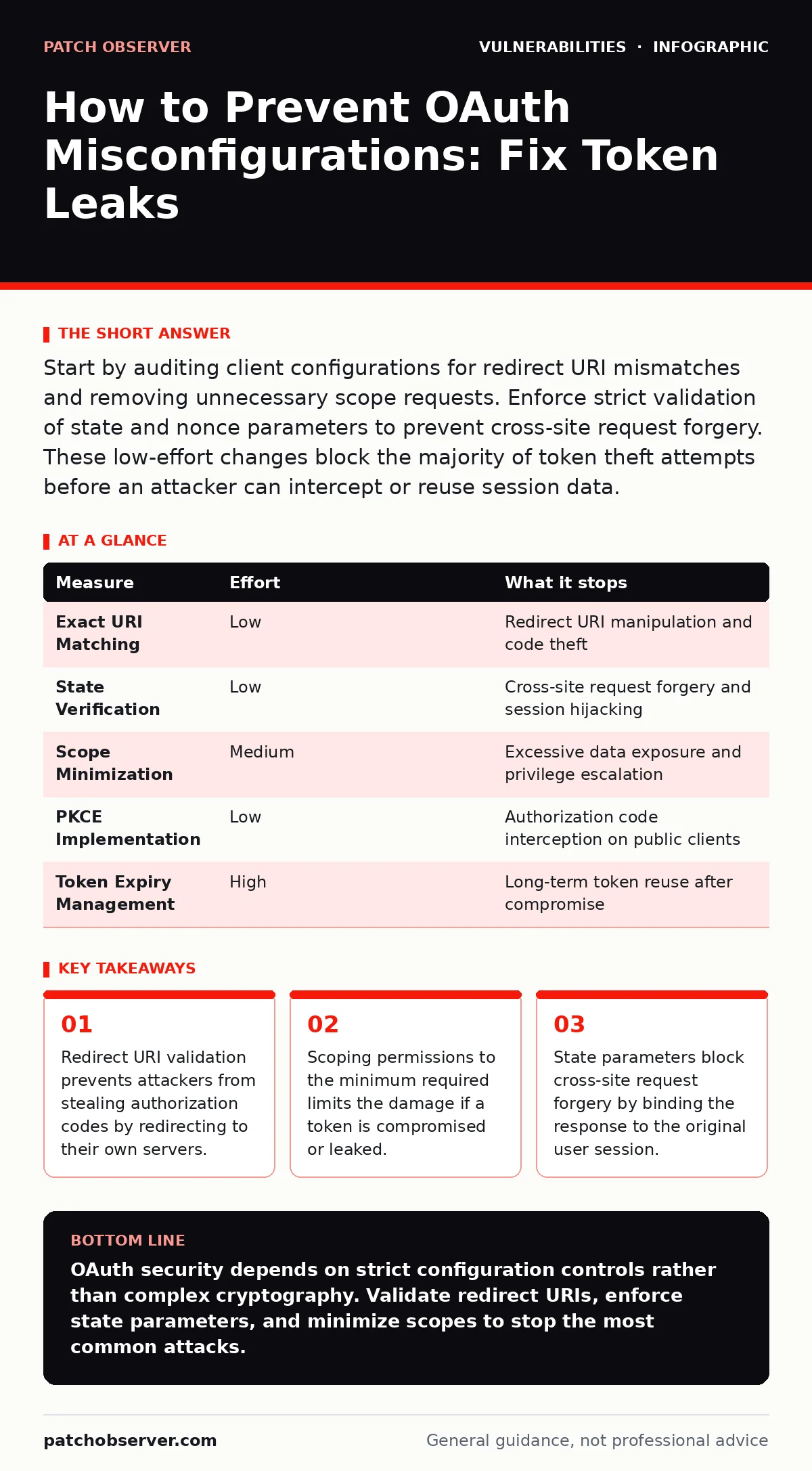
Start by auditing client configurations for redirect URI mismatches and removing unnecessary scope requests. Enforce strict validation of state and nonce parameters to prevent cross-site request forgery. These low-effort changes block the majority of token theft attempts before an attacker can intercept or reuse session data.
Validate Redirect URIs with Exact Matching
Authorization servers must verify that the redirect URI in the request matches a pre-registered URI exactly. Partial matching or wildcard support creates a dangerous opening. Attackers craft malicious links that redirect the authorization code to a server they control. This technique, known as an open redirect, bypasses the intent of the authentication flow. The user logs in successfully, but the code goes to the attacker instead of your application.
An attacker registers a subdomain evil.example.com and hosts a malicious script there. When a user clicks a link to this subdomain, the authorization server accepts it because it matches the wildcard. The attacker captures the authorization code and exchanges it for an access token. Your application receives no warning, and the attacker gains full access.
This validation step requires zero changes to the user experience. It happens server-side before the user sees any login screen. The trade-off is administrative overhead. You must maintain a strict list of allowed URIs for each client. Adding a new environment, such as a staging server, requires an explicit update to the authorization server configuration. This friction prevents accidental exposure of internal endpoints.
Enforce State Parameter Verification
The state parameter is a random value generated by your application before the authentication request. The authorization server echoes this value back in the response. Your application must verify that the returned state matches the original value. This mechanism prevents cross-site request forgery attacks. Without it, an attacker can force a user to initiate an authentication flow with a malicious redirect URI or scope.
Suppose an attacker sends a user a link that initiates an OAuth flow but sets the redirect URI to the attacker’s server. The user clicks the link and logs in. The authorization server sends the code to the attacker. If your application does not check the state, it cannot distinguish this malicious request from a legitimate one initiated by the user. The attacker uses the code to obtain a token, effectively hijacking the user’s session.
This check adds minimal latency to the authentication flow. The cost is negligible for the user but adds a layer of integrity to the transaction. It ensures that the response belongs to the request your application actually initiated. This protection remains effective even if the user is tricked into clicking a malicious link. The mismatch in state values causes your application to abort the login process immediately.
Minimize Requested Scopes
Scopes define what an application can do with the user’s data. Requesting more permissions than necessary increases the risk surface. If an attacker obtains the access token, they inherit all the permissions associated with those scopes. Limiting scopes to the absolute minimum required for functionality reduces the potential damage. This principle, known as least privilege, applies directly to OAuth configurations.
Consider an application that only needs to read a user’s public profile. Requesting write access to emails or contacts provides no benefit to the application but grants the attacker additional capabilities if the token is stolen. Users are also less likely to approve a request that asks for excessive permissions. High-privilege requests can lead to user abandonment or suspicion.
Implementing scope minimization requires careful analysis of application features. Developers must map each feature to the specific API permissions it requires. This process often reveals redundant permissions accumulated over time. Removing these permissions simplifies the security review and limits the blast radius of a breach. It also aligns with modern privacy expectations and regulatory requirements.
Implement PKCE for Public Clients
Proof Key for Code Exchange (PKCE) adds a secret to the authorization code flow. Public clients, such as single-page applications or mobile apps, cannot securely store a client secret. Traditional flows rely on this secret to prove identity. PKCE replaces the secret with a code verifier and a code challenge. The client generates a random verifier and sends a hashed version (the challenge) to the authorization server.
When the client exchanges the authorization code for a token, it sends the original verifier. The server hashes the verifier and compares it to the stored challenge. If they match, the server issues the token. This process prevents authorization code interception attacks. An attacker who steals the code cannot exchange it for a token because they do not possess the original verifier.
This measure is critical for any application running in a user-controlled environment. Browsers and mobile devices expose tokens to potential leakage through browser extensions or device compromises. PKCE ensures that even if the code is intercepted, it is useless without the corresponding verifier. The implementation effort is low for modern libraries, as most handle PKCE automatically. The trade-off is compatibility with older authorization servers that may not support this extension.
| Measure | Effort | What it stops |
|---|---|---|
| Exact URI Matching | Low | Redirect URI manipulation and code theft |
| State Verification | Low | Cross-site request forgery and session hijacking |
| Scope Minimization | Medium | Excessive data exposure and privilege escalation |
| PKCE Implementation | Low | Authorization code interception on public clients |
| Token Expiry Management | High | Long-term token reuse after compromise |
Manage Token Lifespans and Refresh
Access tokens should have short lifespans. A compromised token is only useful for a limited window if it expires quickly. Refresh tokens allow applications to obtain new access tokens without re-authentication. These tokens often have longer lifespans and higher privileges. Protecting refresh tokens is more complex than protecting access tokens. They must be stored securely and rotated regularly.
Imagine an application stores refresh tokens in local storage on a user’s device. A cross-site scripting vulnerability allows an attacker to read this storage. The attacker obtains the refresh token and exchanges it for a new access token. The user remains unaware, and the attacker maintains persistent access. Short-lived access tokens mitigate the impact of a single token theft, but refresh tokens require stricter handling.
Implementing strict token policies requires coordination between the client and the authorization server. You must define expiry times that balance security and user convenience. Too short, and users face frequent re-authentication. Too long, and the risk of token reuse increases. Regular rotation of refresh tokens ensures that a stolen token becomes invalid after a single use, triggering a re-authentication that alerts the user to potential compromise.
Audit Client Configurations Regularly
OAuth configurations drift over time. New clients are added, scopes are expanded, and redirect URIs change. Without regular audits, misconfigurations accumulate. These drifts create gaps that attackers can exploit. Automated tools can scan for common misconfigurations, but manual review is necessary to understand the context of each client. Establish a routine for reviewing client permissions and access patterns.
Suppose a development team adds a new client for a testing environment. They copy the configuration from the production client, including broad scopes and multiple redirect URIs. This test client is left active with production-level permissions. An attacker discovers this client and uses it to access production data. The audit process would identify the mismatch between the client’s purpose and its permissions, leading to immediate remediation.
This audit process also helps detect unused clients. Orphaned clients that no longer serve a purpose should be decommissioned. Each active client represents a potential entry point. Reducing the number of active clients reduces the attack surface. Integrate these audits into your change management process to ensure that new configurations are reviewed before deployment. This proactive approach prevents misconfigurations from becoming permanent fixtures in your security landscape.
Key takeaways
- Redirect URI validation prevents attackers from stealing authorization codes by redirecting to their own servers.
- Scoping permissions to the minimum required limits the damage if a token is compromised or leaked.
- State parameters block cross-site request forgery by binding the response to the original user session.
OAuth security depends on strict configuration controls rather than complex cryptography. Validate redirect URIs, enforce state parameters, and minimize scopes to stop the most common attacks.
Frequently asked questions
Does using HTTPS prevent OAuth misconfigurations?
No, HTTPS protects data in transit but does not stop logical errors like incorrect redirect URIs or excessive scopes. You must configure the protocol correctly regardless of encryption.
How often should I review OAuth client permissions?
Review permissions whenever a new client is added or existing features change. Conduct a full audit at least quarterly to catch drift and remove unused clients.
Can I use a client secret for a mobile app?
No, mobile apps cannot securely store secrets. Use PKCE instead to secure the authorization code flow. Exposing a secret in an app allows attackers to extract it and impersonate your application.
What is the difference between state and nonce parameters?
State prevents cross-site request forgery by binding the response to the request. Nonce prevents replay attacks by ensuring each token request is unique. Both are needed for full protection.
How this guide was produced: written by the Patch Observer editorial team with AI assistance, checked against the public references listed below, and reviewed when the facts change. See our editorial policy or report an error.