GDPR Breach Notification: Why the Clock Changes Security
The 72-hour window forces teams to treat detection speed as a business metric, shifting focus from perfect prevention to rapid containment.

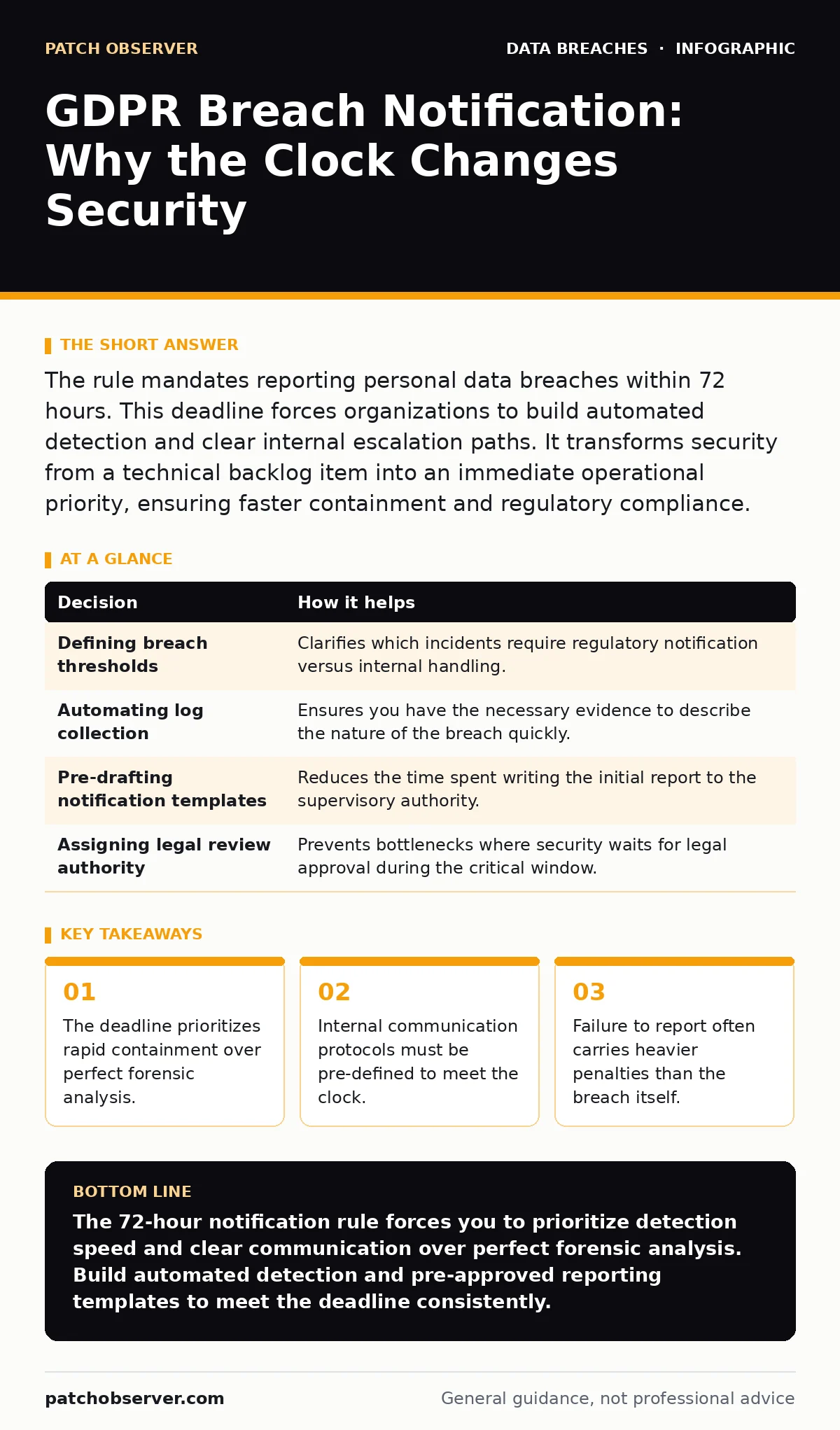
The rule mandates reporting personal data breaches within 72 hours. This deadline forces organizations to build automated detection and clear internal escalation paths. It transforms security from a technical backlog item into an immediate operational priority, ensuring faster containment and regulatory compliance.
The Clock Starts at Detection, Not Impact
The General Data Protection Regulation (GDPR) requires organizations to notify the supervisory authority of a personal data breach within 72 hours of becoming aware of it. This window begins the moment your team confirms an incident, not when the attacker first entered the network. Many organizations mistakenly believe the clock starts when they discover the full scope of the damage. This misunderstanding leads to delayed reporting and significant regulatory fines.
You must distinguish between a security alert and a confirmed breach. An alert is a signal that something might be wrong. A breach is the confirmed processing or loss of personal data. The 72-hour rule applies only to the latter. If you spend three days investigating an alert and find no personal data was touched, you do not need to report. However, if you find personal data was exposed on hour two, you have 70 hours left.
Decisions Driven by the Deadline
The notification requirement forces you to make specific operational decisions before an incident occurs. You cannot wait for a crisis to define who speaks to regulators or what information is required. The pressure of the deadline shapes your incident response plan. It dictates the tools you buy and the training you provide.
| Decision | How it helps |
|---|---|
| Defining breach thresholds | Clarifies which incidents require regulatory notification versus internal handling. |
| Automating log collection | Ensures you have the necessary evidence to describe the nature of the breach quickly. |
| Pre-drafting notification templates | Reduces the time spent writing the initial report to the supervisory authority. |
| Assigning legal review authority | Prevents bottlenecks where security waits for legal approval during the critical window. |
What Goes Wrong Without Structure
Without a clear process, teams often freeze when the clock starts. Security analysts may continue digging for the root cause while the reporting deadline approaches. This is a common failure mode. The team believes they need more information to provide a complete report. The regulation does not require a complete forensic analysis. It requires a description of the nature of the breach, the categories of data, and the approximate number of data subjects.
Imagine your team discovers a misconfigured cloud storage leak containing customer emails. You spend 48 hours trying to identify every single email address in the bucket. By hour 70, you still do not have a precise count. You miss the deadline because you were seeking perfection instead of the required approximation. The regulator expects you to report what you know at the time. You can provide further information later if it becomes available.
How Teams Use the Rule Effectively
Effective teams treat the 72-hour window as a constraint for their detection capabilities. They invest in tools that reduce the time to detect anomalies. This aligns security spending with regulatory requirements. You do not need to prevent every attack, but you must detect the ones that matter quickly.
Teams also use the rule to streamline internal communication. They create a checklist that triggers specific actions. When a breach is confirmed, the checklist assigns tasks to security, legal, and communications. This prevents the chaos of ad-hoc decision-making. The security team focuses on containment. The legal team focuses on the notification text. The communications team prepares for potential public disclosure.
The Hidden Cost of Silence
The most surprising consequence of the notification rule is not the fine for the breach itself. It is the penalty for failing to report. Regulators view non-notification as a deliberate attempt to hide negligence. This often results in higher fines than the initial breach would have warranted.
Silence also prevents you from learning from the incident. Reporting forces you to document what happened. This documentation becomes a record for future improvements. If you do not report, you miss the opportunity to formalize the lessons learned. Your team may repeat the same mistakes because the incident was never fully analyzed in a structured way.
See also: Attack Vectors Explained: Mechanisms, Limits, and Defense Strategies · Social Engineering Tactics: How Attackers Bypass Technical Defenses
Integrating with Broader Security Measures
The notification rule does not exist in a vacuum. It interacts with other security controls. For instance, data encryption reduces the severity of a breach. If stolen data is encrypted, you may not need to notify the authority if the encryption keys were not compromised. This is a powerful incentive for strong encryption practices.
Similarly, data loss prevention tools can help you identify when personal data leaves the network. These tools provide the evidence you need to confirm a breach quickly. Without them, you may rely on manual log reviews, which are too slow for the 72-hour window. You should also consider mobile device management if your workforce uses personal devices. A lost phone can trigger a breach notification if it contains unencrypted company data.
The Role of External Resources
You may need to verify whether specific data elements have been exposed in previous incidents. Tools like Have I Been Pwned can help you check if email addresses are known to be compromised. This information can inform your risk assessment. If the data was already public, the risk to the data subjects may be lower. This does not exempt you from reporting, but it can influence the severity of the notification.
You should also review your data breaches history. Past incidents reveal weaknesses in your detection and response. If you repeatedly fail to detect breaches in time, you need to improve your monitoring. The notification rule highlights these gaps. It shows you where your current defenses are too slow.
Preparing for the Unknown
You cannot predict when a breach will occur. But you can prepare for the notification process. Test your incident response plan regularly. Simulate a breach and time how long it takes to reach the reporting stage. Identify bottlenecks in your approval chain. Remove unnecessary steps that delay the notification.
Ensure your team understands the difference between a technical incident and a reportable breach. Train them to recognize the signs of personal data exposure. Provide them with clear guidance on when to escalate. The goal is not to avoid breaches, but to respond to them effectively. The 72-hour rule is a tool for accountability. Use it to drive better security practices.
Key takeaways
- The deadline prioritizes rapid containment over perfect forensic analysis.
- Internal communication protocols must be pre-defined to meet the clock.
- Failure to report often carries heavier penalties than the breach itself.
The 72-hour notification rule forces you to prioritize detection speed and clear communication over perfect forensic analysis. Build automated detection and pre-approved reporting templates to meet the deadline consistently.
Frequently asked questions
Does the 72-hour clock start when the attack happens or when we find it?
The clock starts when you become aware of the breach. You are not expected to report incidents you did not know about. Awareness requires reasonable steps to detect such incidents.
What if we do not know the exact number of people affected?
You can provide an estimate. The regulation allows for approximate numbers. You can provide further details later if they become available during your investigation.
Do we need to notify every individual whose data was breached?
No. You only need to notify individuals if the breach is likely to result in a high risk to their rights and freedoms. Low-risk breaches do not require individual notification, only regulatory notification.
Can we delay reporting to investigate further?
You cannot delay the initial notification beyond 72 hours. You can provide partial information and update it later. The initial report must include what you know at the time, even if it is incomplete.
How this guide was produced: written by the Patch Observer editorial team with AI assistance, checked against the public references listed below, and reviewed when the facts change. See our editorial policy or report an error.