How Hashing Works: The Mechanics Behind Data Integrity
Hashing transforms variable data into a fixed fingerprint that changes completely if even one bit of the original input is altered.

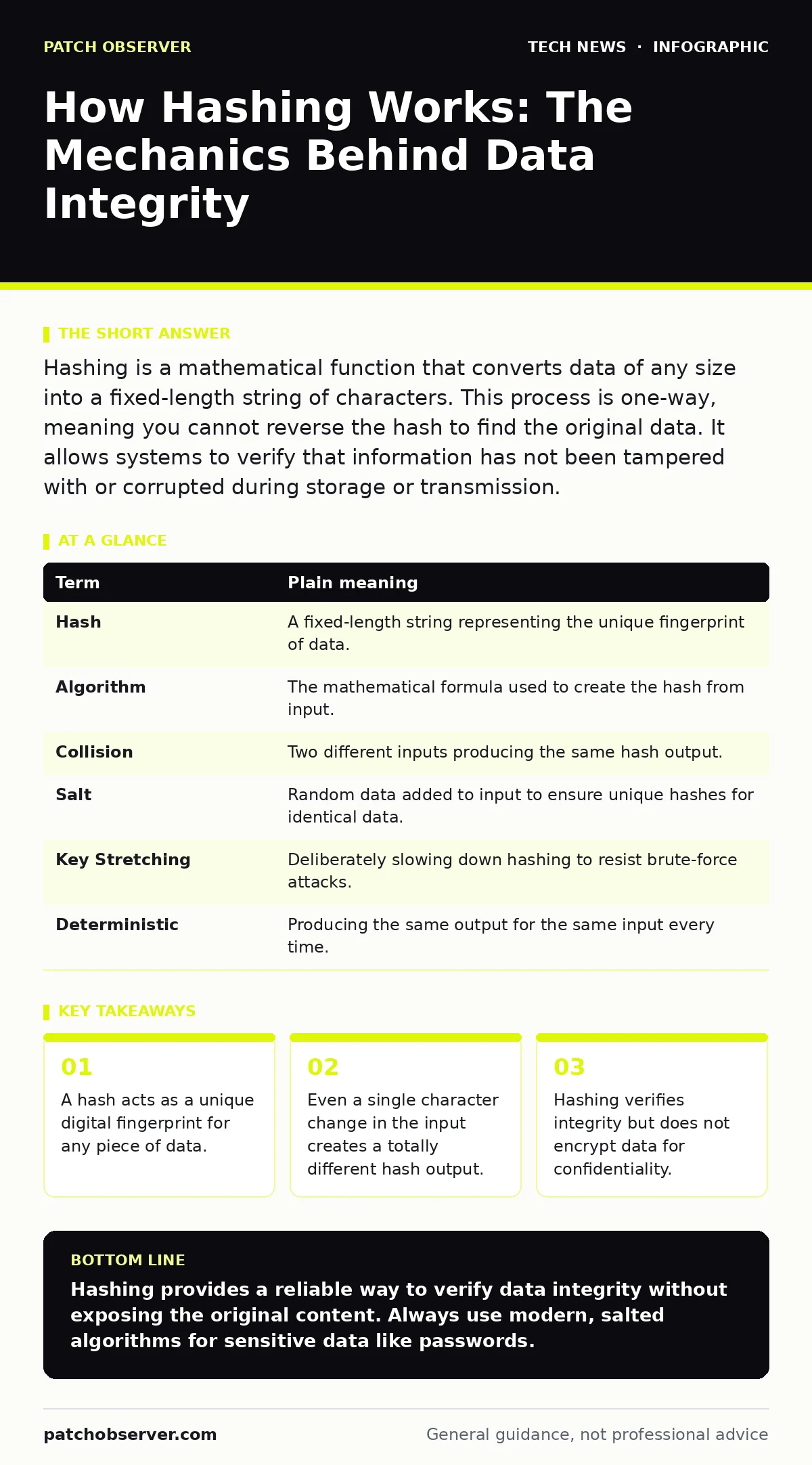
Hashing is a mathematical function that converts data of any size into a fixed-length string of characters. This process is one-way, meaning you cannot reverse the hash to find the original data. It allows systems to verify that information has not been tampered with or corrupted during storage or transmission.
The Digital Recipe Card
Imagine you are a chef who creates a unique signature scent for every dish you cook. You do not write down the recipe. Instead, you mix the ingredients and capture the final aroma in a sealed glass jar. Anyone who smells that jar knows exactly which dish it represents. If someone swaps a pinch of salt for sugar, the scent changes entirely. The jar does not tell you how to make the dish, but it proves the dish inside is exactly what you promised.
This analogy explains how hashing works in computing. You take input data, run it through a mathematical algorithm, and receive a fixed-length output called a hash. The hash is the sealed jar. It represents the data but does not contain the data itself. You cannot recreate the original ingredients from the scent alone.
The Mechanics of the Fingerprint
The core mechanism relies on determinism. If you hash the same input twice, you get the same output every time. This consistency allows systems to compare values. If the new hash matches the stored hash, the data is identical. If they differ, even slightly, the data has changed.
This sensitivity is known as the avalanche effect. Changing one bit in the input changes approximately half the bits in the output. This makes it impossible to guess what change caused a specific hash difference. It also prevents attackers from making small tweaks to data to bypass checks. The system sees a completely different fingerprint and rejects the altered data.
Common Points of Confusion
Many people confuse hashing with encryption. This is a critical distinction. Encryption is two-way. You encrypt data with a key, and you decrypt it with the same or a related key to read the original message. Hashing is one-way. There is no key to unlock a hash. You cannot retrieve the original text from the hash value.
Another common error is assuming hashes are unique. While good algorithms make collisions extremely rare, they are not theoretically impossible. A collision occurs when two different inputs produce the same hash. Modern algorithms are designed to make finding a collision computationally impractical. However, older algorithms have been broken, allowing attackers to craft collisions. This is why you must choose current standards.
Why We Use Hashes
You use hashing to verify integrity, not to hide secrets. When you download a file, the provider often lists a hash value. You compute the hash of the downloaded file and compare it to the listed value. If they match, the file arrived without corruption or tampering. If they do not match, the file is compromised.
This principle applies to password storage as well. Systems should never store plain-text passwords. Instead, they store the hash of the password. When you log in, the system hashes your input and compares it to the stored hash. If they match, you are granted access. The system never sees your actual password. This protects users if the database is stolen. See our guide on API key security for similar principles applied to authentication tokens.
The Hidden Cost of Speed
Hashing must be fast to be useful in real-time applications. However, this speed is a liability for password storage. If hashing is fast, an attacker can try billions of guesses per second. This is called a brute-force attack. The attacker hashes common passwords and compares them to the stolen hash until they find a match.
To counter this, you use key stretching. This technique deliberately slows down the hashing process. Algorithms like Argon2 or bcrypt add computational work. This makes guessing passwords exponentially slower for attackers while having a negligible impact on user login times. This trade-off is necessary for security. You sacrifice speed to increase the cost of an attack.
See also: Telegram link and domain outages: Understanding routing failures · Getting a Reddit API Key: Account Types and Rate Limits Explained
Choosing the Right Tool
Not all hashing algorithms are equal. Older algorithms like MD5 and SHA-1 are considered broken. They are too fast and prone to collisions. You should avoid them for any security-sensitive purpose. For general data integrity, SHA-256 is a widely accepted standard. It provides a good balance of speed and security.
For passwords, you need a specialized algorithm. Use bcrypt, scrypt, or Argon2. These include a salt. A salt is random data added to the password before hashing. This ensures that identical passwords produce different hashes. It prevents attackers from using pre-computed tables to crack multiple accounts at once. Refer to hardware security modules if you need to manage these keys at scale.
| Term | Plain meaning |
|---|---|
| Hash | A fixed-length string representing the unique fingerprint of data. |
| Algorithm | The mathematical formula used to create the hash from input. |
| Collision | Two different inputs producing the same hash output. |
| Salt | Random data added to input to ensure unique hashes for identical data. |
| Key Stretching | Deliberately slowing down hashing to resist brute-force attacks. |
| Deterministic | Producing the same output for the same input every time. |
Try This Now
- Find a command-line tool on your system that supports SHA-256. Type a short phrase and generate its hash.
- Change one letter in the phrase and generate the hash again. Observe how the output changes completely.
- Add a random string of characters to the end of the original phrase and hash it. This simulates adding a salt.
Verifying Your Setup
You must verify that your hashing implementation is correct. Test your system with known inputs and expected outputs. Ensure that your salt is unique for every entry. Store the salt alongside the hash in your database. The salt does not need to be secret, but it must be random and unique.
Regularly review your algorithms. Cryptography evolves. What is secure today may be broken tomorrow. Stay updated on industry standards. This discipline ensures your data remains protected against emerging threats. See Linux server hardening for more on maintaining secure system configurations.
Key takeaways
- A hash acts as a unique digital fingerprint for any piece of data.
- Even a single character change in the input creates a totally different hash output.
- Hashing verifies integrity but does not encrypt data for confidentiality.
Hashing provides a reliable way to verify data integrity without exposing the original content. Always use modern, salted algorithms for sensitive data like passwords.
Frequently asked questions
Can I recover a password from its hash?
No. Hashing is a one-way function. You cannot reverse the process to get the original password. You can only guess inputs and compare their hashes.
Is SHA-256 safe for passwords?
It is safe for data integrity, but too fast for passwords. Use a key-stretching algorithm like bcrypt or Argon2 for passwords to slow down attackers.
What is a salt and why do I need it?
A salt is random data added to the input before hashing. It ensures that identical inputs produce different hashes, preventing the use of pre-computed attack tables.
How do I know if a hash algorithm is broken?
Follow reputable security advisories. Algorithms like MD5 and SHA-1 are known to be broken. Stick to current standards like SHA-256 or SHA-3.
How this guide was produced: written by the Patch Observer editorial team with AI assistance, checked against the public references listed below, and reviewed when the facts change. See our editorial policy or report an error.