Public Key Cryptography Algorithms: How Asymmetric Encryption Works
Public key cryptography algorithms solve the key distribution problem by using two mathematically linked keys, eliminating the need to share secrets over insecure channels.

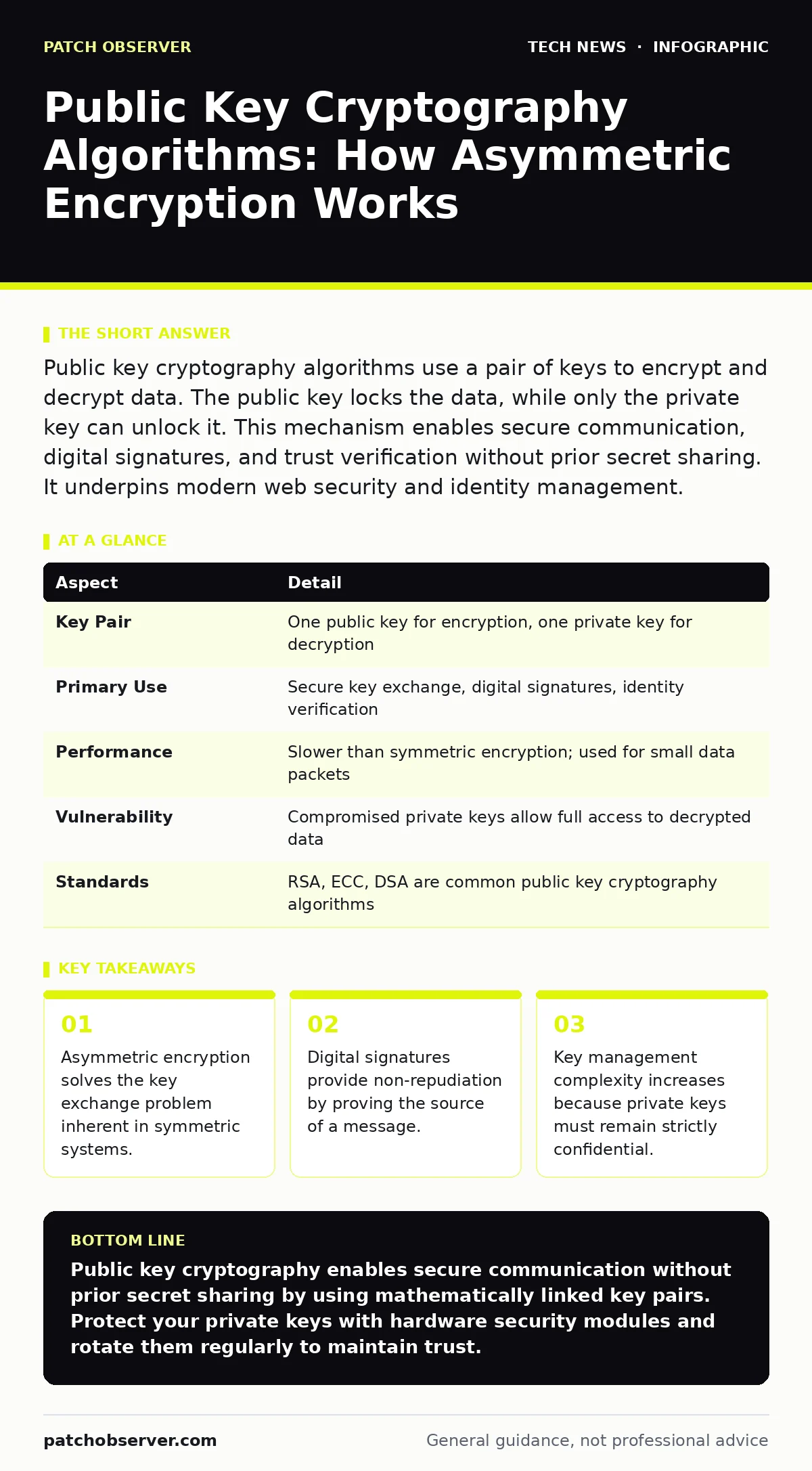
Public key cryptography algorithms use a pair of keys to encrypt and decrypt data. The public key locks the data, while only the private key can unlock it. This mechanism enables secure communication, digital signatures, and trust verification without prior secret sharing. It underpins modern web security and identity management.
The Mailbox Analogy
Imagine a mailbox with a slot that anyone can use to drop a letter. The slot is open to the public, but only the owner has the key to open the box and read the contents. This simple mechanical model explains the core function of public key cryptography. The open slot represents the public key, which you can share freely. The locked box represents the private key, which you keep secret. Anyone can send you encrypted data, but only you can decrypt it.
This analogy highlights the separation of concerns. In symmetric encryption, you must share the same key to lock and unlock. In asymmetric systems, the locking and unlocking functions are distinct. This distinction removes the risk of intercepting the key during transmission. You do not need a secure channel to exchange keys before communicating. The mathematics ensures that deriving the private key from the public key is computationally infeasible.
At a Glance
| Aspect | Detail |
|---|---|
| Key Pair | One public key for encryption, one private key for decryption |
| Primary Use | Secure key exchange, digital signatures, identity verification |
| Performance | Slower than symmetric encryption; used for small data packets |
| Vulnerability | Compromised private keys allow full access to decrypted data |
| Standards | RSA, ECC, DSA are common public key cryptography algorithms |
How Public Key Cryptography Algorithms Work
Public key cryptography algorithms rely on one-way mathematical functions. These functions are easy to compute in one direction but extremely difficult to reverse without specific secret information. The most common approach involves factoring large prime numbers or solving discrete logarithm problems. When you generate a key pair, the system creates two numbers that are mathematically linked. The public key is derived from the private key, but the reverse process is not possible with current computing power.
You use the public key to encrypt a message or verify a signature. You use the private key to decrypt a message or create a signature. The system validates that the two keys belong together without revealing the private key. This mechanism allows two parties who have never met to establish a secure connection. The handshake process typically uses asymmetric encryption to agree on a symmetric session key. The symmetric key then handles the bulk of the data transfer because it is faster.
What People Usually Get Wrong
Many assume that public key cryptography encrypts all data in a session. This is incorrect. Asymmetric operations are computationally expensive. They consume significant processing power and time. Systems use them only for the initial handshake and for signing small pieces of data. The actual data transfer uses symmetric encryption with a temporary session key. This hybrid approach balances security and performance.
Another common error is treating the public key as sensitive. The public key is meant to be distributed widely. It is not a secret. The security of the system depends entirely on the secrecy of the private key. If you lose your private key, you lose access to your encrypted data and your identity. If you share your private key, the entire security model collapses. The public key can be compromised without breaking confidentiality, but it breaks authenticity if an attacker substitutes their own public key.
Digital Signatures and Non-Repudiation
Encryption is only one function of public key cryptography algorithms. Digital signatures provide proof of origin and integrity. When you sign a document, you use your private key to create a unique hash of the content. The recipient uses your public key to verify that the signature matches the document. This process proves that you created the signature and that the document has not been altered since you signed it.
This feature enables non-repudiation. You cannot deny sending the message because only you hold the private key that generated the signature. This is critical for legal contracts, software updates, and code verification. It prevents attackers from injecting malicious code into legitimate software packages. The system checks the signature against a trusted certificate authority. If the signature is invalid, the system rejects the update. This trust chain relies on the security of the root certificates.
See also: Full Disk Encryption Best Practices for Secure Data Storage · Data Encryption Explained: How to Scramble Secrets
Key Management Challenges
The complexity of public key cryptography lies in key management. You must generate, store, distribute, and rotate keys securely. Generating weak keys compromises the entire system. You must use sufficient bit lengths to resist brute-force attacks. Storing keys securely requires protecting against physical and digital theft. Losing a private key means permanent data loss. There is no password reset for cryptography.
Key rotation is necessary but difficult. You must update public keys across all systems that trust you. Old keys must be revoked and added to certificate revocation lists. This process is often slow and prone to errors. Many organizations fail to rotate keys regularly, leaving them vulnerable to long-term exposure. The hidden cost of asymmetric encryption is the administrative overhead of maintaining the trust infrastructure. You must also consider the impact on related systems like API key security when integrating cryptographic services.
Performance Trade-Offs
Public key cryptography algorithms are slower than symmetric counterparts. The mathematical operations required for key generation and signature verification are intensive. This latency matters in high-throughput environments. Systems must balance security requirements with performance needs. Using larger key sizes increases security but decreases performance. You must choose an algorithm that meets your security threshold without causing unacceptable delays.
Elliptic Curve Cryptography (ECC) offers a performance advantage over traditional RSA. ECC achieves the same security level with smaller key sizes. This reduces computational load and storage requirements. However, ECC implementation is complex and prone to subtle bugs. You must use well-tested libraries to avoid vulnerabilities. The choice of algorithm affects your entire security architecture. It influences how you handle network ports and protocols during the handshake phase.
The Role of Certificate Authorities
Trust in public key cryptography depends on certificate authorities. These entities verify the identity of key owners and issue digital certificates. The certificate binds a public key to an identity. Browsers and operating systems maintain a list of trusted authorities. If a certificate is issued by an untrusted authority, the connection is rejected. This system prevents man-in-the-middle attacks where an attacker presents their own public key.
The security of this model relies on the integrity of the certificate authorities. If an authority is compromised, an attacker can issue fraudulent certificates. This breaks the trust chain for all users relying on that authority. You must monitor certificate validity and revocation status. Automated tools can help manage this process. This infrastructure supports browser security settings by enabling HTTPS connections. It also underpins Wi-Fi security in enterprise environments using 802.1X authentication.
Key takeaways
- Asymmetric encryption solves the key exchange problem inherent in symmetric systems.
- Digital signatures provide non-repudiation by proving the source of a message.
- Key management complexity increases because private keys must remain strictly confidential.
Public key cryptography enables secure communication without prior secret sharing by using mathematically linked key pairs. Protect your private keys with hardware security modules and rotate them regularly to maintain trust.
Frequently asked questions
What is the difference between symmetric and asymmetric encryption?
Symmetric encryption uses one key for both encryption and decryption, while asymmetric encryption uses a pair of keys: one public and one private.
Can I use the same key pair for encryption and signing?
It is possible but not recommended. Using separate keys for encryption and signing limits the damage if one key is compromised.
How do I know if a public key is authentic?
You verify the public key through a digital certificate issued by a trusted certificate authority. The certificate binds the key to an identity.
Are public key cryptography algorithms secure against quantum computers?
Current algorithms are vulnerable to quantum computing attacks. Post-quantum cryptography algorithms are being developed to address this threat.
How this guide was produced: written by the Patch Observer editorial team with AI assistance, checked against the public references listed below, and reviewed when the facts change. See our editorial policy or report an error.