How Does Hashing Work: The Mechanics of Digital Fingerprints
Hashing creates a unique digital fingerprint for data, ensuring that even a single bit change produces a completely different output value for verification.

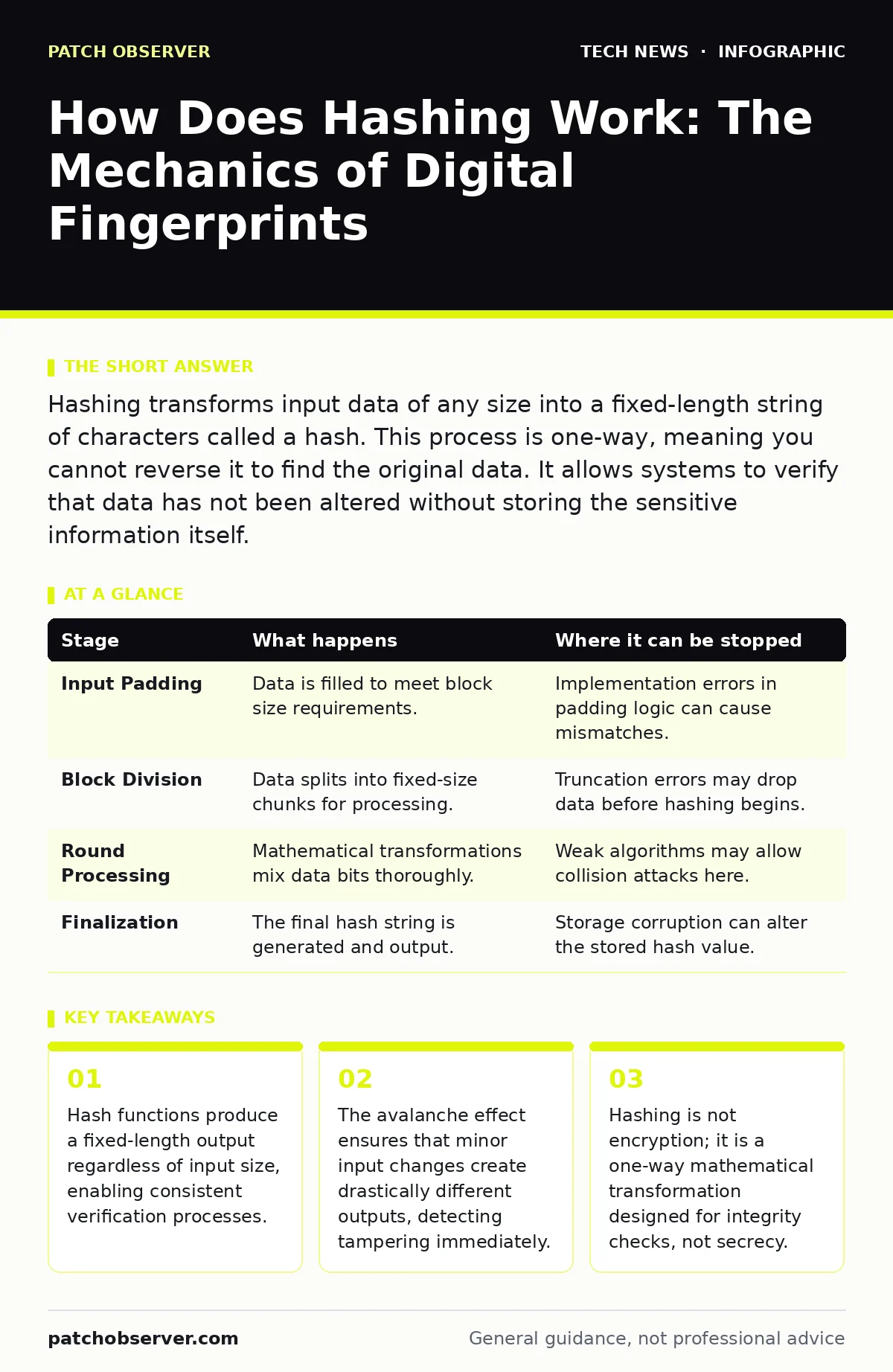
Hashing transforms input data of any size into a fixed-length string of characters called a hash. This process is one-way, meaning you cannot reverse it to find the original data. It allows systems to verify that data has not been altered without storing the sensitive information itself.
How Does Hashing Work: Core Mechanism Explained
Hashing converts variable-length input into a fixed-length output. You take raw data, pass it through a mathematical algorithm, and receive a unique string. This string acts as a digital fingerprint. The algorithm processes the data in blocks. It performs bitwise operations, modular arithmetic, and logical shifts on each block. The final result depends on every bit of the original input.
This mechanism differs from encryption. Encryption aims to hide data so only authorized parties can read it using a key. Hashing aims to prove data has not changed. You cannot retrieve the original message from the hash. This one-way property protects sensitive information. Systems store hashes instead of actual passwords. When you log in, the system hashes your input and compares it to the stored value.
Stages of the Hashing Process
The transformation happens in distinct stages. Understanding these stages reveals where security holds and where it breaks. Each stage modifies the data further, making reversal computationally impossible.
Stage 1: Input Padding
The algorithm prepares the data for processing. Most hash functions require input in specific block sizes. If your data is shorter than the required block size, the algorithm adds padding bits. This padding follows a strict standard. It marks the end of the original message. Without this step, the algorithm cannot process irregular data lengths. Padding ensures the input aligns with the mathematical requirements of the next stage.
Stage 2: Block Division
The padded data splits into fixed-size chunks. The algorithm processes these chunks sequentially. Each block interacts with the previous block’s output. This chaining effect means the final hash depends on the entire message order. Changing one bit in the first block alters the processing of every subsequent block. This structure prevents attackers from modifying early parts of a file without changing the final hash.
Stage 3: Round Processing
The algorithm applies complex transformations to each block. These transformations include substitution, permutation, and mixing operations. The internal state of the hash function updates with each round. The design ensures that small input differences amplify rapidly. This is known as the avalanche effect. A single bit flip in the input should flip roughly half the bits in the output. This sensitivity detects any unauthorized modification.
Stage 4: Finalization
After processing all blocks, the algorithm produces the final hash value. This output is the digest. It is a fixed-length string, often represented in hexadecimal format. The length is determined by the specific algorithm used. Common standards produce 256-bit or 512-bit outputs. This step finalizes the mathematical journey. The result is the unique identifier for that specific set of data.
| Stage | What happens | Where it can be stopped |
|---|---|---|
| Input Padding | Data is filled to meet block size requirements. | Implementation errors in padding logic can cause mismatches. |
| Block Division | Data splits into fixed-size chunks for processing. | Truncation errors may drop data before hashing begins. |
| Round Processing | Mathematical transformations mix data bits thoroughly. | Weak algorithms may allow collision attacks here. |
| Finalization | The final hash string is generated and output. | Storage corruption can alter the stored hash value. |
Collision Resistance and Security Limits
A hash collision occurs when two different inputs produce the same hash. Good algorithms make this computationally infeasible. However, no hash function is perfectly collision-resistant. As computing power increases, older algorithms become vulnerable. Attackers use brute force or mathematical weaknesses to find collisions.
Rainbow tables are precomputed lists of hashes for common passwords. They speed up reverse lookups. Salting defends against this. Salting adds random data to the input before hashing. Each user gets a unique salt. This forces attackers to compute hashes for every password individually. It prevents the reuse of precomputed tables. Proper salting is a critical defense layer.
Where Hashing Fails or Stops
Hashing provides integrity, not confidentiality. If an attacker intercepts the hash, they still cannot see the original data. However, they can try to guess inputs that match the hash. Weak inputs, like "password123", hash to well-known values. Dictionary attacks exploit this.
Algorithm choice matters significantly. Older standards like MD5 or SHA-1 have known vulnerabilities. Modern systems should use SHA-256 or SHA-3. These provide stronger collision resistance. Misconfiguration can also stop the process. If the system stores hashes in plain text, database breaches expose them. Combining hashing with strong access controls protects the stored values.
Imagine a system that reuses the same salt for all users. An attacker who compromises one password can use that knowledge to crack others with similar passwords. This undermines the security model. Unique salts per record are necessary for effective protection.
Integration with System Security
Hashing supports many security controls. It verifies file integrity during software updates. It ensures digital signatures remain valid. It secures credentials in user databases. Understanding how hashing works helps you configure these systems correctly.
Proper configuration of firewall rules often relies on certificate validation, which uses hashing. Similarly, API key security benefits from hashing stored keys to prevent exposure during leaks. Network access control systems may hash device identifiers for tracking. Browser security settings often involve certificate pinning, which depends on hash comparisons. Edge computing security models use hashing to verify code integrity at the network edge.
See also: Telegram link and domain outages: Understanding routing failures · Getting a Reddit API Key: Account Types and Rate Limits Explained
Maintenance and Algorithm Updates
Algorithms age. What is secure today may be broken tomorrow. You must monitor cryptographic standards. When a weakness is discovered, you must migrate to a stronger algorithm. This requires re-hashing stored data.
Smartphone security updates often patch cryptographic libraries. Keeping devices updated ensures you use the latest secure hashing implementations. Legacy systems may lack support for modern algorithms. This forces a choice between compatibility and security. Planned migration paths reduce risk. Regular audits verify that systems use approved algorithms.
The Role of Salting and Stretching
Salting adds randomness. Stretching adds computational cost. Functions like bcrypt or Argon2 intentionally slow down hashing. This delays brute-force attacks. Attackers must spend more time and resources to test each guess.
This trade-off affects performance. Slower hashing increases login times slightly. It also consumes more server resources. You must balance security against user experience. For high-volume systems, tune the cost factor carefully. Ensure your infrastructure can handle the load. Without stretching, fast algorithms allow billions of guesses per second.
Verifying Data Integrity in Practice
You use hashes to verify downloads. The publisher provides the hash. You compute the hash of your downloaded file. If they match, the file is intact. If they differ, the file was corrupted or tampered with.
This process requires trust in the source. If an attacker controls the source, they can change both the file and the provided hash. Secure channels, like HTTPS, protect the hash transmission. Combining hashing with secure transport ensures end-to-end integrity.
Conclusion on Hashing Mechanics
Hashing is a foundational security tool. It protects data integrity without exposing content. Understanding its stages and limitations allows you to implement it correctly. Choose modern algorithms. Apply unique salts. Monitor for vulnerabilities. These practices maintain security over time.
Key takeaways
- Hash functions produce a fixed-length output regardless of input size, enabling consistent verification processes.
- The avalanche effect ensures that minor input changes create drastically different outputs, detecting tampering immediately.
- Hashing is not encryption; it is a one-way mathematical transformation designed for integrity checks, not secrecy.
Frequently asked questions
Can I reverse a hash to find the original password?
No, hashing is a one-way function. You cannot mathematically reverse it to retrieve the original input. Attackers guess inputs and compare their hashes to the target hash.
What is the difference between hashing and encryption?
Encryption is two-way and requires a key to decrypt. Hashing is one-way and produces a fixed-length fingerprint. Encryption hides data; hashing verifies data integrity.
Why do we need salts if we already use hashing?
Salts prevent attackers from using precomputed rainbow tables. They ensure that identical inputs produce different hashes, forcing attackers to crack each password individually.
How do I know if my hashing algorithm is still secure?
Monitor cryptographic standards and security advisories. Deprecated algorithms like MD5 and SHA-1 should be replaced. Use current standards like SHA-256 or specialized password hashing functions.
How this guide was produced: written by the Patch Observer editorial team with AI assistance, checked against the public references listed below, and reviewed when the facts change. See our editorial policy or report an error.