Getting a Reddit API Key: Account Types and Rate Limits Explained
Obtaining API access requires navigating account types, strict rate limits, and distinct security scopes without triggering automated blocks.

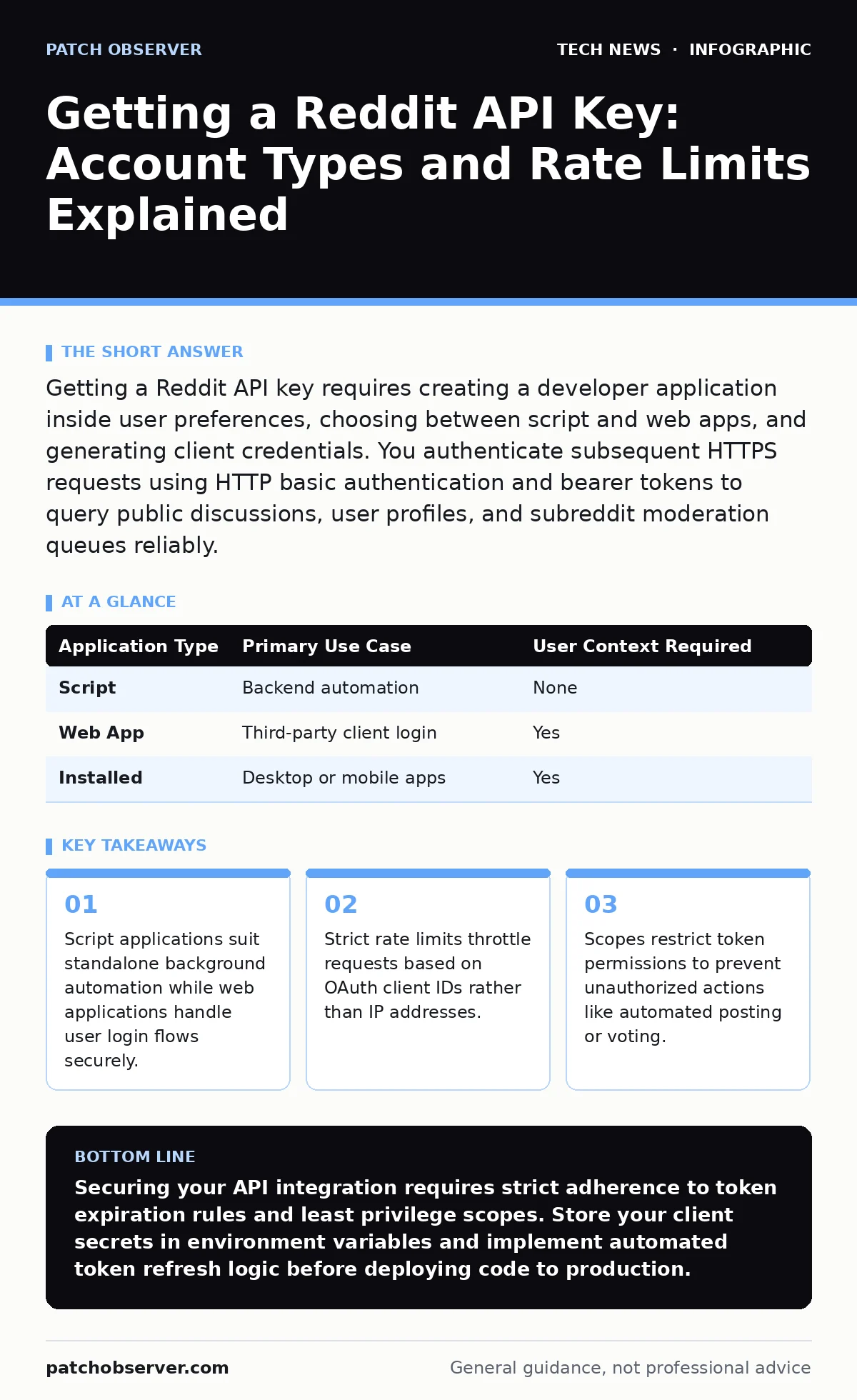
Getting a Reddit API key requires creating a developer application inside user preferences, choosing between script and web apps, and generating client credentials. You authenticate subsequent HTTPS requests using HTTP basic authentication and bearer tokens to query public discussions, user profiles, and subreddit moderation queues reliably.
Why does an API account require a distinct developer application registration?
An API account requires a distinct developer application registration to map your programmatic requests to a specific entity for rate-limiting and auditing. Platform operators assign unique client identifiers and secret keys to each registered script or web integration. This separation ensures that misbehaving automation scripts do not compromise normal user browsing traffic or standard mobile client sessions.
Authentication tokens derived from these credentials dictate what data your software can read or write. Imagine writing a script to monitor specific keywords across thousands of public comment threads. Without a registered application profile, the upstream servers reject connection attempts before evaluating any query parameters.
| Application Type | Primary Use Case | User Context Required |
|---|---|---|
| Script | Backend automation | None |
| Web App | Third-party client login | Yes |
| Installed | Desktop or mobile apps | Yes |
What distinguishes a script application from a web application?
A script application suits server-to-server automation tasks that operate without direct user login prompts. Web applications require an authorization flow where individual human users grant your software permission to act on their behalf. Choosing the wrong application type during creation permanently locks your authentication mechanism into an incompatible request pattern.
Web applications implement a redirect URI mechanism to capture temporary authorization codes from user browsers. Script applications bypass browser interactions entirely by accepting direct client credential exchanges via secure POST requests. Configuring firewall rules on your backend servers helps protect these hardcoded script secrets from unauthorized exfiltration.
How do rate limits operate for authenticated requests?
Rate limits operate by tracking request frequency against your specific client identifier rather than your public IP address. Authenticated applications typically receive significantly higher request ceilings compared to unauthenticated scraping attempts. Exceeding these thresholds triggers HTTP status responses containing headers that specify exact retry intervals.
Ignoring rate-limiting signals leads to progressive IP blacklisting that disrupts data collection pipelines. Background synchronization tools must implement exponential backoff algorithms to handle server congestion gracefully. Proper error handling ensures your automation recovers automatically when upstream capacity constraints ease.
Why do authentication tokens expire continuously?
Authentication tokens expire continuously as a security measure to limit the window of damage if credentials leak. Access tokens usually remain valid for a brief operational window before requiring a refresh token exchange. Refresh tokens persist longer but eventually invalidate if unused for extended periods or if the parent user account resets its password.
Building resilient software requires writing robust exception handlers that intercept expired token errors. Your application must request a fresh bearer token transparently without dropping active data processing queues. This silent renewal cycle prevents script crashes during long-running background synchronization tasks.
What security risks emerge from exposed client secrets?
Exposed client secrets allow malicious actors to impersonate your registered application and abuse platform infrastructure. Attackers who harvest hardcoded API secrets from public code repositories can launch automated spam campaigns or scrape restricted data streams under your identity. Platform administrators respond to such incidents by revoking the compromised application credentials immediately.
Protecting your credentials requires storing client secrets inside environment variables rather than source code files. Regularly rotating your application secrets limits the exposure window if a development machine suffers a security compromise.
See also: SAML vs OpenID Connect: How to Choose the Right Authentication Protocol · Telegram link and domain outages: Understanding routing failures
How do access scopes limit programmatic capabilities?
Access scopes limit programmatic capabilities by enforcing the principle of least privilege on every generated token. Requesting excessively broad scopes invites unnecessary security exposure if an attacker hijacks your active session. You must declare exact permission strings during the initial authorization handshake to restrict your software to necessary read or write functions.
Restricting scopes prevents a compromised analytics script from suddenly editing user profiles or posting unauthorized content. Platform review mechanisms scrutinize applications that request sensitive write permissions across large communities. Careful scope selection keeps your integration compliant with platform terms of service.
Can standard user accounts handle high-volume data ingestion?
Standard user accounts cannot handle high-volume data ingestion because personal rate ceilings apply strictly to human browsing patterns. Automated tools operating on standard accounts quickly trigger automated security challenges and account locks. Dedicated developer credentials establish the proper infrastructure pathway for handling programmatic data flows efficiently.
Organizations must separate human operational accounts from automated service identities to maintain clear audit logs. Combining personal browsing with high-frequency API polling complicates troubleshooting when security anomalies occur. Establishing dedicated service accounts ensures predictable throughput for enterprise monitoring tools.
How should you handle unexpected API schema changes?
Handling unexpected API schema changes requires writing defensive parsing logic that gracefully ignores unfamiliar JSON keys. Upstream platform updates frequently alter data structures without advance notice, breaking brittle scraping scripts that expect rigid field layouts. Implementing robust logging alerts your engineering team immediately when payload structures drift from expected formats.
Maintain internal fallback mechanisms to cache previously retrieved data while you patch broken integration parsers. This defensive design mirrors strategies used when recovering from unexpected Telegram link and domain outages during upstream routing shifts. Resilience engineering focuses on graceful degradation rather than expecting eternal stability from external dependencies.
Key takeaways
- Script applications suit standalone background automation while web applications handle user login flows securely.
- Strict rate limits throttle requests based on OAuth client IDs rather than IP addresses.
- Scopes restrict token permissions to prevent unauthorized actions like automated posting or voting.
Securing your API integration requires strict adherence to token expiration rules and least privilege scopes. Store your client secrets in environment variables and implement automated token refresh logic before deploying code to production.
Frequently asked questions
Can I use a personal account password directly in API requests?
No, modern API endpoints require OAuth2 bearer tokens generated from registered client credentials rather than raw account passwords.
Do I need a paid subscription to obtain an API key?
No, registering a basic developer application is free, though high-volume commercial tiers involve separate enterprise agreements.
What happens if my IP address gets blocked for excessive requests?
Your requests will return explicit HTTP rate-limit error codes, requiring you to pause traffic until the platform cooldown timer expires.
Can multiple servers share the same script application credentials?
Yes, multiple worker nodes can use the same client ID and secret to request tokens, provided they do not exceed aggregate rate ceilings.
How this guide was produced: written by the Patch Observer editorial team with AI assistance, checked against the public references listed below, and reviewed when the facts change. See our editorial policy or report an error.