Why is SAML more secure than traditional password login
Centralizing authentication through a federation standard removes local credentials entirely, preventing credential reuse across independent cloud applications.

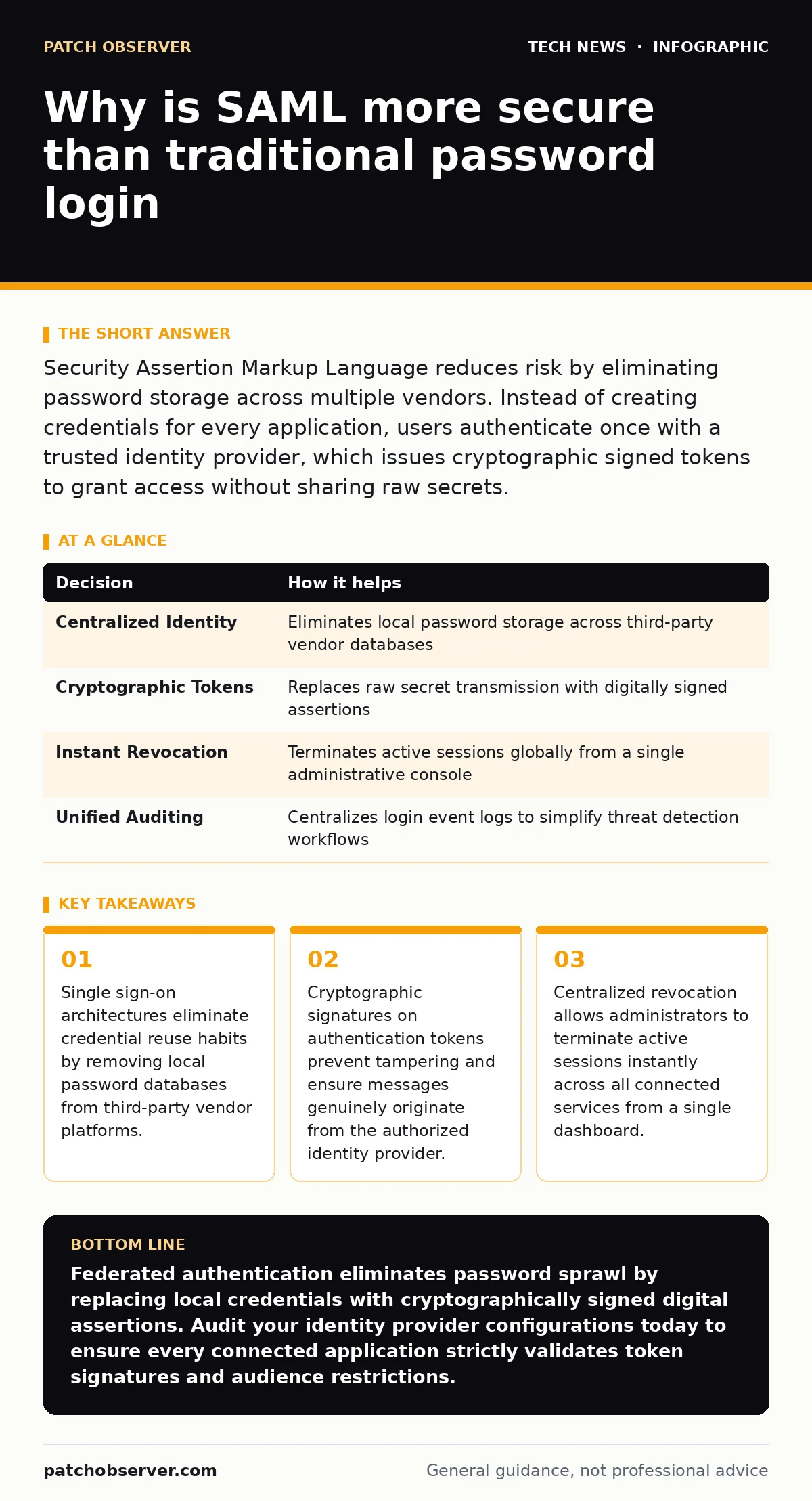
Security Assertion Markup Language reduces risk by eliminating password storage across multiple vendors. Instead of creating credentials for every application, users authenticate once with a trusted identity provider, which issues cryptographic signed tokens to grant access without sharing raw secrets.
Why is SAML more secure than traditional password login
Security Assertion Markup Language relies on centralized identity federation rather than distributed credential storage. Traditional setups force users to remember separate passwords for every platform, which reliably leads to weak choices and reuse. Federated authentication removes local passwords entirely, replacing them with transient digital proofs issued by a single authoritative source.
Centralized credential management transforms how organizations handle access termination. When an employee departs, disabling their account at the identity provider immediately cuts off access to every connected service. Traditional setups require manual removal across dozens of separate vendor dashboards, creating dangerous windows of exposure where forgotten accounts remain active.
Cryptographic trust replaces shared secrets in federated authentication exchanges. The identity provider signs every authentication assertion using public key cryptography, proving the authenticity of the login event without transmitting actual passwords over the network. Receiving applications verify this signature locally against trusted certificates, ensuring attackers cannot forge valid entry tickets even if they intercept network traffic.
Session hijacking risks diminish because federated tokens have strict expiration lifetimes and bind to specific browser contexts. Unlike persistent session cookies that attackers can steal and replay indefinitely, assertion tokens expire rapidly after initial handshakes occur. Applications must periodically re-validate user status with the central authority, ensuring ongoing compliance with security policies.
Hidden costs and edge cases of federated authentication
Federated authentication introduces a single point of failure that demands rigorous infrastructure protection. If the central identity provider suffers an outage or compromise, every connected business application becomes inaccessible simultaneously. Organizations must invest heavily in high availability and strict monitoring for their authentication servers, shifting their risk profile rather than eliminating it entirely.
Configuration complexity creates vulnerabilities that attackers actively scan for during reconnaissance phases. Mismatched audience restrictions or improper certificate validation can allow malicious actors to forge assertions and gain unauthorized entry. Administrators must audit metadata exchanges constantly to ensure applications correctly verify the exact origin of every incoming login token.
Integration gaps appear when older legacy applications refuse to speak modern federation protocols natively. Forcing these systems into a unified architecture often requires proxy servers or fragile wrapper scripts that introduce new attack surfaces. Maintaining these legacy bridges demands careful oversight of firewall rules to prevent unauthorized direct access to backend databases.
How cryptographic assertions protect data in transit
Digital signatures ensure that authentication messages remain tamper-proof as they travel across untrusted networks. When an identity provider authenticates a user, it packages the identity data into an XML document and signs it with a private key. The receiving service uses the matching public key to verify the signature before granting entry, confirming the payload was never altered in transit.
Assertion encryption adds an extra layer of confidentiality by obscuring sensitive user attributes from intermediate network devices. Without encryption, network sniffers might capture metadata such as internal group memberships or email addresses passing between domains. Encrypting the assertion payload ensures that only the intended service provider can read the specific claims inside the token.
Clock synchronization between servers remains a critical requirement for validating token validity periods. If system clocks drift too far apart, valid assertions might be rejected as expired or accepted prematurely, breaking the time-bound security guarantees. Maintaining precise timekeeping across distributed cloud environments requires strict adherence to standardized network protocols.
Architectural comparison of access control models
| Decision | How it helps |
|---|---|
| Centralized Identity | Eliminates local password storage across third-party vendor databases |
| Cryptographic Tokens | Replaces raw secret transmission with digitally signed assertions |
| Instant Revocation | Terminates active sessions globally from a single administrative console |
| Unified Auditing | Centralizes login event logs to simplify threat detection workflows |
Failure modes when federation is misconfigured
Service providers occasionally fail to validate the issuer of an incoming assertion, trusting any digitally signed token regardless of its origin. Attackers exploit this flaw by generating their own valid signatures using self-signed certificates and presenting them to vulnerable applications. Proper deployment requires hardcoding the exact thumbprint of the legitimate identity provider into the application configuration.
Attribute mapping errors can inadvertently grant users elevated privileges across external cloud services. If an application trusts incoming group claims blindly without verifying them against local access control lists, manipulated assertions can escalate standard users to administrators. Rigorous validation of all incoming claims prevents external identity providers from assigning unintended roles.
See also: DMARC Misconceptions: Why Your Policy Fails Without These Fixes · Federated Identity Best Practices for Secure Cloud Access
What to do with your access architecture knowledge
Audit your current application portfolio to identify which services still rely on local credentials instead of federated identities. Prioritize migrating systems that hold sensitive corporate data or handle administrative functions, as these represent the highest impact targets for credential stuffing attacks.
Enforce strict multi-factor authentication requirements at the identity provider level rather than leaving authentication policies scattered across individual vendors. Forcing strong verification before any token issuance occurs protects every downstream application simultaneously, regardless of individual vendor security postures.
Review your emergency break-glass procedures to ensure administrators can still access critical identity infrastructure if network connectivity or federation services fail entirely. Documented offline recovery workflows prevent prolonged operational paralysis during severe cloud outages without compromising overall system security.
Key takeaways
- Single sign-on architectures eliminate credential reuse habits by removing local password databases from third-party vendor platforms.
- Cryptographic signatures on authentication tokens prevent tampering and ensure messages genuinely originate from the authorized identity provider.
- Centralized revocation allows administrators to terminate active sessions instantly across all connected services from a single dashboard.
Federated authentication eliminates password sprawl by replacing local credentials with cryptographically signed digital assertions. Audit your identity provider configurations today to ensure every connected application strictly validates token signatures and audience restrictions.
Frequently asked questions
Can attackers steal and reuse a SAML token?
Attackers can attempt to intercept tokens in transit, but short expiration windows and strict audience restrictions severely limit the usefulness of captured assertions.
Why do legacy applications struggle with modern identity federation?
Older software was built assuming local password verification and often lacks the protocol support needed to parse XML-based security assertions natively.
Does identity federation protect against phishing attacks?
Federation alone does not stop phishing, but combining it with hardware-based authentication tokens makes credential theft significantly harder for attackers.
How this guide was produced: written by the Patch Observer editorial team with AI assistance, checked against the public references listed below, and reviewed when the facts change. See our editorial policy or report an error.