Federated Identity Best Practices for Secure Cloud Access
Federated identity shifts trust to a central provider, but misconfigured claims and weak token handling create new attack surfaces that bypass traditional perimeter defenses.

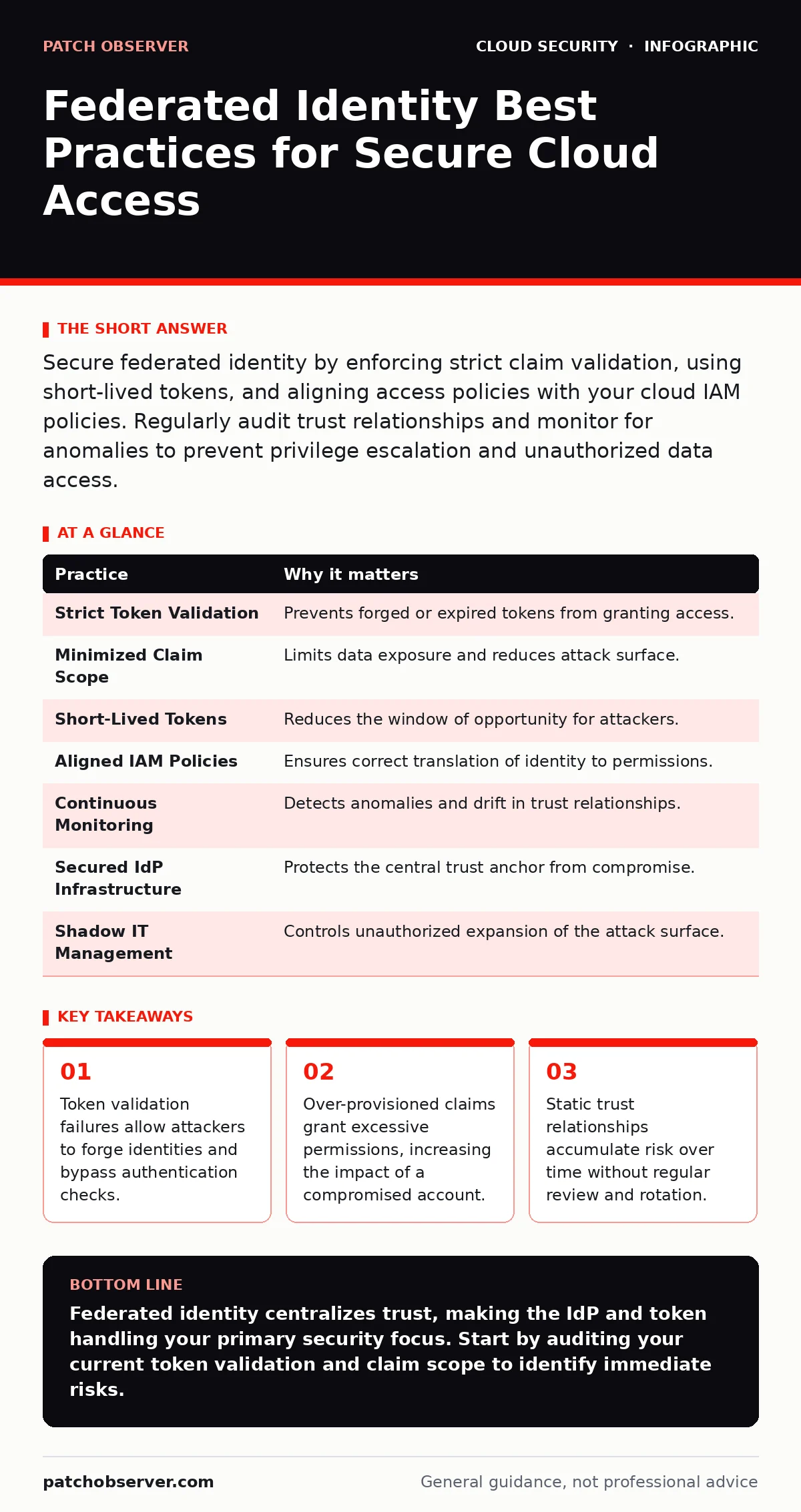
Secure federated identity by enforcing strict claim validation, using short-lived tokens, and aligning access policies with your cloud IAM policies. Regularly audit trust relationships and monitor for anomalies to prevent privilege escalation and unauthorized data access.
The Trust Boundary Shifts
Federated identity allows users to authenticate with a central identity provider (IdP) rather than individual cloud services. This model simplifies user experience but moves the trust boundary from the application to the IdP. You must treat the IdP as a critical infrastructure component. If the IdP is compromised, every connected service is at risk. This shift requires a different approach to security controls. Traditional perimeter defenses do not apply to the internal flow of identity tokens. You need to secure the data in motion and the policies that interpret that data.
1. Enforce Strict Token Validation
Every service receiving a token must verify its signature, issuer, and expiration. Skipping validation steps assumes the network is secure, which is rarely true. Attackers can intercept or forge tokens if validation is lax. The service must reject any token that does not match expected criteria exactly. This includes checking the audience claim to ensure the token was intended for that specific service.
- Verify the digital signature using the IdP’s public key.
- Check the issuer claim against a trusted list.
- Ensure the expiration time has not passed.
2. Minimize Claim Scope
Claims are pieces of information included in the token, such as user roles or group memberships. Sending more claims than necessary increases the attack surface. If a token is leaked, every claim in it becomes a potential vector for unauthorized access. Restrict claims to only what the service needs to make an authorization decision. This limits the damage if a token is intercepted. It also reduces the complexity of your access control logic.
- Map specific roles to minimal required claims.
- Avoid sending personal identifiable information unless strictly necessary.
- Use dynamic claims only when the service requires real-time context.
3. Use Short-Lived Tokens
Long-lived tokens remain valid for extended periods, often hours or days. If such a token is stolen, the attacker has a large window to act before the token expires. Short-lived tokens, such as those valid for only one hour, limit this window. When the token expires, the user must re-authenticate or refresh. This forces a new security check, potentially catching compromised credentials. However, this adds latency to the user experience.
- Set access token lifetimes to one hour or less.
- Use refresh tokens for seamless continuity, but store them securely.
- Monitor refresh token usage for anomalies.
See our guide on MFA for cloud accounts for details on strengthening the initial authentication step that generates these tokens.
4. Align Access Policies with Cloud IAM Policies
The IdP sends claims, but the cloud service decides access based on its own Identity and Access Management (IAM) policies. A mismatch between these two creates security gaps. If the IdP sends a "admin" claim but the cloud policy does not recognize it, access is denied. Conversely, if the cloud policy is too permissive, any valid token grants excessive access. You must synchronize the claims with the IAM policies. This ensures that the identity data translates correctly into permissions.
- Define a clear mapping between IdP claims and cloud roles.
- Test the mapping with various user types before deployment.
- Regularly review IAM policies to ensure they reflect current business needs.
Refer to cloud IAM policies for best practices on structuring these permissions.
See also: CIS Benchmarks for Small Business: Secure Cloud Configs
5. Implement Continuous Trust Monitoring
Trust relationships are not static. Users change roles, services decommission, and new threats emerge. Relying on a one-time configuration leaves you vulnerable to drift. Continuous monitoring detects changes in trust relationships and token usage patterns. Anomalies, such as a user accessing a service they never used before, can indicate compromise. Automated alerts help you respond quickly to suspicious activity.
- Log all authentication and authorization events.
- Set up alerts for unusual login locations or times.
- Review trust relationships quarterly to remove stale connections.
6. Secure the IdP Infrastructure
The IdP is the single point of failure for your federated identity setup. If it goes down, users cannot access services. If it is compromised, all services are at risk. You must harden the IdP infrastructure against attacks. This includes securing the servers, networks, and databases that support the IdP. Regular security assessments help identify weaknesses before attackers do.
- Keep IdP software updated with the latest security patches.
- Restrict administrative access to the IdP.
- Monitor IdP logs for signs of brute force or injection attacks.
Check cloud security assessments for methods to evaluate the security posture of your IdP.
7. Manage Shadow IT Connections
Users often connect personal or unauthorized applications to your IdP. This shadow IT expands the attack surface beyond your control. These applications may not have adequate security controls. They can leak sensitive data or become entry points for attackers. You must discover and manage these connections. Blocking unauthorized apps entirely may be impractical, so a risk-based approach is better.
- Enable discovery tools to identify connected applications.
- Classify applications by risk level.
- Apply stricter controls to high-risk or unauthorized apps.
Read about shadow IT to understand how to balance security with user productivity.
8. Automate Policy Enforcement with Policy as Code
Manual configuration of identity policies is error-prone and difficult to scale. As your environment grows, inconsistencies emerge. Policy as code allows you to define identity and access rules in a version-controlled format. This ensures consistency across all environments. It also enables automated testing and validation of policies. Changes are tracked, and rollbacks are possible if issues arise.
- Define identity policies in a declarative format.
- Integrate policy validation into your deployment pipeline.
- Use infrastructure as code tools to manage IdP configurations.
Explore policy as code for strategies to automate your security controls.
9. Regularly Review and Rotate Secrets
Secrets, such as client IDs and secrets, are used to establish trust between services and the IdP. If these secrets are exposed, attackers can impersonate services. Regular rotation limits the impact of a leak. Long-term secrets increase the risk window. Automation helps manage the rotation process without disrupting services.
- Rotate client secrets every 90 days or less.
- Automate the rotation process using secret management tools.
- Monitor for unauthorized use of rotated secrets.
See cloud key management services for secure storage and rotation of these secrets.
| Practice | Why it matters |
|---|---|
| Strict Token Validation | Prevents forged or expired tokens from granting access. |
| Minimized Claim Scope | Limits data exposure and reduces attack surface. |
| Short-Lived Tokens | Reduces the window of opportunity for attackers. |
| Aligned IAM Policies | Ensures correct translation of identity to permissions. |
| Continuous Monitoring | Detects anomalies and drift in trust relationships. |
| Secured IdP Infrastructure | Protects the central trust anchor from compromise. |
| Shadow IT Management | Controls unauthorized expansion of the attack surface. |
| Policy as Code | Ensures consistency and reduces human error. |
| Secret Rotation | Limits the impact of exposed credentials. |
Key takeaways
- Token validation failures allow attackers to forge identities and bypass authentication checks.
- Over-provisioned claims grant excessive permissions, increasing the impact of a compromised account.
- Static trust relationships accumulate risk over time without regular review and rotation.
Federated identity centralizes trust, making the IdP and token handling your primary security focus. Start by auditing your current token validation and claim scope to identify immediate risks.
Frequently asked questions
How do I validate JWT tokens securely?
Verify the signature, issuer, expiration, and audience claims using the IdP’s public key. Reject any token that fails these checks.
What is the difference between SAML and OIDC?
SAML is an XML-based protocol for web browser SSO, while OIDC is a JSON-based protocol built on OAuth 2.0, suitable for modern apps and mobile devices.
Can federated identity replace passwords?
It reduces reliance on local passwords but still requires strong authentication at the IdP, often via MFA.
How often should I review trust relationships?
Review them quarterly or after significant organizational changes to ensure they remain accurate and secure.
How this guide was produced: written by the Patch Observer editorial team with AI assistance, checked against the public references listed below, and reviewed when the facts change. See our editorial policy or report an error.