Telegram link and domain outages: Understanding routing failures
Telegram link and domain outages occur when infrastructure paths fail, cutting off access even while core messaging servers remain online.

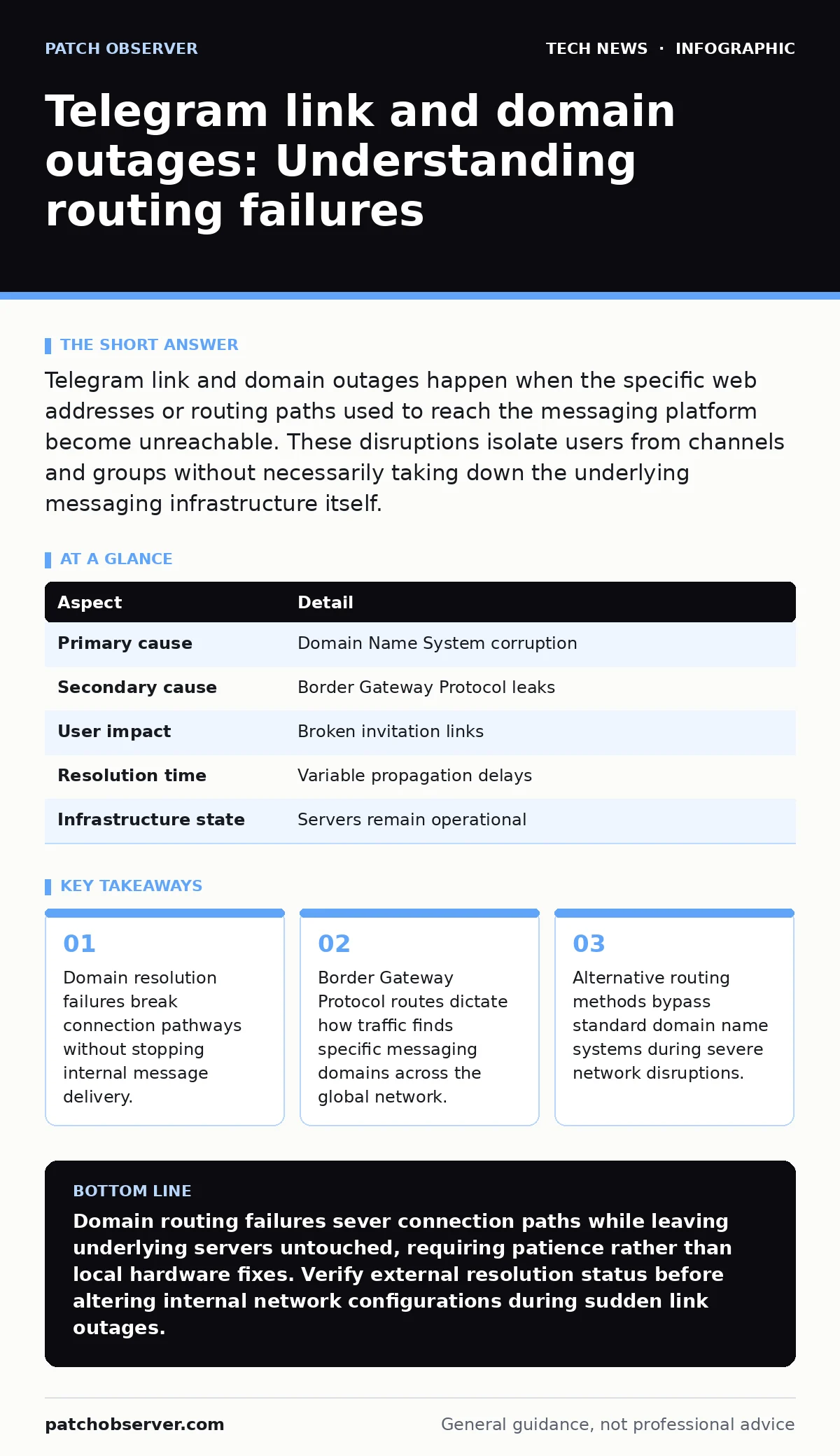
Telegram link and domain outages happen when the specific web addresses or routing paths used to reach the messaging platform become unreachable. These disruptions isolate users from channels and groups without necessarily taking down the underlying messaging infrastructure itself.
Understanding Telegram link and domain outages through a postal analogy
Postal routing disruptions mirror domain failures when local delivery routes close permanently, yet the central sorting facility continues operating normally. Mail trucks cannot reach specific neighborhood boxes because the mapped streets disappear from the city grid. Similarly, messaging networks rely on precise digital addresses to guide user traffic from browsers and applications to the correct servers. When those specific addresses fail to resolve, the communication pathways snap shut.
Digital infrastructure depends on constant translation between human-readable addresses and numeric machine destinations. Domain name resolution acts as the global telephone directory for network traffic, matching friendly names to server IP addresses. If an administrative error or routing leak corrupts this directory, applications cannot locate the service endpoints. You experience a total blockage of specific links while other internet services function without interruption.
Routing tables maintained by major internet service providers dictate the exact path packets take across the globe. A single misconfiguration in these tables creates localized isolation for specific communication domains.
| Aspect | Detail |
|---|---|
| Primary cause | Domain Name System corruption |
| Secondary cause | Border Gateway Protocol leaks |
| User impact | Broken invitation links |
| Resolution time | Variable propagation delays |
| Infrastructure state | Servers remain operational |
Where link and domain failures originate in daily operations
Network administrators encounter routing failures when upstream internet service providers drop specific domain advertisements from their routing tables. These operational mistakes propagate rapidly across global exchange points, causing widespread connection timeouts. You might find that your applications fail to open shared channel links because the translation machinery cannot find the destination host.
Edge routing devices handle incoming connection requests and direct them toward internal server clusters. When these edge devices experience configuration drift, they reject incoming traffic destined for specific subdomains. This creates a scenario where direct application connections work via cached data, but new web links fail instantly.
API security practices often rely on rigid domain pinning that fails gracefully during unexpected routing shifts. Network ports and protocols must remain open and correctly configured to handle fallback connection methods when primary domains become unreachable.
How these outages manifest during day-to-day work
Operational disruptions appear immediately when users click on shared invitation links and receive generic connection timeout errors. Applications spin indefinitely while attempting to resolve the missing domain name into a valid numeric destination. You must distinguish between a complete platform blackout and a localized routing failure affecting only specific web links.
Caching mechanisms inside operating systems often prolong the impact of a routing failure long after administrators fix the underlying problem. Your computer stubbornly remembers the failed path, refusing to query the updated directory until the local cache expires naturally.
Remote work security protocols frequently complicate diagnosis by forcing traffic through corporate virtual private networks that might suffer from independent DNS resolution issues. You need to verify whether the routing failure affects direct internet connections or only traffic passing through managed tunnels.
Hidden costs and non-obvious consequences of routing failures
Operational blind spots expand rapidly when connection failures isolate automated alert channels used by system administrators. You lose real-time notification streams precisely when network stability requires immediate human intervention.
Security monitoring tools often generate false alarms during routing outages because heartbeat checks fail to reach external endpoints. Analysts waste valuable minutes investigating internal firewall rules while the actual failure exists deep within global transport networks.
Managing application dependencies during unexpected path drops
Modern communication tools integrate deeply with external services through programmatic interfaces that depend heavily on stable domain resolution. When link paths fail, background synchronization processes hang indefinitely, consuming system resources and draining device batteries.
Developers must implement robust retry logic with exponential backoff timers to prevent overwhelmed routing infrastructure from collapsing entirely when recovery begins. You should monitor domain health independently from core server availability to isolate the exact point of failure during an incident.
See also: Why is SAML more secure than traditional password login · DNSSEC vs DNS over TLS: Protect Integrity and Privacy
Why standard troubleshooting advice frequently fails
Traditional troubleshooting steps suggest clearing local browser caches and restarting networking hardware to fix connection errors. These actions prove useless when the routing failure originates inside autonomous system pathways far beyond your local control.
Waiting out the propagation delay remains the only effective response once global routing tables require correction by network operators. You can review network ports and protocols to ensure local firewalls are not blocking fallback connection attempts.
Key takeaways
- Domain resolution failures break connection pathways without stopping internal message delivery.
- Border Gateway Protocol routes dictate how traffic finds specific messaging domains across the global network.
- Alternative routing methods bypass standard domain name systems during severe network disruptions.
Domain routing failures sever connection paths while leaving underlying servers untouched, requiring patience rather than local hardware fixes. Verify external resolution status before altering internal network configurations during sudden link outages.
Frequently asked questions
What causes a specific messaging link to stop working while others load?
Domain Name System resolution errors or incorrect routing announcements prevent traffic from reaching the specific subdomain hosting that link.
How do I know if the entire service is down or just the links?
Core messaging applications often continue functioning using cached data or direct IP connections even when web-based invitation links fail to resolve.
Can local firewall settings cause domain resolution failures?
Overly restrictive security rules can block the specific ports or protocols required to query updated network routing tables.
Why do shared chat links sometimes work on mobile data but fail on office Wi-Fi?
Different internet service providers use distinct routing tables and Domain Name System resolvers, meaning one network might have updated paths while another remains isolated.
How this guide was produced: written by the Patch Observer editorial team with AI assistance, checked against the public references listed below, and reviewed when the facts change. See our editorial policy or report an error.