DNSSEC vs DNS over TLS: Protect Integrity and Privacy
DNSSEC proves DNS records are authentic without hiding them, while DNS over TLS encrypts the query path without validating the origin data.

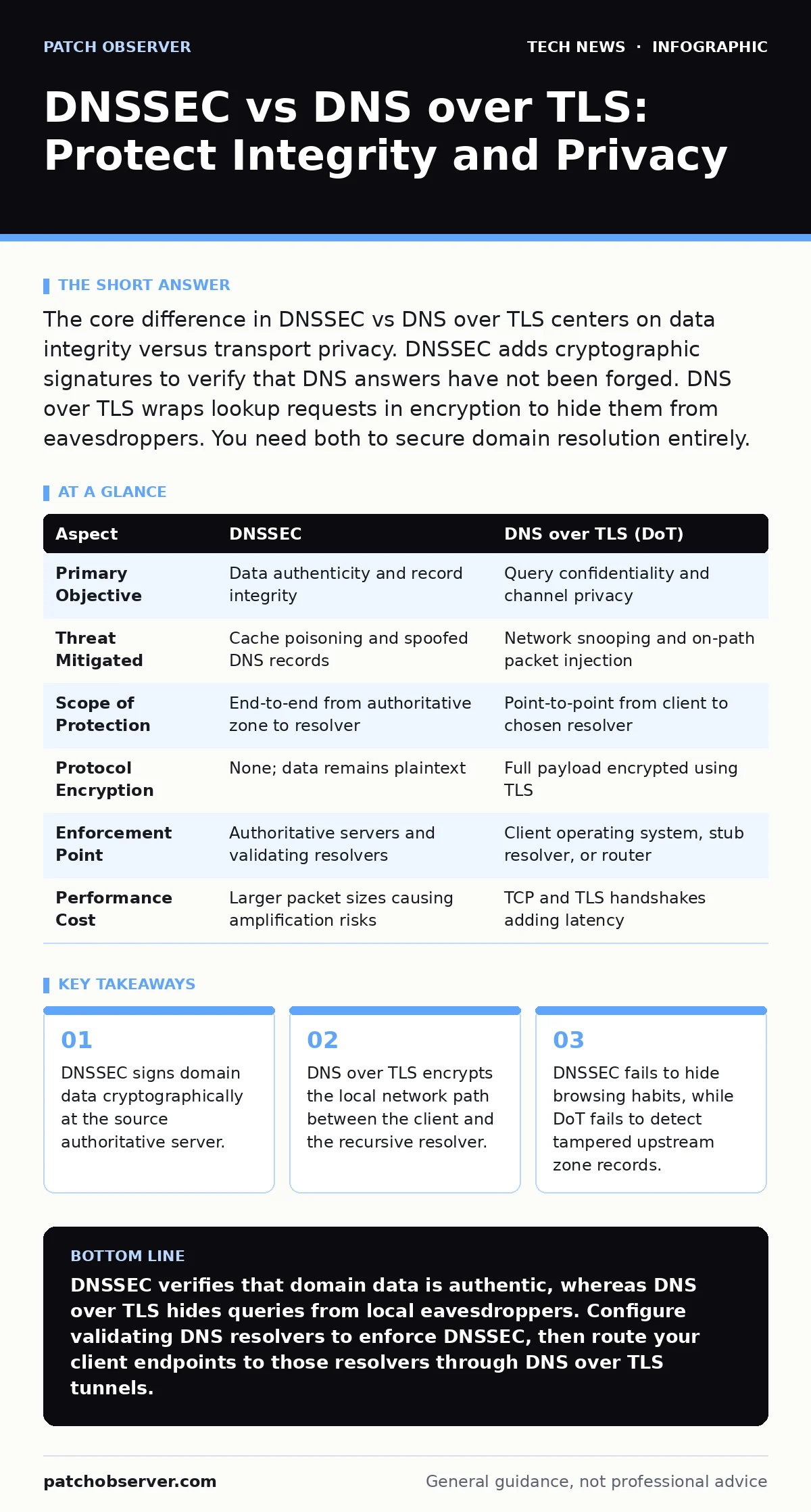
The core difference in DNSSEC vs DNS over TLS centers on data integrity versus transport privacy. DNSSEC adds cryptographic signatures to verify that DNS answers have not been forged. DNS over TLS wraps lookup requests in encryption to hide them from eavesdroppers. You need both to secure domain resolution entirely.
Core Differences in DNSSEC vs DNS over TLS
The fundamental difference between these 2 technologies is that DNSSEC (Domain Name System Security Extensions) verifies that query responses originate from the genuine domain owner and remain unmodified, while DNS over TLS (DoT) encrypts the communication channel between your endpoint and the recursive resolver. DNSSEC secures the data payload across its entire route across the public internet, but leaves every lookup exposed in cleartext. DNS over TLS locks the transport channel against eavesdroppers, but trusts the resolver implicitly to hand back authentic data.
What DNSSEC Does for Origin Authenticity
DNSSEC provides data origin authentication and integrity verification for DNS responses. Authoritative nameservers create cryptographic signatures over their zone records using public key cryptography and public-key hashing. Resolvers validating these signatures walk an unbroken chain of trust back to the global DNS root zone.
Upstream domain operators control whether DNSSEC exists on a domain, not the endpoint user. When an attacker attempts cache poisoning or redirects traffic via manipulated records, a validating resolver rejects the bogus data with a resolution failure. Yet DNSSEC introduces operational friction: zone administrators must roll keys regularly, and misconfigurations can take entire web services offline during domain updates.
What DNS over TLS Does for Query Privacy
DNS over TLS encrypts standard DNS lookups using TLS (Transport Layer Security) over dedicated network port 853. The protocol prevents on-path observers on local networks from logging browsing requests, modifying packets in transit, or injecting fake responses over unencrypted channels.
Network administrators typically implement DoT at the client or gateway level to strengthen local traffic privacy against malicious monitoring on hostile networks. This protection works well alongside disciplined Wi-Fi security practices on untrusted connections. However, DoT secures only the link between the device and its configured upstream resolver, ending its cryptographic guarantees the moment the resolver reaches out to the broader internet.
Comparing DNSSEC and DNS over TLS
| Aspect | DNSSEC | DNS over TLS (DoT) |
|---|---|---|
| Primary Objective | Data authenticity and record integrity | Query confidentiality and channel privacy |
| Threat Mitigated | Cache poisoning and spoofed DNS records | Network snooping and on-path packet injection |
| Scope of Protection | End-to-end from authoritative zone to resolver | Point-to-point from client to chosen resolver |
| Protocol Encryption | None; data remains plaintext | Full payload encrypted using TLS |
| Enforcement Point | Authoritative servers and validating resolvers | Client operating system, stub resolver, or router |
| Performance Cost | Larger packet sizes causing amplification risks | TCP and TLS handshakes adding latency |
Choose DNSSEC When You Must Protect Domain Authority
- You publish DNS zones and must protect your domain reputation from forged records.
- You maintain recursive resolvers and must prevent cache poisoning attacks across local client pools.
- You deploy authentication protocols like DANE (DNS-based Authentication of Named Entities) that require trusted cryptographic domain proofs.
- You want to ensure clients never accept unauthorized IP address changes from hostile transit providers.
Securing records with DNSSEC also guards against routing errors that cause widespread connectivity failures, similar to issues explored in our analysis of Telegram link and domain outages.
See also: Telegram link and domain outages: Understanding routing failures · Getting a Reddit API Key: Account Types and Rate Limits Explained
Choose DNS over TLS When You Must Protect Endpoint Privacy
- You must conceal user DNS queries from local network monitors, intermediate internet providers, or public hotspots.
- You administer network perimeter devices and apply home router security profiles to prevent local upstream providers from profiling devices.
- You require centralized control over outbound DNS queries without exposing requests to opportunistic local spoofing.
- You want protection against local Wi-Fi injection attacks on mobile endpoints that lack direct connections to internal company resolvers.
Where DNSSEC and DNS over TLS Overlap and Intersect
These 2 security mechanisms do not compete; they complement each other at different layers of the domain lookup sequence. A complete DNS defense strategy runs DNS over TLS on the client segment to prevent local traffic inspection, while the recursive resolver actively validates DNSSEC records retrieved from authoritative nameservers.
[ Client ] --( DoT: Port 853 / Encrypted )--> [ Recursive Resolver ] --( DNSSEC: Authenticated )--> [ Authoritative DNS ]
Relying on DoT alone leaves you vulnerable if your upstream resolver suffers an exploit or queries an unauthenticated cache. Conversely, relying exclusively on DNSSEC leaves user identity and internal traffic patterns transparent to any intermediate router. Combining encrypted transport with cryptographic data validation delivers both privacy on the local segment and integrity across the wider internet.
Key takeaways
- DNSSEC signs domain data cryptographically at the source authoritative server.
- DNS over TLS encrypts the local network path between the client and the recursive resolver.
- DNSSEC fails to hide browsing habits, while DoT fails to detect tampered upstream zone records.
DNSSEC verifies that domain data is authentic, whereas DNS over TLS hides queries from local eavesdroppers. Configure validating DNS resolvers to enforce DNSSEC, then route your client endpoints to those resolvers through DNS over TLS tunnels.
Frequently asked questions
Does DNS over TLS replace DNSSEC?
No, DNS over TLS does not replace DNSSEC. DoT secures only the connection between the client and the resolver, while DNSSEC verifies that the records served by authoritative nameservers have not been modified.
Can an attacker intercept DNSSEC traffic?
An attacker can intercept and read DNSSEC traffic because it is not encrypted. However, the attacker cannot alter the records without breaking the cryptographic signature, which causes validating resolvers to drop the manipulated answer.
Why does DNS over TLS use a separate network port?
DNS over TLS runs on dedicated TCP port 853 to separate encrypted lookups from standard plaintext DNS on port 53. This separation allows network equipment to identify DoT streams and lets administrators control encrypted name resolution policies.
Which protocol causes higher latency for clients?
DNS over TLS usually introduces more initial latency for clients because it requires multi-step TCP and TLS handshakes before sending queries. DNSSEC primarily increases payload sizes over UDP, though it requires extra query round-trips to fetch validation keys.
How this guide was produced: written by the Patch Observer editorial team with AI assistance, checked against the public references listed below, and reviewed when the facts change. See our editorial policy or report an error.