API Security Checklist: Verify Access, Data, and Rate Limits
Most API breaches occur because default permissions allow too much data exposure or because rate limits fail under automated load.

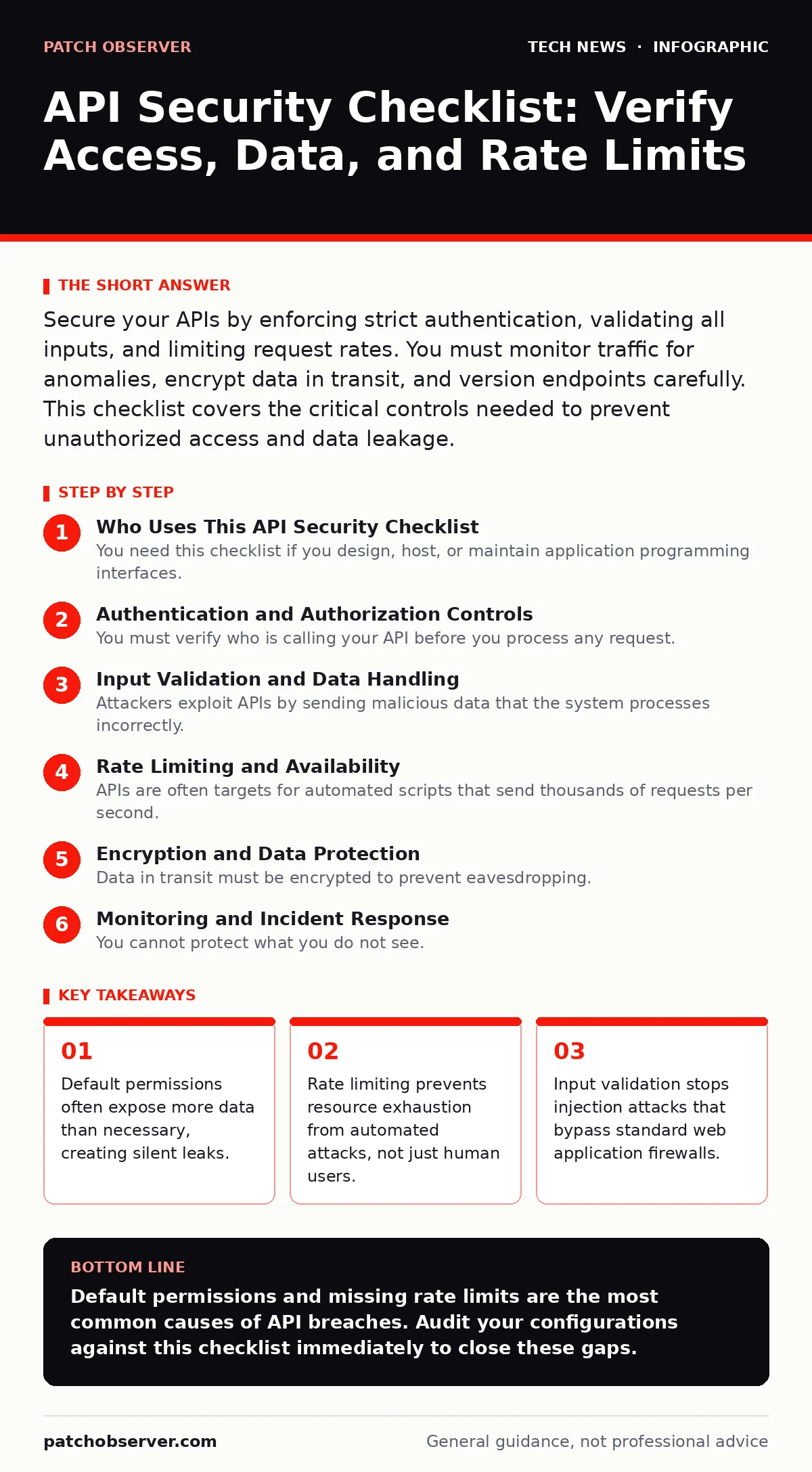
Secure your APIs by enforcing strict authentication, validating all inputs, and limiting request rates. You must monitor traffic for anomalies, encrypt data in transit, and version endpoints carefully. This checklist covers the critical controls needed to prevent unauthorized access and data leakage.
Who Uses This API Security Checklist
You need this checklist if you design, host, or maintain application programming interfaces. An application programming interface allows different software systems to communicate. The checklist applies to internal services as well as public-facing endpoints. Use it during design reviews, before deployment, and after major changes. It helps you catch configuration errors before attackers find them.
Authentication and Authorization Controls
You must verify who is calling your API before you process any request. Authentication confirms identity. Authorization determines what that identity can do. Many teams implement authentication but forget fine-grained authorization. This leads to broken object level authorization.
- Enforce strong authentication: Use standards like OAuth 2.0 or OpenID Connect to verify user identity.
- Implement least privilege access: Grant only the minimum permissions required for each role or service.
- Validate tokens on every request: Do not trust client-side state; verify signatures and expiration times server-side.
- Rotate credentials regularly: Change keys and secrets periodically to limit the impact of a leak.
Broken object level authorization happens when an API checks if a user is logged in but not if they own the requested resource. This allows users to access data belonging to others by changing an ID in the request.
Input Validation and Data Handling
Attackers exploit APIs by sending malicious data that the system processes incorrectly. Input validation ensures that data matches expected formats and types. You must reject anything that does not fit the schema.
- Validate all input fields: Check types, lengths, and formats against a strict schema.
- Sanitize output data: Remove or escape characters that could cause injection attacks.
- Use parameterized queries: Prevent SQL injection by separating code from data in database requests.
- Limit payload size: Reject overly large requests to prevent buffer overflow or resource exhaustion.
Imagine an attacker sends a JSON object with a nested array that expands exponentially when parsed. This is a decompression bomb. If your API parses it without limits, your server crashes. You should also review your hashing practices if you store sensitive data, ensuring you use algorithms resistant to collision attacks.
Rate Limiting and Availability
APIs are often targets for automated scripts that send thousands of requests per second. Rate limiting restricts the number of requests a client can make in a given time. This protects your infrastructure from abuse.
- Set global rate limits: Cap the total requests per second to protect server resources.
- Implement per-user limits: Prevent individual accounts from overwhelming the service.
- Use adaptive throttling: Adjust limits based on current server load and error rates.
- Return clear error codes: Use HTTP 429 Too Many Requests to inform clients they must slow down.
Without proper limits, a single compromised account can disrupt service for all users. You should also consider edge computing security if your API serves global traffic, ensuring that edge nodes enforce these limits before requests reach your core infrastructure.
Encryption and Data Protection
Data in transit must be encrypted to prevent eavesdropping. Data at rest must be encrypted to prevent theft if storage is compromised. You must manage encryption keys carefully.
- Enforce TLS 1.2 or higher: Disable older protocols that have known vulnerabilities.
- Encrypt sensitive fields: Use application-level encryption for critical data like health records or financial details.
- Manage keys securely: Use a dedicated key management service, not hardcoded values.
- Log encryption events: Monitor for failed decryption attempts that may indicate an attack.
Public key cryptography provides a foundation for secure key exchange. You must ensure your certificates are valid and not expired. Expired certificates break trust and may allow man-in-the-middle attacks.
See also: Malvertising Warning Signs: What to Look For and How to React
Monitoring and Incident Response
You cannot protect what you do not see. Monitoring detects anomalous behavior that indicates an attack. You must have a plan to respond when something goes wrong.
- Log all API requests: Record source IP, timestamp, endpoint, and user identity.
- Alert on anomalies: Notify security teams when request patterns deviate from the norm.
- Test incident response plans: Practice responding to API breaches to ensure readiness.
- Review logs regularly: Look for patterns that indicate slow, low-and-slow attacks.
Imagine a sudden spike in 401 Unauthorized errors from a single IP address. This likely indicates a brute-force attack. Your monitoring system should flag this immediately. You should also review your browser security settings to ensure that clients interacting with your API are not vulnerable to cross-site scripting attacks.
Versioning and Deprecation
APIs evolve over time. Old versions may contain vulnerabilities that have been fixed in newer versions. You must manage this lifecycle carefully.
- Version your endpoints: Use URL paths or headers to distinguish between versions.
- Document deprecation schedules: Inform users when old versions will stop working.
- Sunset old versions: Disable support for outdated versions to reduce the attack surface.
- Maintain backward compatibility: Allow gradual migration to new versions without breaking clients.
Leaving old API versions active creates a persistent risk. Attackers often target deprecated endpoints because developers assume they are no longer in use. You should also consider Wi-Fi security if your API is accessed from mobile devices, ensuring that the network connection itself is secure.
Key takeaways
- Default permissions often expose more data than necessary, creating silent leaks.
- Rate limiting prevents resource exhaustion from automated attacks, not just human users.
- Input validation stops injection attacks that bypass standard web application firewalls.
Default permissions and missing rate limits are the most common causes of API breaches. Audit your configurations against this checklist immediately to close these gaps.
Frequently asked questions
How often should I update my API security checklist?
Review it every time you release a new version of your API or when new vulnerabilities are discovered in your underlying technologies.
Can I use the same checklist for REST and GraphQL APIs?
Yes, the core principles of authentication, authorization, and input validation apply to both, though specific implementation details may differ.
Do internal APIs need the same security as public ones?
Yes, internal APIs often hold sensitive data and are accessible to many services, making them prime targets for lateral movement by attackers.
What is the biggest mistake teams make with API security?
Assuming that authentication is sufficient and neglecting fine-grained authorization and input validation for every endpoint.
How this guide was produced: written by the Patch Observer editorial team with AI assistance, checked against the public references listed below, and reviewed when the facts change. See our editorial policy or report an error.