API Key Security: Stop Leaks Before They Cost Your Business
Most small business breaches occur because API keys are stored in plain text within public code repositories, not because attackers broke complex encryption.

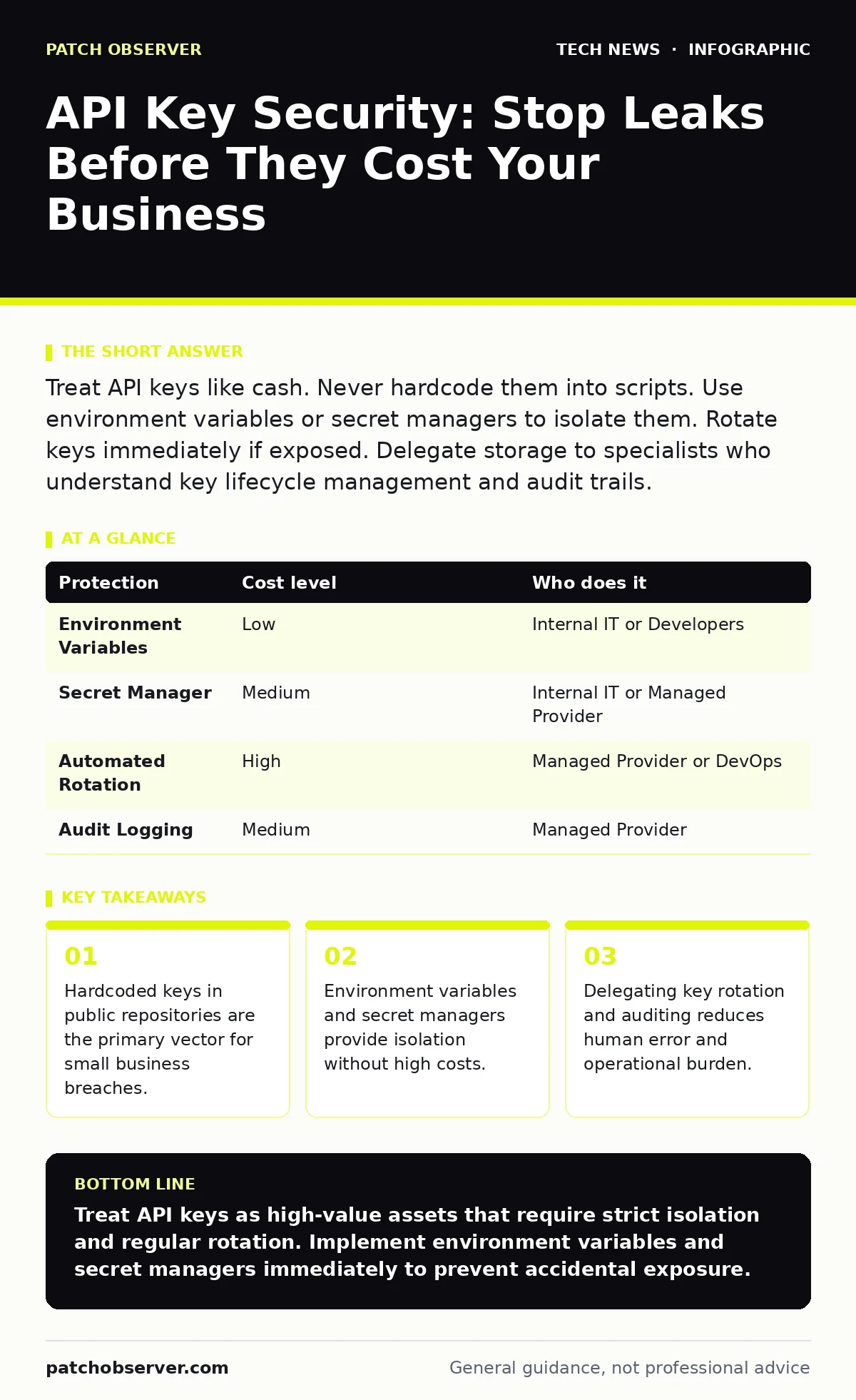
Treat API keys like cash. Never hardcode them into scripts. Use environment variables or secret managers to isolate them. Rotate keys immediately if exposed. Delegate storage to specialists who understand key lifecycle management and audit trails.
The Hidden Cost of Convenience
Small teams often prioritize speed over security. You might copy an API key directly into a script to make a service work faster. This creates a permanent record in your version control history. Even if you delete the file later, the key remains in the commit history. Anyone with access to that history can retrieve it.
API keys act as digital identities. They grant specific permissions to services like email providers, payment processors, or cloud storage. Unlike passwords, which are often protected by multiple layers of authentication, API keys are frequently single-factor. If an attacker obtains one, they can impersonate your application immediately.
The risk scales with exposure. A small business may not have the same attack surface as a large corporation, but it often lacks the detection tools to notice misuse. By the time you realize data is leaking, the damage is done. The cost of remediation far exceeds the time saved by hardcoding the key initially.
Isolation Through Environment Variables
The first line of defense is separating configuration from code. You should store API keys in environment variables. These are dynamic values named KEY=VALUE that exist in the operating system environment where your application runs. This keeps secrets out of your source code files.
When your application starts, it reads these variables from the system rather than the codebase. If you need to change a key, you update the environment, not the code. This prevents accidental commits of sensitive data. It also allows you to use different keys for development, testing, and production environments without modifying the application logic.
This method is free and built into most operating systems. It requires no additional software purchases. However, it relies on the security of the server hosting the application. If an attacker gains shell access to your server, they can read the environment variables. Therefore, this step must be combined with strict server access controls.
For deeper context on how data is transformed before storage, see our guide on hashing. While hashing protects stored passwords, it does not protect active API keys, which must be readable by your application.
Automated Secret Management
As your infrastructure grows, managing environment variables manually becomes error-prone. You might forget to rotate keys or accidentally share a configuration file. Dedicated secret management tools automate this process. These tools store credentials in encrypted vaults and distribute them to applications on demand.
Secret managers enforce access policies. They ensure that only authorized applications can retrieve specific keys. They also provide audit logs showing who accessed which secret and when. This visibility is critical for diagnosing issues and proving compliance.
The cost of entry-level secret management is often low or free for small teams. Many cloud providers offer basic secret storage as part of their core services. You pay for the compute and storage, but the security features are included. This shifts the burden from manual tracking to automated enforcement.
Consider how this relates to edge computing security. When applications run closer to the user, they may need access to local secrets. Centralized secret managers ensure that even distributed services use consistent, secure credential handling.
The Danger of Version Control Systems
Version control systems like Git are designed to track changes to code. They are not designed to protect secrets. When you commit a file containing an API key, that key becomes part of the permanent history. Deleting the file later does not remove the key from previous commits.
Attackers use automated bots to scan public repositories for known API key patterns. These bots run constantly. If your repository is public, your keys are exposed within minutes of being pushed. Even private repositories are at risk if you collaborate with external contractors or if an insider leaks the code.
You must treat version control systems as public by default. Assume anyone can see the contents. Use pre-commit hooks to scan for secrets before they are added to the repository. These hooks block the commit if they detect patterns that look like API keys. This adds a layer of defense against human error.
For more on protecting the perimeter of your network, review our guide on reverse proxies. While proxies filter traffic, they do not protect credentials stored incorrectly in your codebase.
Rotation and Revocation Strategies
API keys should have a limited lifespan. Long-lived keys increase the risk window if they are compromised. You should establish a schedule for rotating keys. This means generating a new key and updating your applications to use it, then disabling the old key.
Manual rotation is tedious and prone to failure. You might forget to update a service, causing downtime. Automated rotation features in secret managers can handle this. They generate new keys and update configurations without human intervention. This ensures that keys are always fresh and that old keys are promptly retired.
If you suspect a key is compromised, revoke it immediately. Most services allow you to disable a specific key without affecting other services. This limits the blast radius of the breach. You can then investigate the incident and generate a new key.
This process mirrors the principles found in our guide on zero-knowledge proofs. While those proofs verify identity without revealing data, key rotation ensures that even if a key is stolen, its utility is short-lived.
See also: Getting a Reddit API Key: Account Types and Rate Limits Explained · macOS security features explained and how they protect systems
Delegating Security Operations
Small teams often lack the bandwidth to manage security operations manually. You can delegate key management to an IT provider or managed service. This shifts the operational burden to specialists who understand key lifecycle management.
When choosing a provider, ask specific questions about their security practices. Do they use automated secret management? How do they handle key rotation? What are their incident response procedures for compromised credentials? Their answers will reveal their commitment to security.
| Protection | Cost level | Who does it |
|---|---|---|
| Environment Variables | Low | Internal IT or Developers |
| Secret Manager | Medium | Internal IT or Managed Provider |
| Automated Rotation | High | Managed Provider or DevOps |
| Audit Logging | Medium | Managed Provider |
Delegation does not mean abdication. You must still understand the basics of key security to hold your provider accountable. Regular audits and reviews ensure that your provider maintains high standards.
For broader context on securing endpoints, see our guide on smartphone security updates. While mobile devices require different controls, the principle of keeping software and credentials current remains universal.
Questions for Your IT Provider
Before delegating key management, verify the provider’s capabilities. Ask these questions to ensure they meet your security needs:
- How do you store and encrypt API keys at rest?
- What is your process for rotating keys automatically?
- Can you provide audit logs of key access and usage?
- How do you handle incident response for compromised keys?
- Do you use pre-commit hooks to prevent secrets from entering version control?
Building a Culture of Security
Security is not just a technical problem. It is a cultural one. Every team member must understand the value of API keys and the risks of mishandling them. Training and clear policies reinforce good habits.
Encourage your team to report potential leaks immediately. Create a safe environment where mistakes are viewed as learning opportunities rather than failures. This openness helps identify vulnerabilities before they are exploited.
Regularly review your security posture. Update your practices as new threats emerge. Stay informed about industry standards and best practices. This continuous improvement mindset ensures your security measures remain effective over time.
For additional technical depth, refer to our guide on RSA encryption. While RSA secures data in transit, proper key management ensures that the endpoints using that encryption are not compromised.
Key takeaways
- Hardcoded keys in public repositories are the primary vector for small business breaches.
- Environment variables and secret managers provide isolation without high costs.
- Delegating key rotation and auditing reduces human error and operational burden.
Treat API keys as high-value assets that require strict isolation and regular rotation. Implement environment variables and secret managers immediately to prevent accidental exposure.
Frequently asked questions
Can I use the same API key for development and production?
No. Using the same key increases the risk of exposure and makes it difficult to isolate incidents. Always use separate keys for different environments.
How often should I rotate API keys?
Rotate keys regularly, such as every 90 days, or immediately if you suspect compromise. Automated rotation ensures consistency and reduces human error.
What if I accidentally commit a key to a public repository?
Revoke the key immediately. Then, remove it from the repository history using specialized tools. Finally, generate a new key and update your applications.
Do I need a secret manager if I have few keys?
Yes. Even with few keys, manual management is error-prone. Secret managers provide audit trails and automation that prevent accidental leaks and simplify rotation.
How this guide was produced: written by the Patch Observer editorial team with AI assistance, checked against the public references listed below, and reviewed when the facts change. See our editorial policy or report an error.