Zero-Knowledge Proofs: How to Verify Secrets Without Revealing Them
Zero-knowledge proofs allow you to prove a statement is true without giving the verifier any information about the statement itself, breaking the link between trust and data exposure.

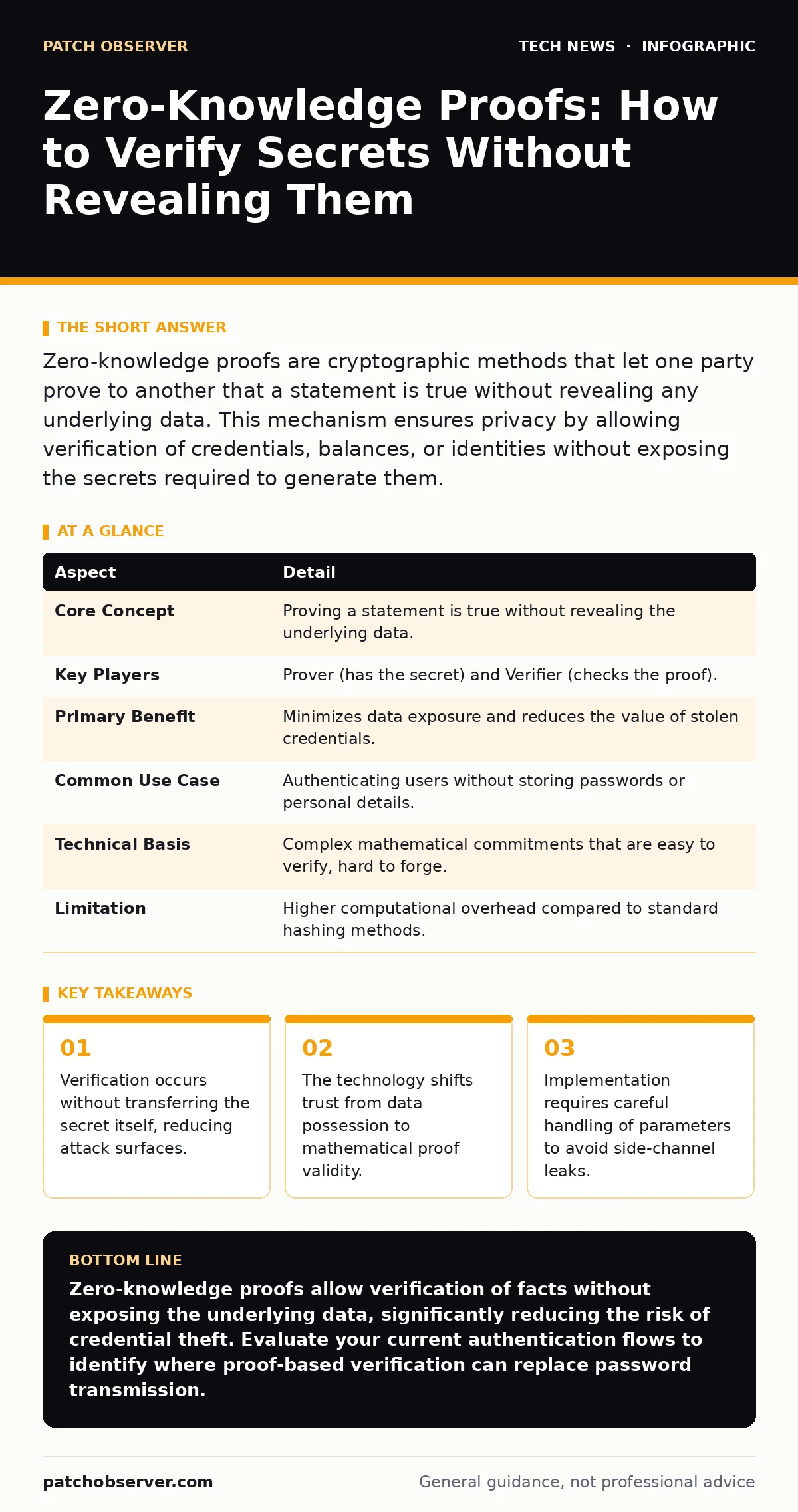
Zero-knowledge proofs are cryptographic methods that let one party prove to another that a statement is true without revealing any underlying data. This mechanism ensures privacy by allowing verification of credentials, balances, or identities without exposing the secrets required to generate them.
The Magic Trick Behind the Math
Imagine you have two marbles of different colors. You want to prove to a friend that the marbles are different without showing them the colors. You hold the marbles behind your back, swap them or not, and let your friend choose which hand to reveal. If you can always show the correct marble based on their choice, they know the marbles are different, but they never learned which color was in which hand.
This scenario illustrates the core promise of zero-knowledge proofs. You provide evidence of a fact without revealing the fact’s supporting data. In cryptography, this means a prover can convince a verifier that a statement is true without conveying any information apart from the validity of the statement itself.
This mechanism changes how systems handle trust. Traditionally, trust required handing over data. You showed your ID to prove your age. You sent your password to prove your identity. Zero-knowledge proofs invert this model. They allow verification without exposure, creating a layer of privacy that traditional authentication lacks.
At a Glance: How It Works
| Aspect | Detail |
|---|---|
| Core Concept | Proving a statement is true without revealing the underlying data. |
| Key Players | Prover (has the secret) and Verifier (checks the proof). |
| Primary Benefit | Minimizes data exposure and reduces the value of stolen credentials. |
| Common Use Case | Authenticating users without storing passwords or personal details. |
| Technical Basis | Complex mathematical commitments that are easy to verify, hard to forge. |
| Limitation | Higher computational overhead compared to standard hashing methods. |
From Theory to Daily Practice
The term originated in theoretical computer science as a way to define interactive proof systems. It started as an abstract concept to understand the limits of computation and privacy. Over time, advances in elliptic curve cryptography and hash functions made these proofs computationally feasible.
Today, you encounter this technology when logging into services that claim passwordless authentication. Instead of sending a password to a server, your device generates a proof that you possess the private key. The server checks the proof. If valid, access is granted. The server never sees the key, nor does it store a hash of it that could be cracked later.
This approach also appears in blockchain transactions. Users can prove they have sufficient funds to make a payment without revealing their total balance or transaction history. This preserves financial privacy while maintaining network integrity. It allows for auditability without sacrificing individual anonymity.
For organizations managing remote infrastructure, this shifts the focus from securing stored secrets to securing the proof generation process. It complements strategies for remote work security by ensuring that even if network traffic is intercepted, no usable credentials are transmitted.
The Hidden Cost of Privacy
Zero-knowledge proofs are not free. They require significant computational power to generate and verify. A simple password check takes milliseconds. A zero-knowledge proof can take seconds or minutes, depending on the complexity and the specific protocol used.
This latency affects user experience. If a login process feels slow, users may abandon it. Engineers must balance privacy gains against performance costs. They often use optimizations like succinct proofs, which reduce verification time to microseconds, but generation remains expensive.
There is also a risk of implementation errors. The mathematics is complex. A small mistake in the code can create a backdoor that allows an attacker to forge proofs. Unlike a password leak, which is obvious, a broken proof system can silently allow unauthorized access while appearing secure.
You must also consider the storage of public parameters. Some proof systems require large, publicly available setup files. If these files are compromised or generated with malicious seeds, the entire system’s trust model collapses. This requires careful distribution and verification of these foundational elements.
What People Usually Get Wrong
Many assume zero-knowledge proofs encrypt data. They do not. Encryption hides data so it can be read later by someone with the key. Zero-knowledge proofs hide data so it can never be read, only verified. Confusing these two leads to architectural mistakes. You cannot use a proof to retrieve a stored secret.
Another common error is believing the technology eliminates all trust. It reduces the amount of data you must trust a server with. However, you still trust the server to correctly verify the proof and grant access. You also trust the client software to generate the proof honestly. If the client is compromised, it might generate false proofs.
Some think this replaces RSA encryption. It does not. RSA is used for key exchange and digital signatures. Zero-knowledge proofs are used for verification of statements. They often work together. A proof might verify that a user holds a private key, while RSA encrypts the subsequent session traffic.
See also: macOS security features explained and how they protect systems · Why is SAML more secure than traditional password login
Edge Cases and Failures
Zero-knowledge proofs fail if the prover does not know the secret. This is by design. If you cannot prove you know the password, you cannot generate the proof. However, this also means that if a user loses their device or private key, there is no "forgot password" reset in the traditional sense. Recovery requires a backup mechanism, such as social recovery or hardware tokens.
Side-channel attacks remain a threat. While the network traffic reveals nothing, the time it takes to generate the proof or the power consumption of the device might leak information. An attacker analyzing these physical characteristics might deduce parts of the secret. Countermeasures involve constant-time algorithms and noise injection.
Interoperability is another challenge. Different systems use different proof formats. A proof generated by one system may not be verifiable by another. This creates silos. Standards are emerging, but until they are universally adopted, integrating zero-knowledge proofs across diverse platforms requires custom adapters.
Building Trust Without Data
The shift to zero-knowledge proofs represents a fundamental change in how we handle identity and privacy. It moves security from a perimeter model, where you guard the data, to a proof model, where you guard the ability to verify. This reduces the blast radius of a breach. If a database is stolen, there are no passwords or hashes to crack.
For managed environments, this means rethinking identity providers. You must support proof generation on endpoints and verification on servers. This requires robust key management, similar to practices used for hardware security modules. The keys must be protected, and their usage must be audited.
It also impacts how you handle API key security. Instead of sending keys over the wire, clients can prove they hold a valid key. This prevents key leakage during transmission. It also allows for more granular access control, where a proof can demonstrate that a request meets specific criteria without revealing the user’s broader permissions.
The Path Forward
Zero-knowledge proofs are not a silver bullet. They add complexity and cost. But they offer a unique solution to the problem of verifying truth without exposing secrets. As computational power increases and algorithms improve, the cost will decrease. The technology will move from niche applications to mainstream security infrastructure.
You should monitor developments in standardization. As protocols become standardized, integration will become easier. You will see more services offering zero-knowledge options. Understanding the mechanism helps you evaluate these offerings critically. You can distinguish between true zero-knowledge privacy and marketing claims.
This technology complements other security measures. It works alongside reverse proxies to hide backend details and home router security to protect local networks. It does not replace them. It adds a layer of privacy that other tools cannot provide. By integrating it wisely, you build a more resilient security posture.
Key takeaways
- Verification occurs without transferring the secret itself, reducing attack surfaces.
- The technology shifts trust from data possession to mathematical proof validity.
- Implementation requires careful handling of parameters to avoid side-channel leaks.
Zero-knowledge proofs allow verification of facts without exposing the underlying data, significantly reducing the risk of credential theft. Evaluate your current authentication flows to identify where proof-based verification can replace password transmission.
Frequently asked questions
Can zero-knowledge proofs be hacked?
The mathematics is secure, but the software implementation can have bugs. Attackers target the code, not the math. Regular audits and updates are necessary.
Do I need to change my passwords?
Not necessarily. You can use zero-knowledge proofs to verify your existing password. The system checks the proof, not the password itself.
Is this technology slow?
Generation can be slow, but verification is fast. Optimizations are reducing latency, making it viable for most user-facing applications.
How does this differ from hashing?
Hashing converts data to a fixed string. Zero-knowledge proofs generate a dynamic proof of knowledge. Hashes can be cracked with enough power; proofs cannot be reversed.
How this guide was produced: written by the Patch Observer editorial team with AI assistance, checked against the public references listed below, and reviewed when the facts change. See our editorial policy or report an error.