Reverse Proxies: Meaning, Definition, and Security Mechanics
A reverse proxy acts as the gatekeeper for your servers, hiding internal architecture and filtering traffic before it reaches your application.

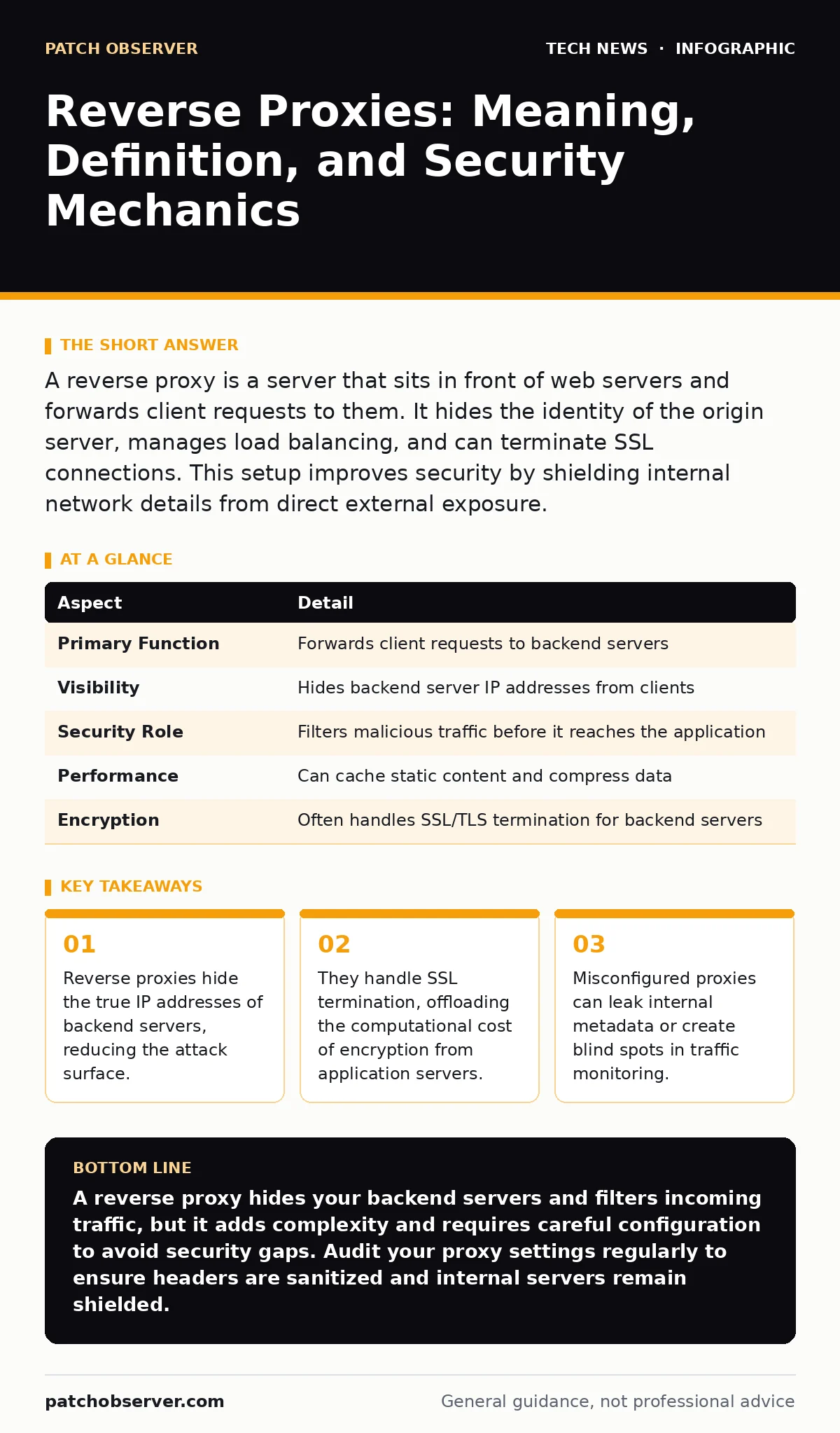
A reverse proxy is a server that sits in front of web servers and forwards client requests to them. It hides the identity of the origin server, manages load balancing, and can terminate SSL connections. This setup improves security by shielding internal network details from direct external exposure.
The Mailroom Analogy
Imagine a large office building with strict security protocols. Visitors cannot walk directly into the executive suites. Instead, they check in at a reception desk. The receptionist verifies their identity, checks if they have an appointment, and then escorts them to the correct office. The visitor never sees the internal layout of the building or the direct paths to the private offices.
A reverse proxy functions exactly like that reception desk for your web servers. Clients send requests to the proxy, not the server. The proxy validates the request and forwards it to the appropriate backend server. The client only knows the proxy’s address, never the server’s.
At a Glance
| Aspect | Detail |
|---|---|
| Primary Function | Forwards client requests to backend servers |
| Visibility | Hides backend server IP addresses from clients |
| Security Role | Filters malicious traffic before it reaches the application |
| Performance | Can cache static content and compress data |
| Encryption | Often handles SSL/TLS termination for backend servers |
How the Term Originated
The term "reverse" distinguishes this device from a forward proxy. A forward proxy sits between a client and the internet, acting on behalf of the client to hide their identity. This is common in corporate environments to control employee web access.
A reverse proxy sits between the internet and a server, acting on behalf of the server to hide its identity. The direction of the anonymity is reversed. In practice, this means the proxy accepts incoming connections from the outside world and routes them inward. This architectural choice allows administrators to place multiple servers behind a single public entry point.
Daily Operational Use
In day-to-day operations, you configure the reverse proxy to listen on standard ports for web traffic. When a request arrives, the proxy examines the headers and the URL path. Based on these details, it decides which backend server should handle the request. This process is called load balancing when you distribute traffic across multiple servers to prevent any single one from becoming overwhelmed.
You also use the proxy to terminate SSL connections. The proxy decrypts the incoming HTTPS traffic and sends plain HTTP to the backend servers. This saves the backend servers from performing expensive cryptographic operations. However, this requires a secure internal network, as the traffic between the proxy and the backend is unencrypted. You must ensure that internal network segmentation prevents unauthorized access to this unencrypted traffic.
Common Misconceptions
Many people believe a reverse proxy is a firewall. This is incorrect. A firewall filters traffic based on IP addresses and ports. A reverse proxy understands application-layer protocols like HTTP. It can inspect the content of the request, not just the connection metadata. While a proxy can block certain requests, it does not replace the need for strict firewall rules at the network perimeter.
Another common error is assuming the proxy automatically secures the backend. If the internal network is compromised, an attacker can bypass the proxy and attack the backend servers directly. The proxy only protects against external threats that must pass through it. You still need to secure the operating systems of the backend servers. This is where practices like Linux server hardening become critical to protect the underlying infrastructure.
See also: Server-Side Template Injection Warning Signs and Immediate Response
The Hidden Cost of Abstraction
Using a reverse proxy adds a layer of complexity to your infrastructure. This is known as the abstraction tax. When something goes wrong, diagnosing the issue becomes harder. Is the error coming from the proxy configuration or the backend application? Logs from the proxy may not show the full picture of the internal server state.
This complexity also introduces a single point of failure. If the proxy goes down, no traffic reaches the backend servers, even if they are healthy. You must design your proxy setup with high availability in mind. This often means running multiple proxy instances behind a load balancer of their own. This circular dependency requires careful planning to avoid cascading failures.
Configuration Pitfalls
One non-obvious risk is header manipulation. Proxies often add or modify headers as they forward requests. If you do not configure the proxy to preserve original client headers accurately, your backend applications may receive incorrect information. For example, the original IP address of the client might be replaced with the proxy’s IP address. This breaks logging and geo-blocking features.
Another pitfall is exposing server version information. If the proxy is not configured to strip or rewrite server headers, it might reveal the software version of the backend server. Attackers use this information to find known vulnerabilities. You must explicitly configure the proxy to remove or sanitize these headers. This ties into broader browser security settings that rely on accurate header information to enforce strict transport security.
Integration with Modern Architectures
Reverse proxies are central to modern web architectures, including microservices. In a microservices environment, you have many small services handling different parts of an application. A reverse proxy routes traffic to the correct service based on the URL path. This allows you to scale individual services independently.
However, this routing complexity increases the attack surface. Each route you define is a potential entry point for abuse. You must validate input at the proxy level before it reaches the microservices. This approach aligns with edge computing security principles, where security checks happen as close to the client as possible. By filtering requests early, you reduce the load on your internal services and prevent malformed data from causing crashes.
Maintenance and Monitoring
Maintaining a reverse proxy requires regular review of access logs and error rates. You should monitor for unusual patterns in request headers or sudden spikes in traffic to specific endpoints. These patterns may indicate automated attacks or misbehaving clients.
You must also keep the proxy software updated. Like any software, proxies can have vulnerabilities. Patching them promptly is necessary to prevent exploitation. This process is similar to maintaining home router security, where the gateway device must be kept current to protect the entire network behind it. Regular audits of your proxy configuration files help ensure that no stale rules or exposed endpoints remain.
Key takeaways
- Reverse proxies hide the true IP addresses of backend servers, reducing the attack surface.
- They handle SSL termination, offloading the computational cost of encryption from application servers.
- Misconfigured proxies can leak internal metadata or create blind spots in traffic monitoring.
A reverse proxy hides your backend servers and filters incoming traffic, but it adds complexity and requires careful configuration to avoid security gaps. Audit your proxy settings regularly to ensure headers are sanitized and internal servers remain shielded.
Frequently asked questions
Does a reverse proxy replace a firewall?
No, a reverse proxy operates at the application layer and understands HTTP traffic, while a firewall operates at the network layer. You need both for defense in depth.
Can a reverse proxy slow down my website?
It can add latency if not configured properly, but it often improves performance by caching static content and compressing data before sending it to clients.
Is SSL termination safe?
It is safe only if the internal network between the proxy and backend servers is secure. Traffic in this segment is unencrypted and vulnerable to interception if the network is compromised.
Do I need a reverse proxy for a single server?
It is not strictly required, but it is recommended. It provides an extra layer of security, handles SSL efficiently, and allows you to hide server details from the public internet.
How this guide was produced: written by the Patch Observer editorial team with AI assistance, checked against the public references listed below, and reviewed when the facts change. See our editorial policy or report an error.