Edge Computing Security: Benefits, Limits, and When to Deploy
Moving security logic to the edge reduces latency but creates thousands of unmanaged attack surfaces that traditional perimeter defenses cannot see or control.

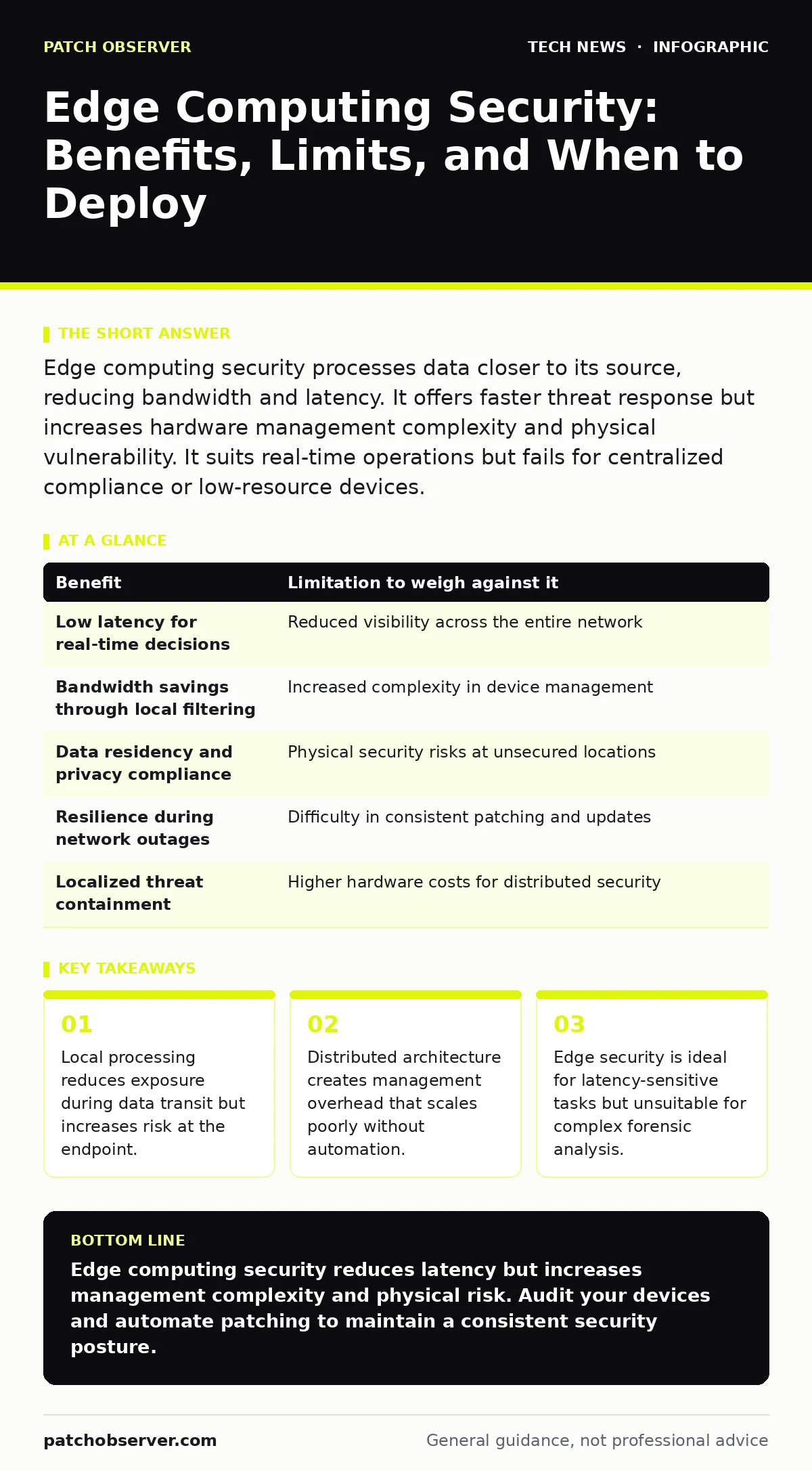
Edge computing security processes data closer to its source, reducing bandwidth and latency. It offers faster threat response but increases hardware management complexity and physical vulnerability. It suits real-time operations but fails for centralized compliance or low-resource devices.
The Shift in Perimeter Defense
Traditional security relies on a strong outer wall. You assume the inside is safe if the perimeter holds. Edge computing shatters this assumption. You push computation and storage to the network edge, closer to where data is generated. This means security controls must also move to the edge.
Imagine a factory floor with hundreds of sensors. Sending every data packet to a central cloud for analysis creates latency. It also exposes the data to interception during transit. By processing data locally, you keep sensitive information away from the public internet. This reduces the attack surface for transit-based threats.
However, you now have hundreds of mini-data centers. Each one requires configuration, monitoring, and patching. The convenience of local processing comes with the burden of distributed management. You trade a single point of failure for many potential failure points.
Concrete Benefits of Local Processing
The primary benefit is reduced latency. When security decisions happen locally, they happen instantly. This is critical for industrial control systems or autonomous vehicles. A delayed security alert can cause physical damage. Local processing allows immediate isolation of compromised devices.
Bandwidth conservation is another advantage. You filter noise at the source. Only relevant alerts or aggregated data travel to the central cloud. This lowers costs and reduces the volume of data exposed to potential eavesdroppers. It also simplifies compliance for data residency requirements. Data stays within the local jurisdiction.
You also gain resilience. If the connection to the central cloud fails, edge nodes can continue to operate securely. They enforce local policies without waiting for remote validation. This ensures business continuity during network outages.
Honest Limitations and Hidden Costs
The biggest limitation is visibility. When security logic is distributed, you lose a single pane of glass. Monitoring thousands of edge devices is difficult. You may miss subtle anomalies that only appear when viewed across the entire fleet. Centralized correlation becomes harder to implement.
Physical security is a major concern. Edge devices are often in unsecured locations. A attacker can physically access an edge server in a warehouse or a retail store. They can tamper with hardware, install keyloggers, or simply steal the device. Traditional cloud providers have guarded data centers. You do not have that luxury at the edge.
Patch management is a logistical nightmare. Updating firmware on a central server is easy. Updating hundreds of dispersed edge nodes requires robust automation. If one device fails during an update, it may become unreachable. You risk creating a fragmented security posture.
Weighing Benefits Against Limitations
You must balance speed against control. The table below outlines the trade-offs. Use this to evaluate your specific use case. Do not assume edge security is better. It is different.
| Benefit | Limitation to weigh against it |
|---|---|
| Low latency for real-time decisions | Reduced visibility across the entire network |
| Bandwidth savings through local filtering | Increased complexity in device management |
| Data residency and privacy compliance | Physical security risks at unsecured locations |
| Resilience during network outages | Difficulty in consistent patching and updates |
| Localized threat containment | Higher hardware costs for distributed security |
When It Is Worth It
Edge computing security is worth it when latency is critical. Suppose you run a smart grid. A power surge must be detected and mitigated in milliseconds. Cloud-based analysis is too slow. Local processing allows immediate action. The risk of physical tamper is worth the operational necessity.
It is also worth it for bandwidth-constrained environments. Imagine a remote mining operation with limited satellite connectivity. Sending terabytes of video footage to the cloud is impossible. Local AI models can analyze video for safety violations. Only alerts are transmitted. This makes security feasible where it would otherwise be too expensive.
Consider edge security when you need data residency. Some regulations require data to stay within specific borders. Processing data locally ensures it never leaves the jurisdiction. This simplifies legal compliance and reduces liability.
See also: Network Access Control Definition: How Policies Block Unauthorized Devices · Firewall Rules FAQ: Troubleshooting Conflicts and Logic Errors
When It Is Not Worth It
Edge computing security is not worth it for low-value devices. Suppose you have a few smart thermostats. The cost of securing each device outweighs the value of the data. Centralized management is cheaper and easier. Do not over-engineer security for trivial endpoints.
It is not worth it if you lack automation skills. Managing hundreds of edge nodes manually is unsustainable. If you cannot automate patching and configuration, you will fall behind. The security posture will degrade over time. Centralized security is more reliable for small teams.
Avoid edge security for complex forensic analysis. Edge devices have limited storage and compute power. They cannot store long-term logs or run heavy analytical queries. If you need deep historical analysis, centralize the data. Use edge for real-time alerts only.
Integration With Central Security
Edge security does not replace central security. It complements it. You need a hybrid approach. Edge devices handle real-time threats. Central systems handle long-term analysis and policy management. Ensure your edge devices can communicate securely with the central hub.
Use standard protocols for communication. This ensures interoperability and reduces vendor lock-in. Implement mutual authentication between edge and cloud. This prevents unauthorized devices from joining the network. Regularly audit the connection integrity.
Review related topics for deeper insights. See Linux server hardening for securing edge servers. Understand hashing to verify data integrity during local processing. Consider home router security principles for edge gateways. These foundational practices apply to edge environments.
Implementing a Secure Edge Strategy
Start with inventory. You cannot secure what you do not know. Catalog all edge devices, their locations, and their functions. Identify which devices handle sensitive data. Prioritize these for enhanced security measures.
Enforce least privilege. Edge devices should only have the permissions they need. Disable unnecessary services and ports. Use hardware security modules for key management if available. This protects cryptographic keys from extraction.
Monitor continuously. Use automated tools to detect anomalies. Set up alerts for unusual behavior. Regularly update firmware and software. Test your incident response plan for edge-specific scenarios. Ensure you can isolate a compromised device quickly.
Key takeaways
- Local processing reduces exposure during data transit but increases risk at the endpoint.
- Distributed architecture creates management overhead that scales poorly without automation.
- Edge security is ideal for latency-sensitive tasks but unsuitable for complex forensic analysis.
Edge computing security reduces latency but increases management complexity and physical risk. Audit your devices and automate patching to maintain a consistent security posture.
Frequently asked questions
Does edge computing eliminate the need for cloud security?
No, edge computing complements cloud security. You still need centralized monitoring, policy management, and long-term storage. Edge handles real-time processing, while the cloud handles analysis and archival.
How do I protect edge devices from physical tampering?
Use tamper-evident seals, secure enclosures, and remote wipe capabilities. Monitor device integrity through hardware sensors. Assume physical access is possible and plan for key rotation.
Can I use standard firewalls for edge security?
Standard firewalls are too heavy for many edge devices. Use lightweight intrusion detection systems or application-layer firewalls. Focus on protocol-specific filtering rather than deep packet inspection.
What happens if an edge device loses connectivity?
It should continue to enforce local security policies. Ensure devices have cached configurations and can operate autonomously. They should queue data for later transmission when connectivity is restored.
How this guide was produced: written by the Patch Observer editorial team with AI assistance, checked against the public references listed below, and reviewed when the facts change. See our editorial policy or report an error.