How to Prevent SQL Injection Attack: 3 Layers of Defense
Prepared statements eliminate injection by separating code from data, while input validation alone fails when parsers interpret special characters as logic rather than content.

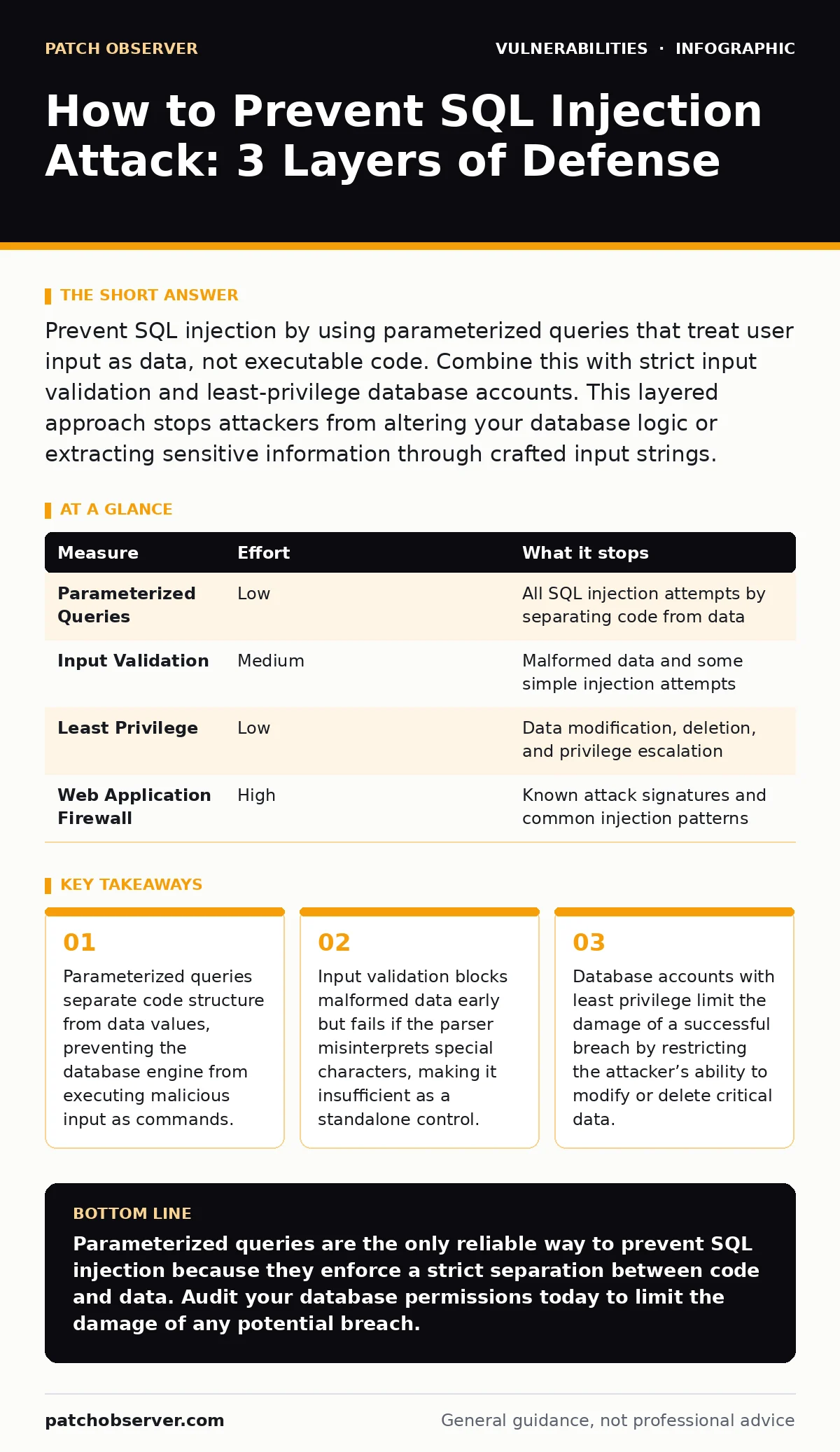
Prevent SQL injection by using parameterized queries that treat user input as data, not executable code. Combine this with strict input validation and least-privilege database accounts. This layered approach stops attackers from altering your database logic or extracting sensitive information through crafted input strings.
How to Prevent SQL Injection Attack
SQL injection remains one of the most persistent web application vulnerabilities because it exploits the fundamental way databases process requests. Attackers insert malicious SQL code into input fields, tricking the database into executing unintended commands. The core problem is the failure to distinguish between executable code and data content. When you mix these two elements, the database cannot tell where your query ends and the attacker’s command begins. This confusion allows an attacker to read, modify, or delete data, bypass authentication, or even execute system commands on the host server. The solution requires a strict separation of concerns at the application level.
Parameterized Queries as the Primary Defense
Parameterized queries, also known as prepared statements, are the single most effective measure against SQL injection. This technique sends the SQL command structure to the database first, with placeholders for data values. The database compiles this structure into an execution plan. Only after compilation does the application send the actual data values. Because the database has already defined the command structure, it treats all incoming data strictly as literal values. An attacker cannot inject a command like DROP TABLE because the database engine never interprets that string as code. It remains inert data. This method works regardless of the complexity of the input or the character set used. It forces the database to maintain a rigid boundary between logic and content.
Why Input Validation Fails Alone
Input validation checks whether data matches expected formats, such as requiring only digits for an age field or specific characters for a username. While useful for data quality, validation is a poor security control on its own. Attackers can often bypass simple regex rules by using encoding tricks or unexpected character sequences. More critically, validation happens at the application layer, while injection happens at the database layer.
If the application fails to catch a malicious string, the database still receives it. If the application then concatenates that string into a SQL command, the injection succeeds. Validation reduces the attack surface but does not eliminate the risk. It acts as a filter, not a shield. You must assume that some malicious data will pass through validation and reach the database.
| Measure | Effort | What it stops |
|---|---|---|
| Parameterized Queries | Low | All SQL injection attempts by separating code from data |
| Input Validation | Medium | Malformed data and some simple injection attempts |
| Least Privilege | Low | Data modification, deletion, and privilege escalation |
| Web Application Firewall | High | Known attack signatures and common injection patterns |
The Hidden Cost of Concatenation
Many legacy applications build SQL strings by concatenating user input directly into the query text. This practice is the root cause of most injection vulnerabilities. When you concatenate strings, you give the user control over the SQL syntax. Imagine a login form that builds a query like SELECT * FROM users WHERE name = ' + username + '. If the user enters ' OR '1'='1, the resulting query becomes SELECT * FROM users WHERE name = '' OR '1'='1'. The condition '1'='1' is always true. The database returns every row in the table. This simple trick bypasses authentication entirely. The cost of rewriting these queries is often underestimated. Refactoring legacy code to use parameterized statements requires testing and discipline. However, the cost of a breach far exceeds the development effort.
Least Privilege Database Accounts
Even if an attacker successfully injects SQL code, their impact depends on the permissions of the database account used by the application. Many applications connect to the database using an admin account or a user with full read and write access. This is a critical error. The application should use an account with the minimum permissions required to function. If the application only needs to read data, the account should have only SELECT permissions. If it needs to update records, it should have UPDATE permissions on specific tables, not the entire schema. This limits the damage of a successful injection. An attacker cannot drop tables, create new users, or read sensitive data from unrelated tables if the account lacks those privileges. This defense is cheap to implement and highly effective.
Server-Side Template Injection Risks
Modern frameworks often use template engines to generate HTML or SQL. If these templates allow dynamic code execution, they introduce a different but related risk. Server-side template injection occurs when user input is processed by the template engine as code. This can lead to remote code execution, which is more severe than SQL injection.
While not the same vulnerability, the prevention strategy is similar: never trust user input. Ensure that template engines treat user data as plain text. Disable any features that allow arbitrary code execution within templates. This defense is relevant when you use modern frameworks that blur the line between data and logic. Understanding the distinction helps you apply the right controls to the right component.
What Does Not Work on Its Own
Several popular measures are often touted as complete solutions but fail when used in isolation. Stored procedures can help, but if they accept parameters and concatenate them into dynamic SQL, they remain vulnerable. Blacklisting specific characters like semicolons or quotes is easily bypassed using encoding or alternative syntax.
Web Application Firewalls (WAFs) are useful for blocking known attack patterns, but they cannot inspect every possible variant of a malicious payload. They provide a layer of defense in depth, not a complete fix. The application code itself must be secure. Relying on a WAF to fix bad coding practices is like locking the front door while leaving the windows open. It delays the attacker but does not stop them.
Vulnerability Prioritization in Practice
Not all SQL injection vulnerabilities are equal. Some allow an attacker to read sensitive data, while others allow them to execute system commands. You must prioritize remediation based on the potential impact. Use vulnerability prioritization techniques to identify which endpoints are most critical. Focus on authentication flows, data retrieval endpoints, and admin panels first.
These are the most attractive targets for attackers. Fixing the most dangerous vulnerabilities first reduces your risk profile significantly. This approach ensures that your limited resources are spent where they matter most. It is better to have a few critical endpoints perfectly secured than many endpoints partially protected.
Closing Checklist for Immediate Action
You do not need to rewrite your entire application today. Start with these three actions to reduce your immediate risk.
- Audit your database accounts and revoke unnecessary privileges. Ensure application users have only the permissions they need.
- Identify all places where user input is concatenated into SQL strings. Mark these for refactoring to use parameterized queries.
- Review your input validation rules to ensure they are strict but not the sole line of defense. Add logging to detect potential injection attempts.
These steps provide immediate risk reduction while you plan a longer-term refactoring effort. They are low-cost, high-impact actions that any team can implement today.
Key takeaways
- Parameterized queries separate code structure from data values, preventing the database engine from executing malicious input as commands.
- Input validation blocks malformed data early but fails if the parser misinterprets special characters, making it insufficient as a standalone control.
- Database accounts with least privilege limit the damage of a successful breach by restricting the attacker’s ability to modify or delete critical data.
Parameterized queries are the only reliable way to prevent SQL injection because they enforce a strict separation between code and data. Audit your database permissions today to limit the damage of any potential breach.
Frequently asked questions
Is escaping special characters enough to stop SQL injection?
Escaping characters like quotes and semicolons is error-prone and easily bypassed. It does not guarantee safety because new encoding tricks and parser behaviors emerge regularly. Parameterized queries are safer because they never interpret data as code.
Do stored procedures prevent SQL injection automatically?
No. Stored procedures only prevent injection if they use parameterized inputs internally. If the procedure builds dynamic SQL strings by concatenating parameters, it remains vulnerable. The protection comes from how the procedure handles input, not from the procedure itself.
Can a Web Application Firewall replace secure coding practices?
No. A WAF blocks known attack signatures but cannot detect every novel injection technique. It is a defensive layer, not a substitute for secure code. Relying solely on a WAF leaves your application vulnerable to zero-day attacks or custom payloads that bypass the firewall rules.
How do I know if my application is vulnerable to SQL injection?
Manual code review is the most accurate method. Look for places where user input is inserted into SQL strings. Automated scanners can help identify potential issues, but they may produce false positives or miss complex logic. Combine both methods for a thorough assessment.
How this guide was produced: written by the Patch Observer editorial team with AI assistance, checked against the public references listed below, and reviewed when the facts change. See our editorial policy or report an error.