Logging Library Vulnerabilities: Definition, Risks, and Remediation
Logging libraries often bypass input validation, allowing attackers to inject code or exfiltrate sensitive data through standard diagnostic outputs.

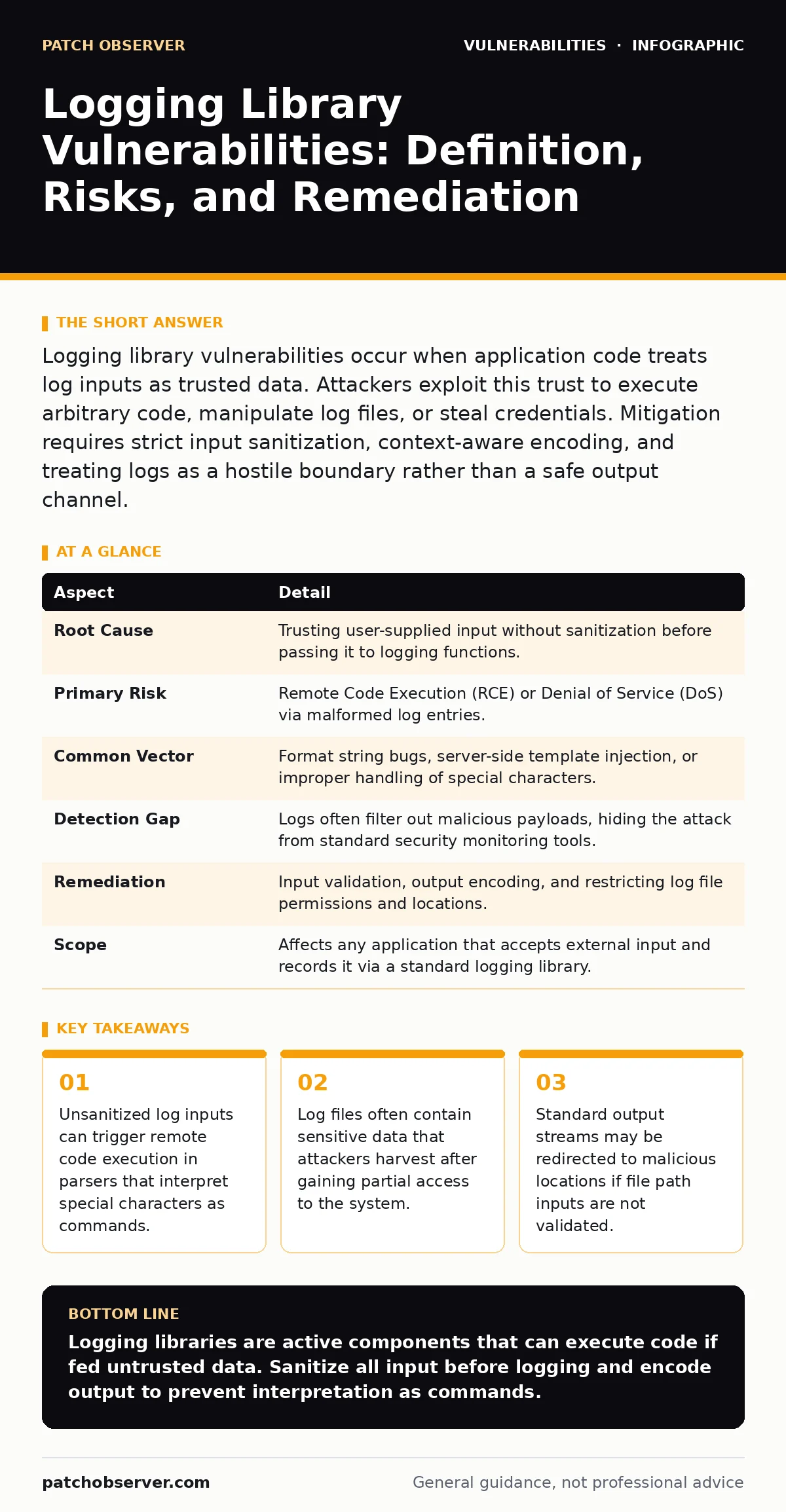
Logging library vulnerabilities occur when application code treats log inputs as trusted data. Attackers exploit this trust to execute arbitrary code, manipulate log files, or steal credentials. Mitigation requires strict input sanitization, context-aware encoding, and treating logs as a hostile boundary rather than a safe output channel.
The Silent Channel in Application Architecture
Imagine a security guard who writes down every visitor’s name in a guest book. Now imagine a visitor writes a command in the book that the guard reads aloud to the entire building. The guard trusts the book is just for record-keeping, but the content carries executable intent. Logging libraries function similarly. They are designed to capture system events for debugging and auditing. They are not designed to interpret the semantic meaning of the data they capture. This disconnect creates a persistent attack surface that many development teams overlook during initial design phases.
Developers treat logs as passive records. Attackers treat them as active channels. The vulnerability exists because the logging component often processes the string data before writing it to disk or sending it to a remote aggregator. This processing step is where the exploitation occurs. The application assumes the data is harmless text. The logging library may parse that text using rules that allow code execution, format string expansion, or path traversal.
| Aspect | Detail |
|---|---|
| Root Cause | Trusting user-supplied input without sanitization before passing it to logging functions. |
| Primary Risk | Remote Code Execution (RCE) or Denial of Service (DoS) via malformed log entries. |
| Common Vector | Format string bugs, server-side template injection, or improper handling of special characters. |
| Detection Gap | Logs often filter out malicious payloads, hiding the attack from standard security monitoring tools. |
| Remediation | Input validation, output encoding, and restricting log file permissions and locations. |
| Scope | Affects any application that accepts external input and records it via a standard logging library. |
How Exploitation Occurs in Practice
The mechanism of exploitation relies on the logging library’s parsing behavior. Many libraries use format strings to structure output. These strings contain placeholders that are replaced with variable data at runtime. If an attacker can control the data that fills these placeholders, they can also control the format string itself. This allows them to read from or write to arbitrary memory locations. The library interprets the attacker’s input as instructions rather than text.
Another common mechanism involves template engines. Some logging frameworks use lightweight templating to customize message formats. If the template language supports variable expansion or function calls, an attacker can inject template code into the log message. When the library processes the message, it executes the injected template. This is a form of server-side template injection. The code runs with the privileges of the application server. This bypasses traditional web application firewalls that inspect HTTP requests but not the internal processing of log strings.
Who Bears the Impact
Any organization that deploys software accepting external input is at risk. Web applications, mobile backends, and IoT devices all rely on logging for operational visibility. The impact extends beyond the immediate application. Logging libraries are often shared components across multiple services. A vulnerability in a shared logging library can compromise an entire microservices ecosystem. Managed service providers must scrutinize these shared dependencies because a single flawed library version can affect dozens of client environments simultaneously.
Attackers target logging libraries because they are rarely hardened against input manipulation. Security teams focus on input validation at the API gateway or database layer. They often assume that data reaching the logging layer is already sanitized. This assumption is dangerous. If the application logic fails to sanitize data before logging, the logger becomes the execution point. The attacker gains control over the server’s process space. This allows them to install backdoors, pivot to other internal systems, or exfiltrate data stored in memory.
Common Forms of Vulnerability
Format string vulnerabilities remain prevalent in C and C++ applications. These languages allow developers to specify output formats using special characters. If user input is passed directly as the format string, the attacker can leak memory or crash the application. Even in higher-level languages, similar issues arise with string interpolation. If the interpolation mechanism does not escape special characters, it can lead to unintended behavior.
Server-side template injection is another frequent issue. Logging frameworks that support dynamic message formatting are susceptible. Attackers inject template syntax into log messages. The framework renders the template, executing embedded code. This is particularly dangerous in cloud-native environments where applications run with elevated privileges. The resulting code execution can compromise the entire container or host.
Path traversal vulnerabilities occur when log file names are derived from user input. Attackers can inject directory traversal sequences to write logs to sensitive locations. This can overwrite system configuration files or web-accessible pages. It can also be used to create files that are executed by other system processes. This form of attack is less about code execution within the logging library and more about abusing the file system permissions granted to the application.
Denial of service attacks exploit the resource consumption of logging operations. Attackers send massive volumes of log data or complex strings that trigger expensive parsing routines. This can exhaust disk space, memory, or CPU resources. The application becomes unresponsive or crashes. This is a low-skill attack vector but highly effective against systems that do not rate-limit or size-limit log entries.
What People Usually Get Wrong
A common misconception is that logging is a passive activity. Developers view logging as a side effect of application execution. They do not consider the security implications of the data flow into the logger. This mental model leads to inadequate input validation. The data is logged before it is sanitized because the sanitization logic is placed downstream in the application flow.
Another mistake is assuming that log aggregation tools sanitize data. Centralized logging platforms often parse and index log entries. If the data is already malicious, the aggregation tool may execute code during parsing. This spreads the vulnerability from the application server to the logging infrastructure. Attackers can compromise the central log repository, gaining access to logs from multiple applications.
Some teams believe that restricting log file permissions is sufficient. While this mitigates path traversal and unauthorized access, it does not prevent remote code execution within the application process. The attacker can still execute code in the memory space of the application. File permissions do not protect against memory corruption or template injection.
Reducing Risk Through Defense in Depth
Input validation is the first line of defense. Treat all external input as untrusted. Validate data types, lengths, and character sets before passing them to logging functions. Reject or sanitize any input that contains special characters or control sequences. This prevents format string attacks and template injection. Validation should occur at the application boundary, not inside the logging library.
Output encoding is the second layer. Encode special characters in log messages to ensure they are treated as literal text. This prevents the logging library from interpreting them as commands or format specifiers. Use context-aware encoding that matches the destination of the log. Logs sent to a web interface require HTML encoding. Logs sent to a syslog server may require different escaping rules.
Restrict the privileges of the application process. The application should run with the minimum permissions necessary to perform its tasks. This limits the impact of a successful exploit. If the attacker gains code execution, they cannot easily escalate privileges to the system administrator. This is a key principle in secure configuration baselines.
Regularly update logging libraries. Vendors frequently release patches for discovered vulnerabilities. Implement a process to track dependency updates and apply them promptly. Use automated tools to scan for known vulnerabilities in your software supply chain. This includes checking for vulnerabilities in transitive dependencies that your library relies on.
Monitor log patterns for anomalies. Look for unusual characters, excessive log volume, or failed log writes. These can indicate an ongoing attack. Integrate log monitoring with your security incident response process. This allows you to detect and respond to exploitation attempts in real time. Consider the relationship between logging library vulnerabilities and exploit chains, as a logger breach is often the initial foothold for deeper system compromise.
Verification and Maintenance
Establish a baseline for normal logging behavior. Define what constitutes a valid log entry. Use this baseline to detect deviations. Automated tools can help enforce these baselines. They can block or flag log entries that do not conform to expected patterns. This reduces the noise in your security monitoring and highlights genuine threats.
Conduct regular code reviews focused on logging practices. Look for instances where user input is passed directly to logging functions. Ensure that input validation and output encoding are consistently applied. Train developers on the security implications of logging. Make them aware of the risks associated with format strings, template injection, and path traversal.
Review log file configurations. Ensure that log files are stored in secure locations with restricted access. Rotate and archive logs regularly to prevent disk exhaustion. Encrypt logs at rest and in transit to protect sensitive data. This protects against data exfiltration even if the logging infrastructure is compromised.
Integrate security testing into your CI/CD pipeline. Use static analysis tools to detect potential logging vulnerabilities in your code. Use dynamic analysis tools to test for runtime exploitation. This ensures that new vulnerabilities are caught before they reach production. Maintain a register of all logging libraries in use. Track their versions and known vulnerabilities. This allows for rapid response when new threats are identified.
Key takeaways
- Unsanitized log inputs can trigger remote code execution in parsers that interpret special characters as commands.
- Log files often contain sensitive data that attackers harvest after gaining partial access to the system.
- Standard output streams may be redirected to malicious locations if file path inputs are not validated.
Logging libraries are active components that can execute code if fed untrusted data. Sanitize all input before logging and encode output to prevent interpretation as commands.
Frequently asked questions
Do logging library vulnerabilities affect only web applications?
No, any application that accepts external input and logs it is at risk. This includes desktop software, mobile apps, and IoT devices. The vulnerability exists in the code, not the delivery mechanism.
How do I know if my logging library is vulnerable?
Check the version against known vulnerability databases. Review the library’s documentation for input handling requirements. Conduct code reviews to identify unsanitized input paths leading to logging functions.
Can output encoding completely prevent these attacks?
Output encoding reduces risk significantly but is not a silver bullet. It must be combined with input validation and secure configuration. If the logging library has a memory corruption bug, encoding may not prevent exploitation.
Should I disable logging in production environments?
No, logging is critical for security monitoring and debugging. Instead of disabling it, secure the logging process. Use structured logging, sanitize inputs, and restrict access to log data.
How this guide was produced: written by the Patch Observer editorial team with AI assistance, checked against the public references listed below, and reviewed when the facts change. See our editorial policy or report an error.