How Secure Configuration Baselines Work: The Mechanism and Limits
Secure configuration baselines function as a continuous drift detection system that compares live system states against a known good state to identify unauthorized changes before exploitation occurs.

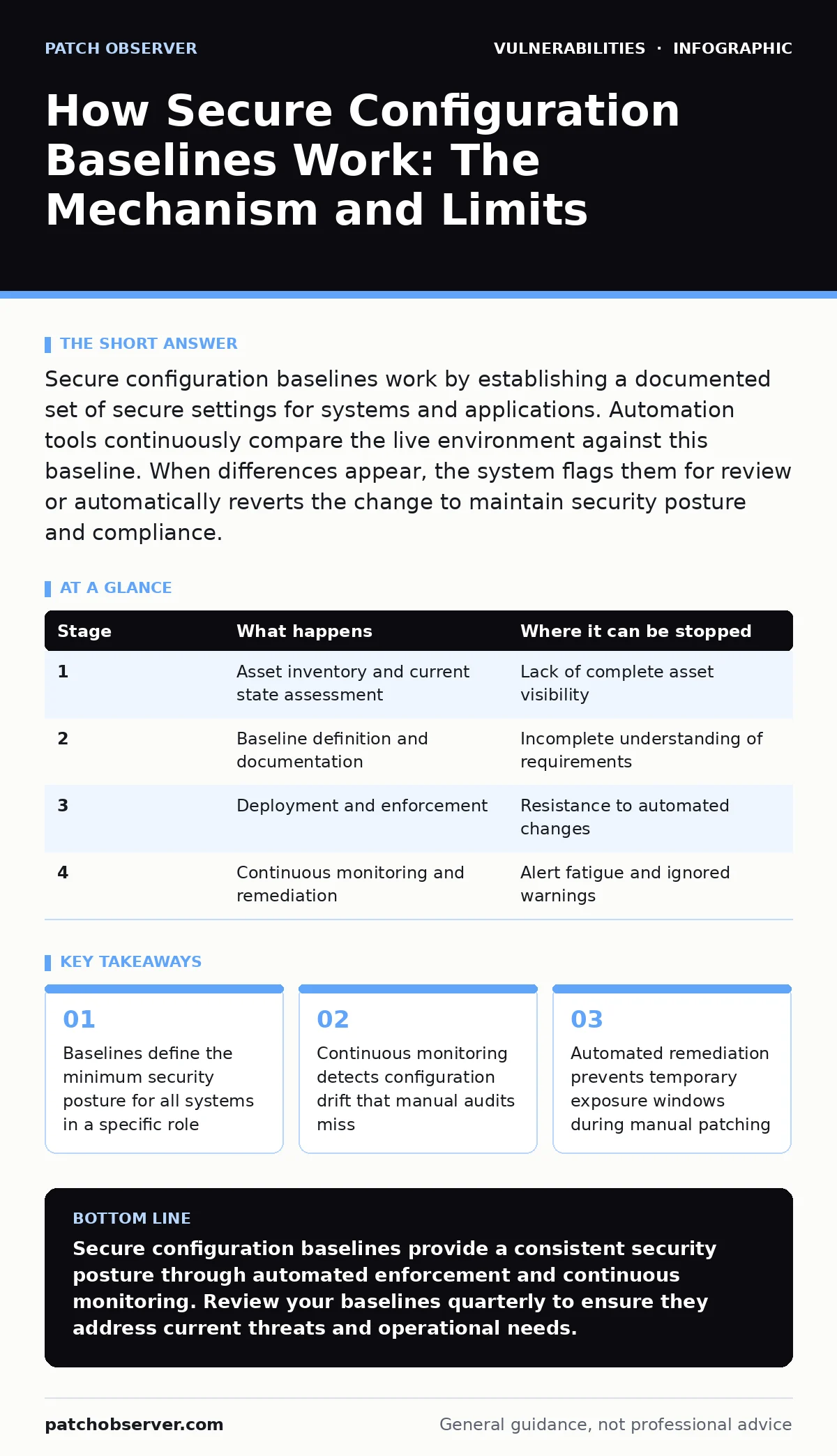
Secure configuration baselines work by establishing a documented set of secure settings for systems and applications. Automation tools continuously compare the live environment against this baseline. When differences appear, the system flags them for review or automatically reverts the change to maintain security posture and compliance.
Defining the Baseline Architecture
A secure configuration baseline is a documented set of secure settings for a specific system type. You create this baseline by analyzing the software, its dependencies, and its intended function. The baseline defines which services run, which ports listen, and which user permissions exist. This process requires deep technical knowledge of the operating system and application stack. You must document every setting that affects security, not just the obvious ones.
The baseline serves as the single source of truth for that system type. Any deviation from this state represents a potential security risk. You build the baseline by starting with a vanilla installation and applying only necessary configurations. This approach ensures you do not inherit insecure defaults from previous deployments. You must validate the baseline in a test environment before deploying it to production.
Imagine a web server that requires only HTTP and HTTPS traffic. The baseline disables FTP, SSH, and Telnet services. It restricts file permissions for the web root directory. It configures the firewall to drop all other inbound traffic. This strict definition creates a predictable security posture.
Stage 1: Inventory and Assessment
Stage 1: Inventory and Assessment
The first stage involves identifying every asset that requires a baseline. You catalog servers, containers, and network devices by their function. You assess the current configuration of each asset against security best practices. This assessment reveals existing vulnerabilities and misconfigurations. You document the current state to establish a starting point.
This stage often uncovers legacy configurations that no longer serve a purpose. You identify unused accounts, disabled services, and outdated software versions. You map the dependencies between systems to understand the impact of changes. This mapping is critical for understanding how a change in one system affects others.
| Stage | What happens | Where it can be stopped |
|---|---|---|
| 1 | Asset inventory and current state assessment | Lack of complete asset visibility |
| 2 | Baseline definition and documentation | Incomplete understanding of requirements |
| 3 | Deployment and enforcement | Resistance to automated changes |
| 4 | Continuous monitoring and remediation | Alert fatigue and ignored warnings |
Stage 2: Baseline Definition and Documentation
Stage 2: Baseline Definition and Documentation
You define the secure settings for each system type in this stage. You document the required configuration for the operating system, middleware, and applications. You specify user permissions, network settings, and logging requirements. You align these settings with industry standards and regulatory requirements. This documentation becomes the reference for all future configurations.
The baseline must be specific and actionable. Vague instructions lead to inconsistent implementations. You define exact values for security parameters. You specify which cryptographic algorithms are approved. You document the steps to verify that each setting is applied correctly. This precision allows for automated validation.
Stage 3: Deployment and Enforcement
Stage 3: Deployment and Enforcement
You apply the baseline to new systems during provisioning. You use configuration management tools to enforce these settings automatically. This automation ensures consistency across all instances. You also apply the baseline to existing systems to remediate known issues. This process may require downtime or careful scheduling to avoid service disruption.
Enforcement mechanisms prevent users from making unauthorized changes. You configure systems to reject inputs that violate the baseline. You implement role-based access controls to limit who can modify configurations. This control reduces the risk of insider threats and accidental misconfigurations.
Stage 4: Continuous Monitoring and Remediation
Stage 4: Continuous Monitoring and Remediation
The final stage involves continuously monitoring systems for configuration drift. You use agents or agentless scanners to check the live state against the baseline. These tools run at regular intervals to detect changes. When a deviation is detected, the system generates an alert. You can configure the system to automatically revert unauthorized changes.
This continuous process ensures that the system remains secure even after initial deployment. Users may change settings for troubleshooting or feature requests. These changes often introduce vulnerabilities. Automated remediation restores the secure state without manual intervention. This capability is critical for maintaining compliance and security.
Understanding the Limits of Baselines
Secure configuration baselines do not protect against all threats. They cannot prevent zero-day exploits or application logic flaws. They assume that the baseline itself is secure and up to date. If the baseline contains errors, all systems will inherit those errors. You must regularly review and update the baseline to address new threats.
Baselines also struggle with dynamic environments. Containers and serverless functions change state frequently. Traditional baselines may not account for these ephemeral resources. You need specialized tools to monitor these environments. Additionally, baselines cannot detect malicious code that runs within allowed configurations.
Integrating with Broader Security Practices
Baselines work best when integrated with other security measures. You should combine them with vulnerability management and patch management processes. Regular updates ensure that the baseline reflects the latest security requirements. You should also monitor for Kubernetes misconfigurations if you use container orchestration. These environments require specialized baselines due to their complexity.
Consider how firmware updates interact with your baselines. Firmware changes can alter hardware-level settings that software baselines cannot control. You must include firmware integrity checks in your overall security strategy. Similarly, logging library vulnerabilities can compromise the visibility you rely on for monitoring. Ensure your logging components are secure and up to date.
Maintaining Baseline Integrity Over Time
Maintenance is the most challenging aspect of baseline management. You must balance security with operational needs. Business requirements change, and systems must adapt. You need a process for approving and implementing changes to the baseline. This process should include security review and testing.
You should automate the testing of baseline changes. Any change that breaks functionality must be rejected. You should also monitor for Windows privilege escalation vulnerabilities that may require baseline adjustments. When new exploits emerge, you may need to tighten settings or disable features. This agility ensures that your baselines remain effective against evolving threats.
The Hidden Costs of Configuration Drift
Configuration drift occurs when systems deviate from their baseline over time. This drift happens due to manual changes, software updates, or user modifications. Drift increases the attack surface and reduces predictability. It makes incident response more difficult because the system state is unknown.
The cost of drift includes increased vulnerability to attacks and compliance failures. You spend more time investigating alerts that turn out to be benign changes. You also risk service outages when unauthorized changes conflict with other systems. Continuous monitoring reduces these costs by detecting drift early.
Conclusion and Next Steps
Secure configuration baselines provide a foundation for system security. They ensure consistency, reduce risk, and simplify compliance. However, they are not a silver bullet. You must maintain them, update them, and integrate them with other security practices. The goal is to create a resilient security posture that adapts to change.
You should start by defining baselines for your most critical systems. Use automation to enforce these baselines and monitor for drift. Regularly review and update your baselines to address new threats. By treating baselines as living documents, you ensure long-term security effectiveness.
Key takeaways
- Baselines define the minimum security posture for all systems in a specific role
- Continuous monitoring detects configuration drift that manual audits miss
- Automated remediation prevents temporary exposure windows during manual patching
- Baselines reduce attack surface by disabling unused services and ports
Secure configuration baselines provide a consistent security posture through automated enforcement and continuous monitoring. Review your baselines quarterly to ensure they address current threats and operational needs.
Frequently asked questions
How often should I update my secure configuration baselines?
You should update baselines whenever new vulnerabilities are discovered or system requirements change. Quarterly reviews are a good minimum frequency.
Can baselines prevent all types of cyber attacks?
No. Baselines reduce the attack surface but cannot prevent zero-day exploits or application logic flaws. They must be part of a layered security strategy.
What is configuration drift and why does it matter?
Configuration drift is the gradual deviation from a secure baseline. It matters because it introduces unknown vulnerabilities and complicates incident response.
How do I handle baseline changes in dynamic cloud environments?
Use infrastructure-as-code and automated policy enforcement. These tools can apply and verify baselines rapidly in ephemeral environments.
How this guide was produced: written by the Patch Observer editorial team with AI assistance, checked against the public references listed below, and reviewed when the facts change. See our editorial policy or report an error.