What Is WPA3 SAE: How Simultaneous Authentication Secures Wi-Fi
WPA3 SAE prevents offline dictionary attacks by forcing attackers to interact with the network for every password guess, making brute force impractical.
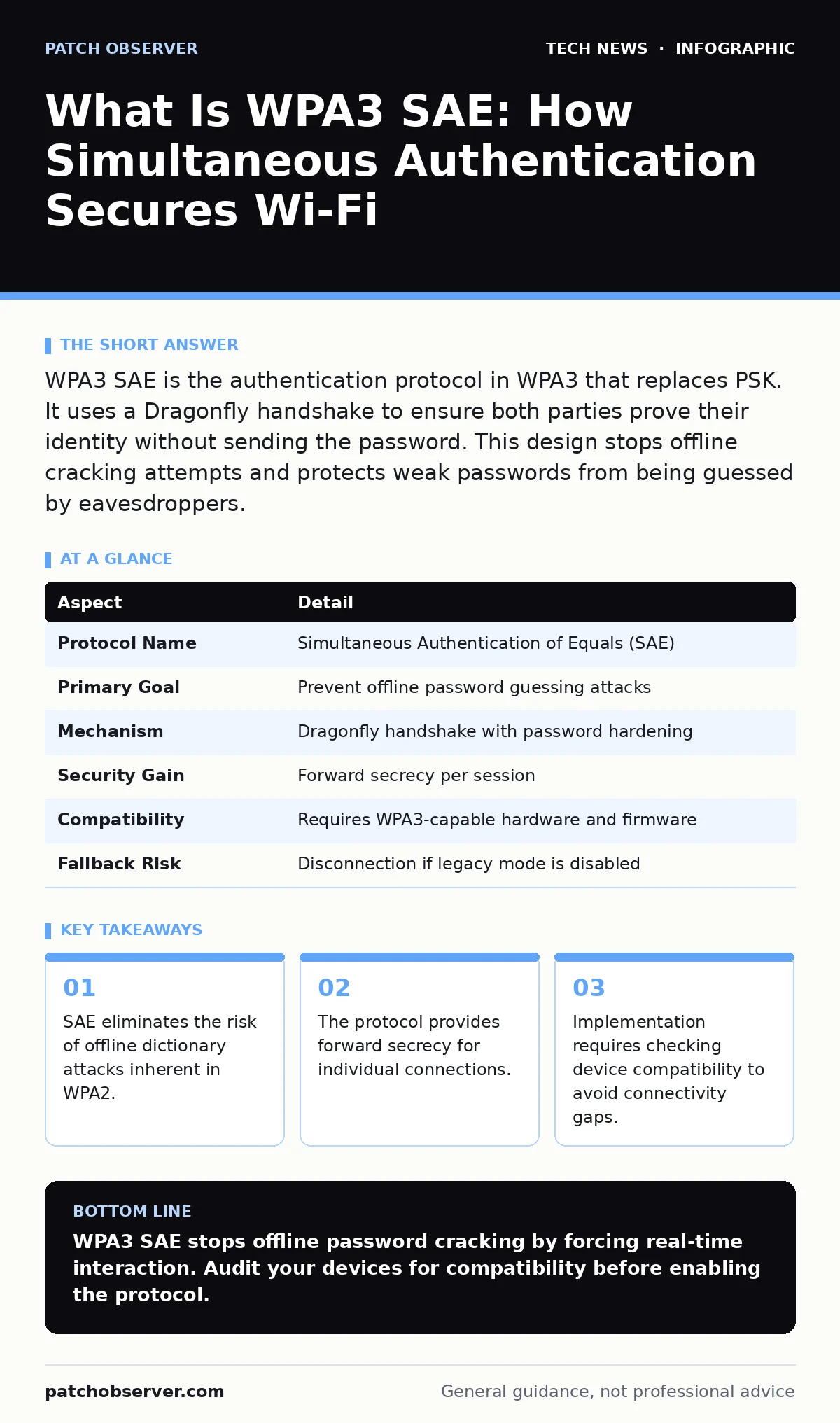
WPA3 SAE is the authentication protocol in WPA3 that replaces PSK. It uses a Dragonfly handshake to ensure both parties prove their identity without sending the password. This design stops offline cracking attempts and protects weak passwords from being guessed by eavesdroppers.
Everyday Analogy for Secure Handshakes
Imagine you and a friend agree to meet at a park. In the old method, you both shout your secret meeting code across the square. Anyone listening can record that shout and try thousands of codes later in private. With the new method, you both perform a synchronized dance move based on the code. An observer sees the dance but cannot reverse-engineer the code from the movement alone. WPA3 SAE operates on this principle of mutual proof without exposure.
What Is WPA3 SAE
What is WPA3 SAE? It is the Simultaneous Authentication of Equals protocol that defines how devices prove their identity on WPA3 networks. SAE replaces the Pre-Shared Key method used in WPA2. Instead of exchanging a password hash that can be captured and cracked later, SAE performs a real-time cryptographic handshake. This handshake ensures that both the client and the access point derive the same encryption key without ever transmitting the password or a crackable hash.
| Aspect | Detail |
|---|---|
| Protocol Name | Simultaneous Authentication of Equals (SAE) |
| Primary Goal | Prevent offline password guessing attacks |
| Mechanism | Dragonfly handshake with password hardening |
| Security Gain | Forward secrecy per session |
| Compatibility | Requires WPA3-capable hardware and firmware |
| Fallback Risk | Disconnection if legacy mode is disabled |
How the Dragonfly Handshake Works
The core of SAE is the Dragonfly handshake. This algorithm transforms the shared password into a group element using a process called password hardening. Both the client and the access point compute this value independently. They then exchange public values derived from these computations. If an attacker tries to guess the password, they must interact with the access point for each guess. This interaction triggers rate limiting and alerts. The system detects the anomaly because legitimate clients only authenticate once. Offline cracking becomes impossible because the attacker lacks the necessary response data from the server.
Who Affected by the Transition
Every organization deploying Wi-Fi networks faces this change. Home users benefit from automatic protection against casual eavesdropping. Enterprise environments must manage the complexity of mixed device populations. Internet of Things devices often lack the processing power for SAE. Legacy smartphones and laptops may not support the protocol at all. You must audit your inventory to identify devices that rely on WPA2. Ignoring this audit leads to service disruptions when you upgrade the access point. The shift affects anyone who manages network access control policies. You cannot enforce security standards if endpoints cannot meet them.
Common Misconceptions About SAE
People often believe that WPA3 SAE makes weak passwords safe. This belief is dangerous. SAE prevents offline cracking, but it does not stop online guessing. An attacker can still attempt to log in with common passwords. If the password is "password123", an attacker can guess it in seconds during the handshake. You must still enforce strong password policies. Another mistake is assuming SAE provides full forward secrecy. It only provides forward secrecy for the specific session key. The underlying password remains a vulnerability if compromised. Do not confuse protocol strength with credential hygiene.
See also: Telegram link and domain outages: Understanding routing failures · Getting a Reddit API Key: Account Types and Rate Limits Explained
Implementation Trade-Offs and Costs
Deploying WPA3 SAE introduces operational friction. The primary cost is compatibility testing. You must verify that all client devices can authenticate. Some older devices will fail to connect. You may need to maintain a separate network for legacy hardware. This creates a security gap where older devices use weaker encryption. Another cost is the processing overhead. SAE requires more CPU cycles than WPA2 PSK. Low-end access points may experience higher latency during peak connection times. You must balance security gains against performance requirements. Monitoring network monitoring tools helps identify authentication failures early.
Strategic Integration Steps
Start by identifying devices that lack WPA3 support. Create a list of exceptions and plan for their replacement or isolation. Configure your access points to enable WPA3 SAE mode. Test the configuration in a non-production environment. Verify that authentication succeeds for all critical devices. Monitor the logs for handshake failures.
Adjust rate limiting settings to balance security and usability. Document the new baseline for your security operations. This process mirrors the discipline required for API key security. You must control access points rigorously. Consider integrating with network access control systems to enforce device compliance automatically. This ensures that only verified devices join the network.
Long-Term Security Posture
WPA3 SAE represents a significant step forward in wireless security. It addresses the fundamental flaw of offline cracking in previous standards. However, it is not a silver bullet. You must combine it with other security measures. Use strong passwords to resist online guessing. Implement network segmentation to limit lateral movement. Regularly update firmware to patch implementation bugs. The protocol evolves, and so must your defenses. Stay informed about new vulnerabilities in the Dragonfly handshake. Security is a continuous process, not a one-time configuration.
Conclusion on Wireless Protocols
The transition to WPA3 SAE is inevitable. The security benefits outweigh the implementation costs. You must act proactively to avoid being left behind. Plan your rollout carefully. Test thoroughly. Educate users about the importance of strong passwords. By understanding the mechanics of SAE, you can deploy it effectively. This knowledge protects your infrastructure from modern threats. The future of wireless security depends on these foundational changes.
Key takeaways
- SAE eliminates the risk of offline dictionary attacks inherent in WPA2.
- The protocol provides forward secrecy for individual connections.
- Implementation requires checking device compatibility to avoid connectivity gaps.
WPA3 SAE stops offline password cracking by forcing real-time interaction. Audit your devices for compatibility before enabling the protocol.
Frequently asked questions
Does WPA3 SAE protect against all Wi-Fi attacks?
No. It specifically prevents offline dictionary attacks. It does not protect against weak passwords, evil twin attacks, or physical access to the network.
Can I use WPA3 SAE with a router that supports WPA2?
Only if the router firmware supports WPA3. Most WPA2-only routers cannot run SAE. You must upgrade your hardware to enable this protocol.
Is SAE slower than WPA2 authentication?
Yes. The Dragonfly handshake requires more computational power. This may result in slightly longer connection times, especially on older devices.
How does SAE relate to zero-knowledge proofs?
SAE shares a similar goal: proving knowledge of a secret without revealing it. However, SAE uses a specific handshake protocol, not a general zero-knowledge proof system.
How this guide was produced: written by the Patch Observer editorial team with AI assistance, checked against the public references listed below, and reviewed when the facts change. See our editorial policy or report an error.