Difference between network management and network monitoring for uptime
Network monitoring only watches traffic flow and device health, whereas management actively alters configurations and enforces policies.

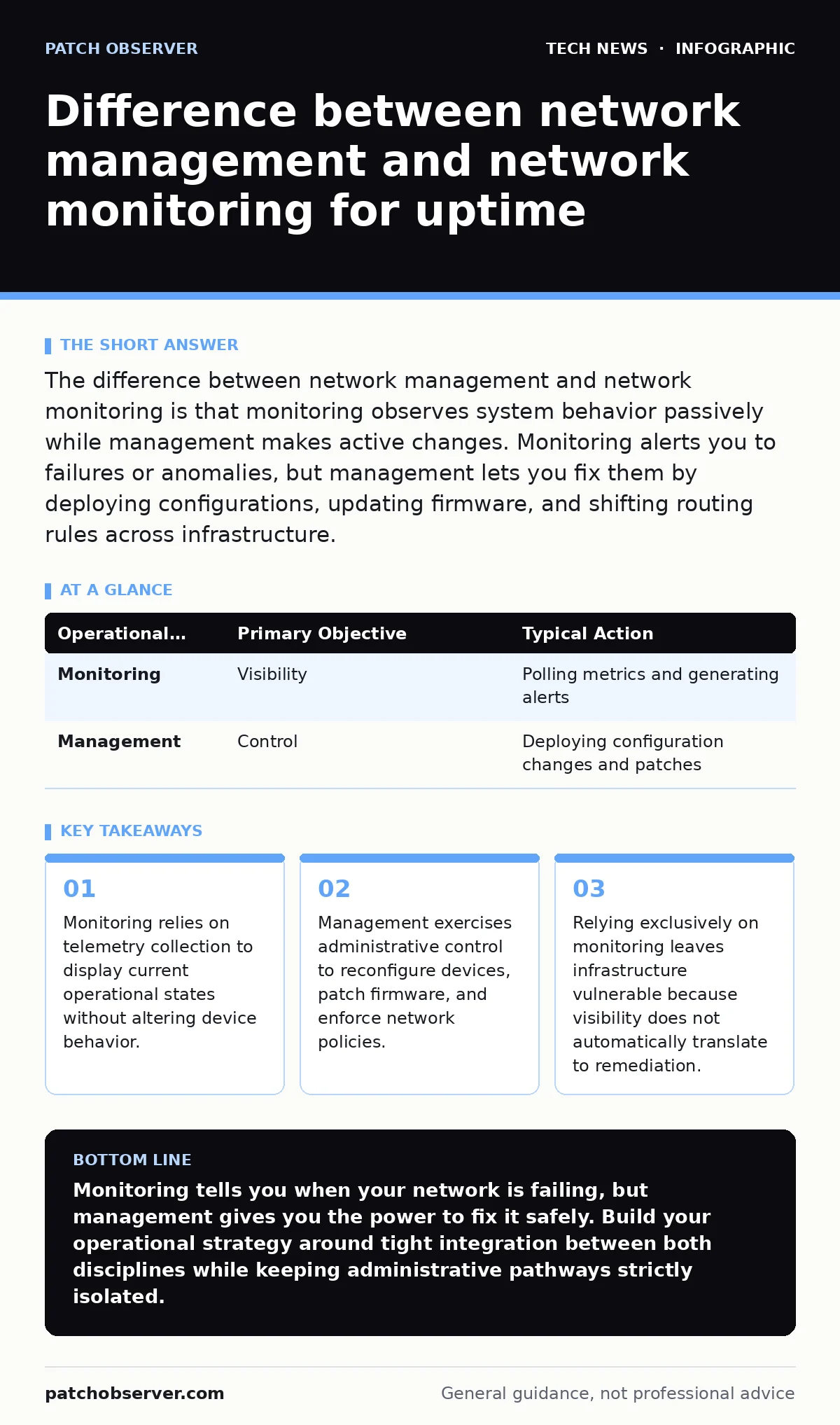
The difference between network management and network monitoring is that monitoring observes system behavior passively while management makes active changes. Monitoring alerts you to failures or anomalies, but management lets you fix them by deploying configurations, updating firmware, and shifting routing rules across infrastructure.
Is monitoring the same thing as management?
Network monitoring is not the same thing as network management because passive observation differs fundamentally from active control. Monitoring tools gather metrics, log events, and track packet flows to inform you when something breaks. Management solutions take those insights and apply administrative changes to correct problems, provision new resources, or alter device behavior. Treating these two functions as interchangeable leads to severe blind spots in operational readiness.
Observability tools collect data streams through protocols like Simple Network Management Protocol, streaming telemetry, and packet capture. This data reveals CPU utilization, interface errors, and bandwidth consumption across your switches and routers. However, simply knowing that a buffer is overflowing does not clear the queue or adjust the buffer allocation. Management provides the execution layer required to alter those underlying parameters.
| Operational Phase | Primary Objective | Typical Action |
|---|---|---|
| Monitoring | Visibility | Polling metrics and generating alerts |
| Management | Control | Deploying configuration changes and patches |
What does network monitoring actually do?
Network monitoring observes operational parameters continuously to establish baseline behavior and detect deviations. This discipline involves polling devices, collecting syslog messages, and analyzing traffic patterns to spot bottlenecks or unauthorized access attempts.
The primary limitation of monitoring is its lack of contextual remediation. An alert tells you that a firewall is dropping packets, but it cannot determine whether those drops stem from a legitimate security measure or a misconfigured rule. Furthermore, high volumes of alerts create operator fatigue, causing genuine warnings to get lost inside endless streams of routine notifications.
How does network management change infrastructure?
Network management alters device configurations, deploys firmware updates, and enforces access policies across your hardware ecosystem. Management platforms push standardized configuration templates to multiple switches simultaneously, ensuring consistency and preventing configuration drift. When a vulnerability emerges in router operating systems, management systems facilitate the deployment of patches across the fleet.
Active management introduces significant risks alongside its utility. Pushing a faulty configuration script to a core switch can isolate entire segments of an organization within seconds. Therefore, robust change management procedures and automated rollback mechanisms are required before any automated management tool touches production hardware.
What is the difference between network management and network monitoring in daily operations?
The difference between network management and network monitoring dictates how your engineering team divides its time between investigation and remediation. Monitoring consumes attention by generating tickets, dashboards, and graphs that demand human interpretation. Management consumes attention through planning changes, maintaining firmware inventories, and auditing compliance standards.
Imagine a scenario where a malicious actor attempts to reroute internal traffic by spoofing routing protocols. Monitoring software spots the abnormal topology change and triggers a high-priority alert for your analysts. Management software, configured correctly, can simultaneously restrict the compromised port or withdraw the false routing advertisement before widespread disruption occurs.
Why do monitoring tools fail without management integration?
Monitoring tools fail to protect infrastructure when they operate in isolation from remediation workflows. Without management capabilities attached to your monitoring signals, your team spends valuable minutes manually logging into individual command-line interfaces to execute fixes. This manual translation from alert to action introduces delays during active network outages or security incidents.
Integrating monitoring with management requires careful boundary definition to prevent runaway automation loops. If an automated script misinterprets a temporary spike in latency as a hardware failure and reboots a core router, the resulting downtime outweighs the initial anomaly. Human oversight remains necessary to validate complex remediation steps before execution.
See also: Getting a Reddit API Key: Account Types and Rate Limits Explained · macOS security features explained and how they protect systems
How should you secure your monitoring and management planes?
Securing monitoring and management planes requires isolating administrative traffic from user data streams using dedicated management VLANs. Management protocols often lack encryption by default, meaning attackers who capture traffic on standard segments can harvest administrative credentials. Restricting access to management interfaces using network access control prevents unauthorized devices from reaching administrative endpoints.
Public key cryptography authenticates administrative sessions and prevents adversaries from intercepting configuration commands sent to network hardware. You must also monitor the monitoring systems themselves, ensuring that attackers cannot disable alerting agents before launching broader intrusions into your environment.
What prerequisites matter before deploying active management?
Deploying active management safely requires comprehensive inventory tracking, secure credential stores, and reliable backup mechanisms for every device configuration. Without accurate backups of running configurations, an accidental command execution can result in permanent data loss or extended outages. You must also establish strict role-based access control so that individual administrators only possess the privileges necessary for their specific duties.
- Maintain an offline repository of verified device configurations.
- Audit administrator accounts and remove stale credentials regularly.
- Test backup restoration procedures under simulated failure conditions.
Key takeaways
- Monitoring relies on telemetry collection to display current operational states without altering device behavior.
- Management exercises administrative control to reconfigure devices, patch firmware, and enforce network policies.
- Relying exclusively on monitoring leaves infrastructure vulnerable because visibility does not automatically translate to remediation.
Monitoring tells you when your network is failing, but management gives you the power to fix it safely. Build your operational strategy around tight integration between both disciplines while keeping administrative pathways strictly isolated.
Frequently asked questions
Can I use a single software suite for both monitoring and management?
Many commercial platforms combine both functions into a single interface, though they often require separate licensing modules for active configuration features.
How often should I audit my network monitoring thresholds?
Review your alert thresholds quarterly to eliminate noisy warnings that do not require immediate human intervention.
What causes network management tools to lose synchronization with physical devices?
Out-of-band manual changes made directly via console cables cause management platforms to lose track of the true running configuration.
Does network monitoring degrade overall link performance?
Polling intervals that occur too frequently can consume noticeable switch CPU resources and bandwidth on constrained links.
How this guide was produced: written by the Patch Observer editorial team with AI assistance, checked against the public references listed below, and reviewed when the facts change. See our editorial policy or report an error.