Network Monitoring for Small Businesses: Detect Threats Without the Big Budget
Small teams often miss silent data exfiltration because they monitor connectivity rather than inspecting actual traffic patterns for anomalies.

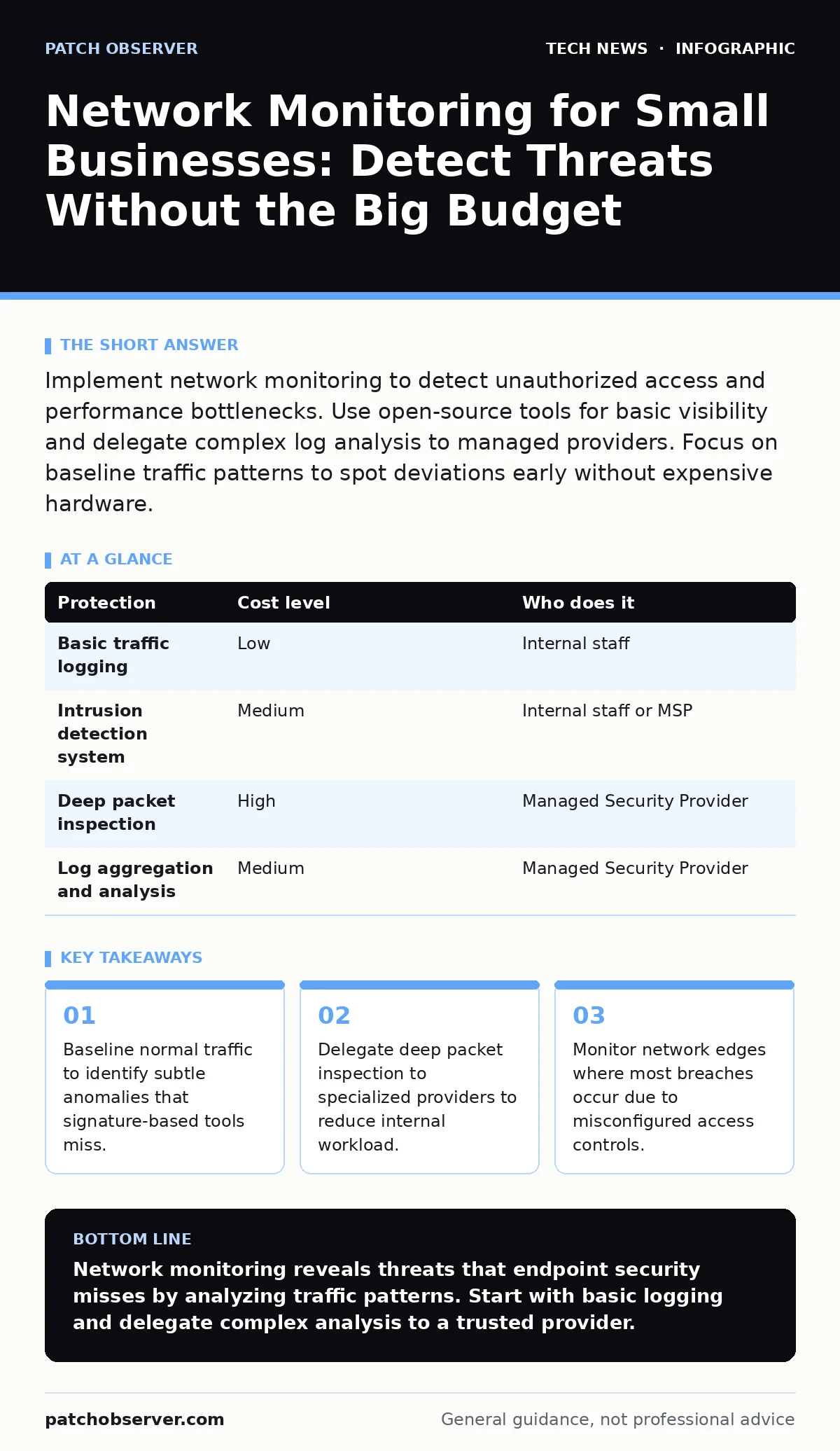
Implement network monitoring to detect unauthorized access and performance bottlenecks. Use open-source tools for basic visibility and delegate complex log analysis to managed providers. Focus on baseline traffic patterns to spot deviations early without expensive hardware.
Why Small Scale Demands Big Visibility
Small organizations often assume they are too small to be targeted by sophisticated attacks. This assumption creates a dangerous blind spot. Attackers frequently target smaller entities because they lack the resources for continuous monitoring. You can detect intrusion attempts by watching for unusual outbound connections. These connections often indicate malware communicating with command-and-control servers.
Visibility into your network traffic reveals more than just speed issues. It shows which devices communicate with which external services. This mapping helps you enforce least privilege principles. You restrict access to only what is necessary for each role. Without this view, you cannot verify that your security controls are working as intended.
The Hidden Cost of Blind Spots
Many small businesses rely solely on antivirus software for protection. Antivirus solutions scan files on individual endpoints. They do not see the broader context of network behavior. A compromised device might send small amounts of data to an attacker. This activity looks like normal web browsing to a local scanner.
Network monitoring provides the context that endpoint tools lack. It aggregates data from multiple sources to show patterns. You can identify a distributed denial-of-service attack by seeing traffic spikes from many sources. You can spot lateral movement by seeing internal devices talking to each other in unusual ways.
Affordable Monitoring Strategies
You do not need enterprise-grade hardware to gain visibility. Open-source tools offer powerful features for a fraction of the cost. These tools require more initial configuration but provide deep insights. You can start by monitoring your network perimeter. This is where most attacks enter your environment.
Consider using a dedicated monitoring device or a virtual appliance. These solutions capture traffic and analyze it for threats. They generate alerts when they detect suspicious activity. You can set these tools to monitor specific ports or protocols. This focus reduces noise and makes it easier to spot real threats.
| Protection | Cost level | Who does it |
|---|---|---|
| Basic traffic logging | Low | Internal staff |
| Intrusion detection system | Medium | Internal staff or MSP |
| Deep packet inspection | High | Managed Security Provider |
| Log aggregation and analysis | Medium | Managed Security Provider |
What to Delegate to Experts
Managing network monitoring internally consumes significant time. You must configure alerts, tune false positives, and investigate incidents. This work distracts from core business operations. Delegating these tasks to a managed service provider allows you to focus on growth.
Providers have specialized tools and expertise. They can correlate events across multiple clients to identify broader trends. This collective intelligence helps them detect threats that might look isolated in your environment. You pay for their expertise rather than building it in-house.
Questions to Ask an IT Provider
Before handing over your monitoring, verify their capabilities. Ask specific questions to ensure they can meet your needs. Do not accept vague promises of "full protection." You need concrete details about their processes.
- How do you differentiate between normal traffic spikes and malicious activity?
- What is your average response time for critical alerts?
- Do you provide regular reports on network health and threats?
- How do you handle false positives to avoid alert fatigue?
- Can you integrate monitoring with our existing security tools?
See also: Sovereign Cloud for Small Business: Control Data Location · MFA for Cloud Accounts: Secure Small Business Access Without Complexity
Integrating with Existing Security Measures
Network monitoring works best when combined with other security controls. You should ensure your endpoints are protected by regular software updates. Unpatched systems provide easy entry points for attackers. Monitoring can detect exploitation attempts before they succeed.
Consider your wireless infrastructure. Weak Wi-Fi security can allow attackers to bypass your perimeter. Monitoring wireless traffic helps you identify unauthorized access points or rogue devices. You can enforce strong encryption and authentication protocols to secure your wireless connections.
Understanding Network Address Translation
Network address translation hides your internal IP addresses from the public internet. This provides a layer of obscurity but not true security. Attackers can still target your exposed services. Monitoring your NAT device helps you see what is being exposed.
You should review your port forwarding rules regularly. Open ports provide direct access to your internal network. Closing unnecessary ports reduces your attack surface. Monitoring logs from your NAT device can reveal scanning activity from potential attackers.
The Role of Public Key Cryptography
Public key cryptography secures data in transit. It ensures that only authorized parties can read sensitive information. Monitoring for certificate errors helps you detect man-in-the-middle attacks. These attacks intercept and alter communications between users and servers.
You should implement certificate management processes to ensure validity. Expired or misconfigured certificates can cause service disruptions. They can also indicate a compromised system. Regular checks prevent these issues and maintain trust in your communications.
Building a Sustainable Monitoring Program
Sustainable monitoring requires clear processes and regular reviews. You must define what constitutes normal behavior for your network. This baseline changes as your business grows. Update your monitoring rules to reflect new applications and users.
Train your staff to recognize suspicious activity. They are your first line of defense. Encourage them to report unusual system behavior. Combine human insight with automated tools for the best results. This hybrid approach balances efficiency with thoroughness.
Key takeaways
- Baseline normal traffic to identify subtle anomalies that signature-based tools miss.
- Delegate deep packet inspection to specialized providers to reduce internal workload.
- Monitor network edges where most breaches occur due to misconfigured access controls.
Network monitoring reveals threats that endpoint security misses by analyzing traffic patterns. Start with basic logging and delegate complex analysis to a trusted provider.
Frequently asked questions
How much does network monitoring cost for a small business?
Costs vary widely based on tools and services. Open-source solutions are free but require labor. Managed services charge monthly fees based on data volume and support levels.
Can I monitor my network without specialized hardware?
Yes, software-based solutions can monitor traffic on existing devices. Virtual appliances and agent-based tools provide visibility without new hardware purchases.
What is the difference between network monitoring and security?
Monitoring observes activity and alerts on anomalies. Security prevents unauthorized access and protects data. Monitoring supports security by providing the data needed to detect breaches.
How often should I review my monitoring alerts?
Review critical alerts immediately. Schedule weekly reviews for less urgent alerts. Regular reviews help you tune your system and reduce false positives.
How this guide was produced: written by the Patch Observer editorial team with AI assistance, checked against the public references listed below, and reviewed when the facts change. See our editorial policy or report an error.