Sovereign Cloud for Small Business: Control Data Location
Sovereign cloud ensures your data stays within national borders, giving you legal protection against foreign surveillance and jurisdictional overreach.

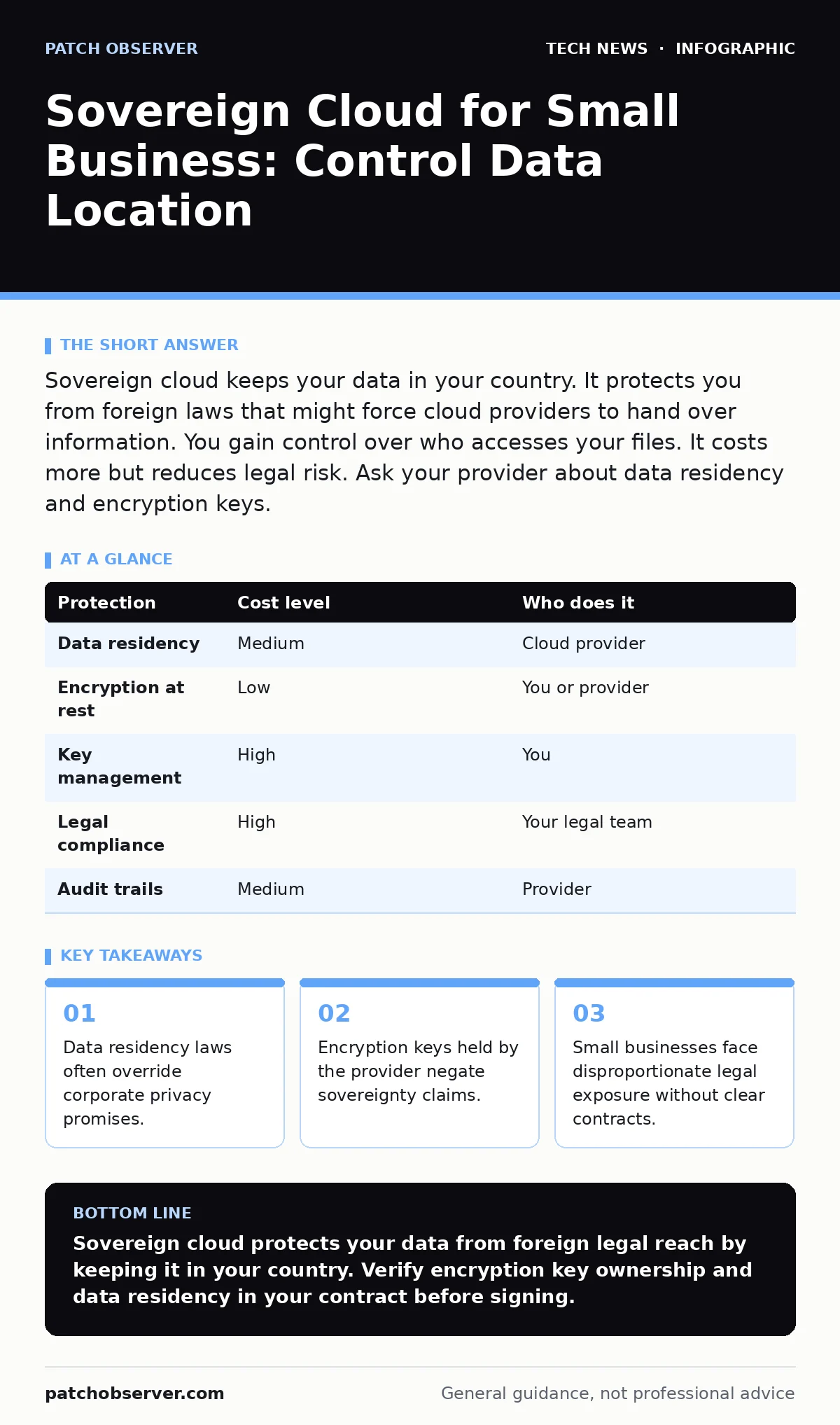
Sovereign cloud keeps your data in your country. It protects you from foreign laws that might force cloud providers to hand over information. You gain control over who accesses your files. It costs more but reduces legal risk. Ask your provider about data residency and encryption keys.
The Ten-Person Company Scenario
Imagine a small professional services firm. The team relies on cloud storage for daily operations. They assume their data is safe because of strong passwords. They do not consider where the physical servers sit. A foreign intelligence agency requests access to the server logs. The cloud provider complies with local law in the server’s location. The small firm has no legal standing to object. Their data leaves the country without their knowledge. This scenario highlights the gap between technical security and legal sovereignty. You must understand where your data lives physically and legally.
Why Sovereignty Matters at Small Scale
Sovereign cloud refers to infrastructure that operates under the exclusive jurisdiction of a specific nation. It prevents foreign governments from accessing your data through legal mandates. Small businesses often think they are too small to be targeted. This assumption is dangerous. Adversaries harvest data from many small targets to build larger intelligence pictures.
Your client data may be valuable to foreign competitors. Keeping data within national borders creates a legal shield. It forces any access request to go through your local courts. This adds friction for unauthorized access attempts. It does not make you invisible, but it raises the cost for attackers. You gain control over the legal framework governing your information.
The Hidden Cost of Global Infrastructure
Global cloud platforms offer convenience and low prices. They distribute data across multiple regions for redundancy. This distribution complicates data residency compliance. A backup in another country may violate local regulations. You might think you are compliant because the primary server is local. The backup location determines your actual legal exposure.
Managing these locations requires constant monitoring. You need to verify where every copy of your data resides. This verification adds administrative overhead. It also increases the risk of human error. A misconfigured setting can replicate data to an unintended region. You lose sovereignty instantly without realizing it. The cost is not just financial. It is the loss of legal certainty.
| Protection | Cost level | Who does it |
|---|---|---|
| Data residency | Medium | Cloud provider |
| Encryption at rest | Low | You or provider |
| Key management | High | You |
| Legal compliance | High | Your legal team |
| Audit trails | Medium | Provider |
Practical Implementation Steps
You must define your data classification policy first. Not all data requires sovereign storage. Public marketing materials do not need high protection. Client financial records and health data do. Separate these data streams clearly. Use distinct storage buckets or databases. Label them with their compliance requirements. This separation simplifies management.
It reduces the cost of sovereign storage. You only pay the premium for sensitive data. You also simplify auditing processes. Auditors can verify compliance by checking specific buckets. They do not need to scan the entire environment. This targeted approach saves time and money. It also reduces the attack surface. Less sensitive data is easier to secure with standard tools.
What to Ask Your IT Provider
You need specific answers from your IT provider. Vague promises about security are insufficient. You must verify the technical and legal details. Ask these questions to ensure true sovereignty.
- Where are the physical servers located?
- Who holds the encryption keys?
- Can the provider access your data for their own purposes?
- What happens to your data if the provider goes bankrupt?
- How do you verify data residency continuously?
- Are there any third-party subcontractors involved?
- What is the process for deleting data permanently?
- Can you provide a certificate of compliance?
These questions cut through marketing language. They reveal the actual risk profile. If the provider cannot answer clearly, they are not ready for sovereign work. You need written confirmation of these details. Verbal assurances hold no legal weight. Document every answer in your contract. This documentation protects you during audits. It also clarifies responsibilities during an incident. You know who is liable for what. This clarity is vital for small businesses. You lack the legal team to fight ambiguous contracts. Clear terms prevent costly disputes later.
See also: MFA for Cloud Accounts: Secure Small Business Access Without Complexity · Telegram link and domain outages: Understanding routing failures
The Encryption Key Trap
Encryption is often cited as the ultimate protection. It renders data unreadable without the key. However, who holds the key matters. If the cloud provider holds the key, they can decrypt your data. They may be forced to do so by law. This defeats the purpose of sovereignty. You must manage your own encryption keys. This is called Bring Your Own Key or Bring Your Own Key Management. It adds complexity to your operations. You must secure the keys yourself.
If you lose the keys, you lose the data. There is no recovery option. This trade-off is significant. You gain legal control but accept operational risk. You need a robust key management strategy. This strategy must include backup and rotation procedures. It must also define access controls strictly. Only authorized personnel can access the keys. This limits the risk of insider threats. It also ensures that the provider cannot access your data.
Integrating with Existing Security
Sovereign cloud works best with other security measures. It is not a standalone solution. You must combine it with strong access controls. Multi-factor authentication prevents unauthorized access. It ensures that only legitimate users can reach the data. You should also review your browser security settings regularly. Outdated browsers can leak data to malicious sites. This leakage bypasses cloud security entirely. Users often click on phishing links. These links can steal session tokens.
The attacker then accesses the cloud account directly. Sovereign storage does not stop this attack. You need user training and technical controls. Both layers are necessary for complete protection. You must also consider remote work security policies. Employees working from home connect to the cloud. Their home networks may be insecure. You need a secure connection method. A virtual private network helps. It encrypts the traffic between the user and the cloud. This prevents interception on public Wi-Fi networks.
The Role of API Security
Modern applications communicate via APIs. These interfaces allow different systems to share data. They are often the weakest link in security. Misconfigured APIs can expose sensitive data. Attackers exploit these flaws to steal information. You must secure your API keys carefully. Treat them like passwords. Rotate them regularly. Limit their scope to only necessary permissions. Monitor API usage for anomalies. Sudden spikes in traffic may indicate a breach. You should also review your firewall rules.
They control incoming and outgoing traffic. Ensure they block unauthorized API calls. This layered approach reduces risk. It makes it harder for attackers to succeed. You must also keep your software updated. Patches fix known vulnerabilities. Delayed updates leave you exposed. Check for smartphone security updates as well. Mobile devices often access cloud data. They are frequent targets for malware. Keeping them updated closes known holes. This holistic approach protects your sovereign data.
Verifying Provider Claims
You must verify the provider’s claims independently. Do not trust marketing materials alone. Request third-party audit reports. These reports confirm compliance with standards. Look for certifications that match your region. They prove the provider meets local requirements. You should also ask for a reference list. Contact other clients in your industry. Ask about their experience with the provider. Inquire about any data residency issues. Real-world feedback is valuable. It reveals problems that audits might miss.
You should also test the provider’s incident response. Ask how they handle security breaches. Do they notify you immediately? What information do they provide? You need clear communication channels. Delayed notification can harm your business. You must be able to take action quickly. This requires trust in the provider. Build that trust through transparency. Demand detailed logs and reports. They provide evidence of proper handling. This evidence is crucial for legal defense.
The Future of Data Control
Data sovereignty is evolving. New laws are emerging globally. They require stricter control over data. You must stay informed about these changes. Subscribe to industry newsletters. Attend relevant webinars. Network with other IT professionals. Share best practices and lessons learned. The landscape is changing rapidly. What works today may not work tomorrow. You need a flexible strategy. It should adapt to new regulations. It should also leverage new technologies. Zero trust architecture helps.
It verifies every request as if it originates from an open network. This model reduces reliance on perimeter defenses. It complements sovereign cloud strategies. You must also consider the environmental impact. Data centers consume significant energy. Choose providers with green initiatives. This aligns with corporate social responsibility goals. It also future-proofs your operations. Regulations may soon mandate efficiency. Being prepared now saves future costs. You must balance security, compliance, and sustainability. This balance defines modern IT strategy.
Key takeaways
- Data residency laws often override corporate privacy promises.
- Encryption keys held by the provider negate sovereignty claims.
- Small businesses face disproportionate legal exposure without clear contracts.
Sovereign cloud protects your data from foreign legal reach by keeping it in your country. Verify encryption key ownership and data residency in your contract before signing.
Frequently asked questions
Does sovereign cloud mean my data is unhackable?
No, sovereignty addresses legal jurisdiction, not technical security. You still need strong encryption and access controls to prevent hacking.
Can I use sovereign cloud with remote employees?
Yes, but you must secure the connection. Use VPNs and multi-factor authentication to protect data in transit.
How much more does sovereign cloud cost?
Costs vary by provider and data volume. Expect a premium for compliance and key management features.
What if my provider goes out of business?
Ensure your contract includes data extraction clauses. You must be able to retrieve your data easily.
How this guide was produced: written by the Patch Observer editorial team with AI assistance, checked against the public references listed below, and reviewed when the facts change. See our editorial policy or report an error.