AI Data Center Myths: Infrastructure Truths for Secure Operations
AI workloads demand distinct power and cooling architectures that traditional IT frameworks cannot support without significant structural modification.
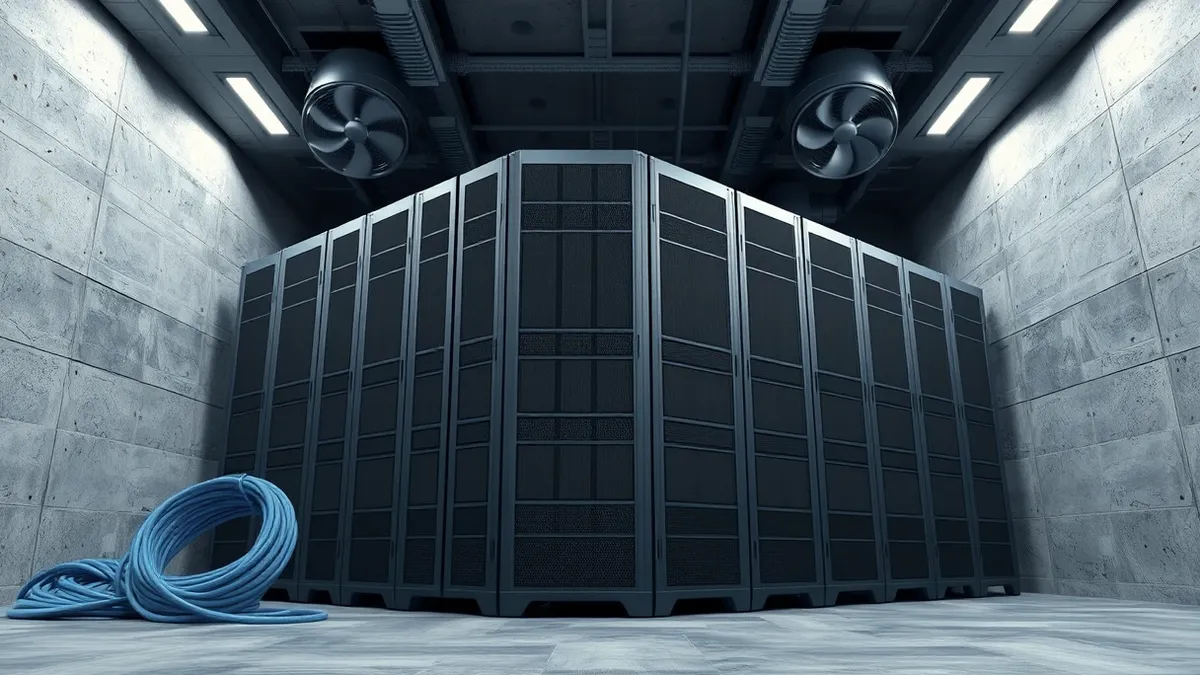
People often assume AI infrastructure behaves like standard server farms. It does not. AI systems generate extreme localized heat, require specialized network topologies, and consume power at rates that break conventional facility designs. Understanding these physical and logical differences prevents costly security and operational failures.
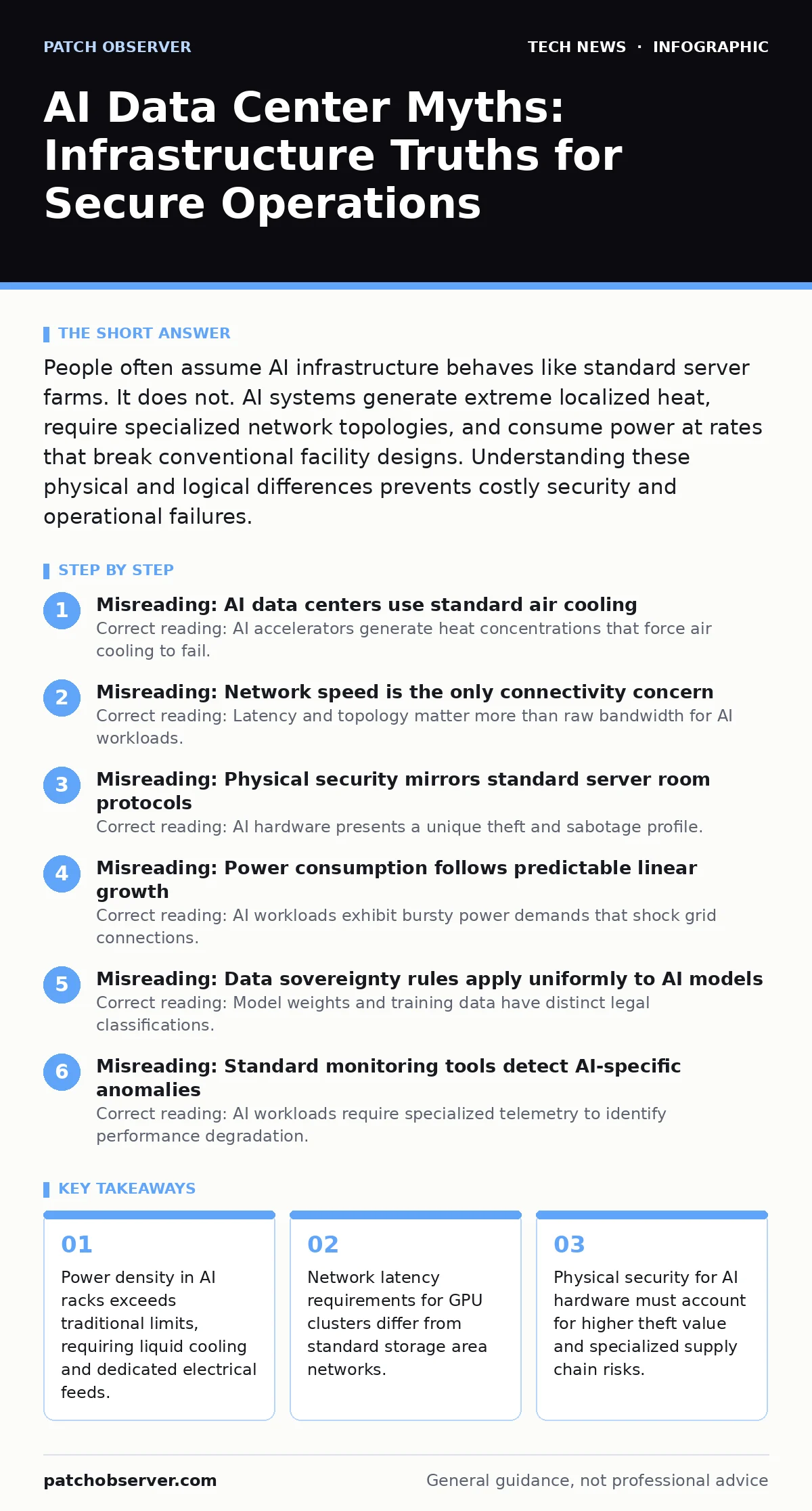
Misreading: AI data centers use standard air cooling
Correct reading: AI accelerators generate heat concentrations that force air cooling to fail. Traditional server racks dissipate power linearly across the room. AI inference and training clusters concentrate megawatts of heat into specific zones. This creates hot spots that standard computer room air conditioning cannot remove efficiently. The result is thermal throttling, which reduces computational performance and increases energy waste. Facilities must implement liquid cooling or direct-to-chip solutions to maintain stable operating temperatures. This shift changes maintenance schedules and introduces new leak risks that standard IT teams are not trained to handle.
Misreading: Network speed is the only connectivity concern
Correct reading: Latency and topology matter more than raw bandwidth for AI workloads. Standard data centers prioritize throughput for file transfers and database queries. AI training requires synchronous communication between thousands of GPUs. If one chip waits for data from another, the entire cluster slows down.
This necessitates specialized interconnects that prioritize low latency over high volume. Standard Ethernet switches often introduce jitter that disrupts these tight synchronization loops. You must design the network fabric to handle massive east-west traffic patterns, not just north-south user access. Ignoring this leads to prolonged training times and inefficient resource utilization.
Misreading: Physical security mirrors standard server room protocols
Correct reading: AI hardware presents a unique theft and sabotage profile. Standard servers have low resale value and are difficult to move quickly. AI accelerator boards are compact, expensive, and highly sought after on secondary markets. This changes the risk calculation for physical access controls. You need granular tracking of hardware movement, not just room entry. Standard badge logs do not show which specific rack component was removed. Implementing tamper-evident seals and real-time inventory sensors becomes necessary. This level of scrutiny exceeds typical data center standards and requires dedicated security personnel trained in hardware-specific threats.
Misreading: Power consumption follows predictable linear growth
Correct reading: AI workloads exhibit bursty power demands that shock grid connections. Traditional IT infrastructure draws steady, predictable current. AI training jobs can spike power usage instantly as multiple accelerators engage simultaneously. This volatility requires power distribution units capable of handling rapid load changes.
Standard breakers may trip during these spikes, causing unplanned downtime. You must coordinate with utility providers to ensure the local grid can handle these transient loads. Power factor correction and backup generator sizing must account for these peaks, not just average usage. Failure to plan for these surges leads to costly electrical infrastructure upgrades.
Misreading: Data sovereignty rules apply uniformly to AI models
Correct reading: Model weights and training data have distinct legal classifications. Standard data sovereignty laws govern where customer records are stored. AI introduces a layer of complexity regarding where the model itself resides. A model trained on European data may be stored in a different jurisdiction.
This creates compliance gaps that traditional data residency policies miss. You must map the entire lifecycle of the model, from training data ingestion to inference deployment. This requires a more nuanced approach to sovereign cloud strategies. Simple geographic boundaries are insufficient. You need contractual guarantees about model location and data processing steps.
See also: Getting a Reddit API Key: Account Types and Rate Limits Explained · macOS security features explained and how they protect systems
Misreading: Standard monitoring tools detect AI-specific anomalies
Correct reading: AI workloads require specialized telemetry to identify performance degradation. Standard CPU and memory metrics do not reflect accelerator health. GPU memory utilization and tensor core activity provide better visibility. Without these specific metrics, you cannot distinguish between software bugs and hardware failures. This blind spot leads to prolonged troubleshooting and wasted compute cycles. You must integrate accelerator-specific monitoring into your existing observability stack. This allows you to set alerts for thermal events or memory errors unique to AI chips. Relying on traditional server metrics leaves you unaware of silent data corruption.
Misreading: Supply chain risks are limited to software dependencies
Correct reading: Hardware firmware and boot processes present unique attack surfaces. AI accelerators often use proprietary firmware that is difficult to audit. This creates a trust gap in the hardware supply chain. You must implement strict firmware validation procedures before installation. Standard software supply chain tools do not inspect binary blobs on accelerator cards.
This requires a deeper inspection of hardware provenance and cryptographic signatures. You should also consider zero-knowledge proofs for verifying hardware integrity without exposing sensitive design details. This approach ensures that the underlying silicon has not been tampered with during manufacturing or shipping.
Misreading: Edge deployment solves all latency issues
Correct reading: Edge AI introduces new security and management challenges. Moving inference to the edge reduces latency but fragments security management. You cannot apply the same centralized policies to thousands of distributed devices. This requires a different approach to edge computing security. Device identity and over-the-air updates become critical.
You must ensure that edge devices can authenticate securely and receive patches automatically. Standard data center security models do not scale to edge environments. You need lightweight security protocols that do not consume significant compute resources. This balance between security and performance is delicate and requires careful planning.
Misreading: API security is sufficient for model access
Correct reading: Model endpoints require deeper inspection than standard APIs. AI models expose sensitive capabilities through their inputs and outputs. Standard API key security does not prevent prompt injection or data exfiltration. You must monitor the content of requests and responses, not just the authentication. This requires specialized tools that understand natural language processing risks. You should also implement rate limiting based on semantic complexity, not just request count. This adds a layer of protection against abuse and unauthorized data harvesting. Standard API gateways lack the context to detect these sophisticated attacks.
Misreading: Standard backup strategies protect AI models
Correct reading: AI models are large, versioned, and sensitive to corruption. Traditional backup solutions struggle with the size and frequency of model updates. You need specialized storage tiers that handle large binary files efficiently. Incremental backups are less effective for models that change significantly with each training run. This requires a different data retention strategy. You must also ensure that backup copies are encrypted and access-controlled. Model theft is a growing concern. Standard backup encryption may not be sufficient for high-value intellectual property. You need a dedicated strategy for model lifecycle management.
Key takeaways
- Power density in AI racks exceeds traditional limits, requiring liquid cooling and dedicated electrical feeds.
- Network latency requirements for GPU clusters differ from standard storage area networks.
- Physical security for AI hardware must account for higher theft value and specialized supply chain risks.
Frequently asked questions
Do AI data centers need different fire suppression systems?
Yes, AI racks often use liquid cooling, which requires different fire suppression agents than air-cooled environments. Standard gas systems may not be effective or safe for liquid-filled components.
How do I monitor power efficiency in AI clusters?
Track the Partial Load Ratio and Power Usage Effectiveness specifically for the accelerator racks. Standard PUE metrics hide the inefficiencies caused by hot spots and cooling limitations.
Is it safe to train models on public cloud infrastructure?
It depends on your data classification and the provider's isolation guarantees. Public clouds offer robust infrastructure but require careful configuration to prevent data leakage through shared resources.
What is the biggest risk of edge AI deployment?
Physical tampering with edge devices is the primary risk. Unlike centralized data centers, edge devices are often accessible to unauthorized individuals, requiring ruggedized and tamper-evident hardware.
How this guide was produced: written by the Patch Observer editorial team with AI assistance, checked against the public references listed below, and reviewed when the facts change. See our editorial policy or report an error.