Data Center Attacks: Definition, Vectors, and Defense Strategies
Most data center compromises bypass perimeter firewalls by exploiting trusted maintenance interfaces and physical access controls rather than brute-forcing network entry points.

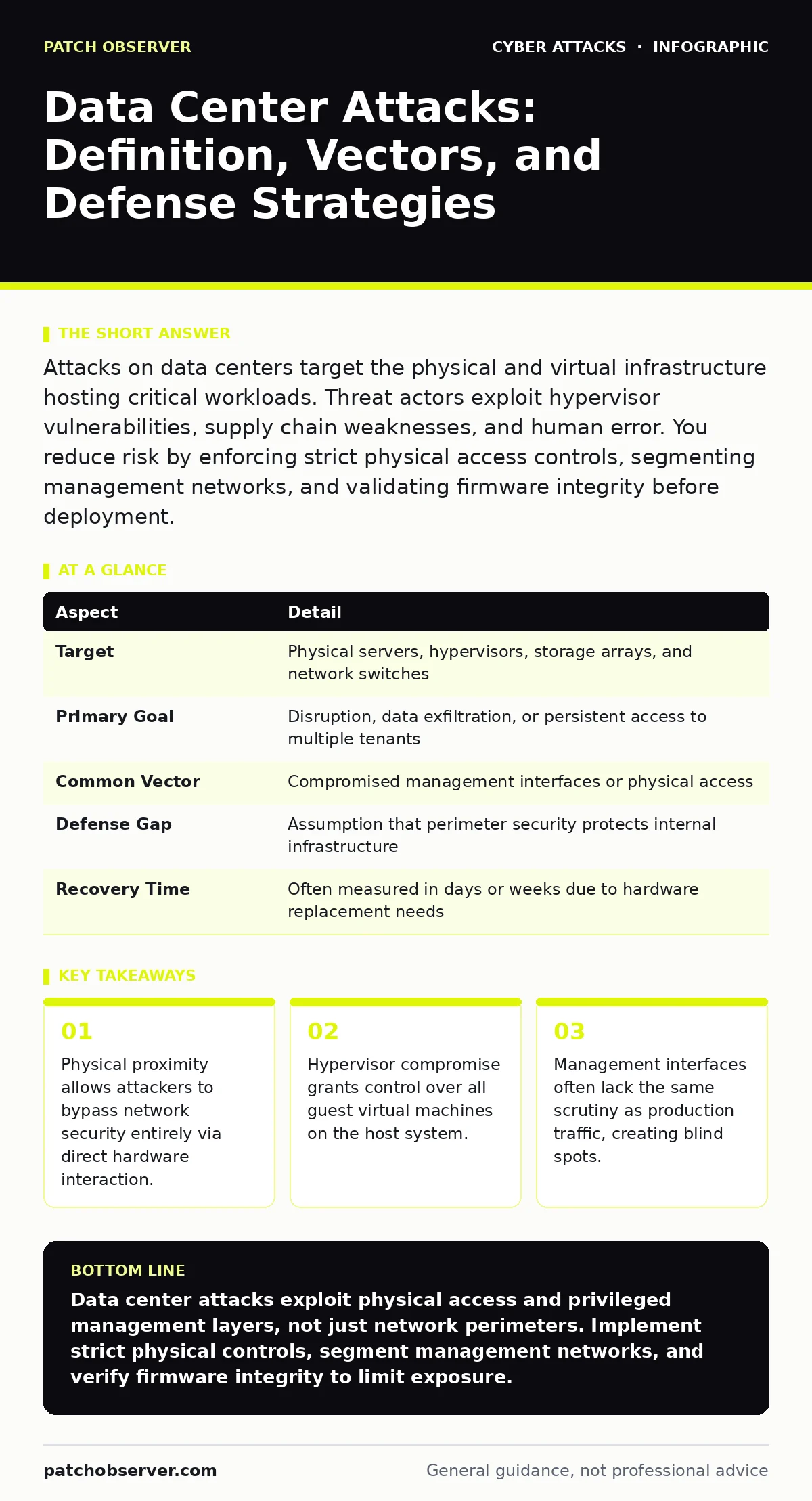
Attacks on data centers target the physical and virtual infrastructure hosting critical workloads. Threat actors exploit hypervisor vulnerabilities, supply chain weaknesses, and human error. You reduce risk by enforcing strict physical access controls, segmenting management networks, and validating firmware integrity before deployment.
Understanding the Threat Surface
Data centers are not monolithic fortresses. They are complex ecosystems of physical hardware, virtualization layers, and management software. An attack on a data center targets these underlying components to disrupt availability, steal data, or inject malware into the broader ecosystem. Unlike endpoint attacks, these incidents affect hundreds or thousands of systems simultaneously. The scale of impact defines the threat.
| Aspect | Detail |
|---|---|
| Target | Physical servers, hypervisors, storage arrays, and network switches |
| Primary Goal | Disruption, data exfiltration, or persistent access to multiple tenants |
| Common Vector | Compromised management interfaces or physical access |
| Defense Gap | Assumption that perimeter security protects internal infrastructure |
| Recovery Time | Often measured in days or weeks due to hardware replacement needs |
Imagine a library where the thief does not steal books from the shelves. Instead, they break into the printing room and alter the master templates. Every new copy produced is corrupted. This is how hypervisor attacks function. The attacker controls the layer that manages all virtual machines. They remain invisible to security tools running inside the virtual machines because they operate at a higher privilege level.
How Physical Access Enables Digital Breaches
Physical security is the first line of defense. If an adversary gains physical access to a server rack, digital controls become secondary. Attackers use direct connection methods to bypass authentication. They may connect a USB device to a server console port or use a keyboard-emulating attack on a management interface. These actions do not leave logs in the operating system.
The hidden cost of this vulnerability is the time required to detect the breach. Standard monitoring tools look for network traffic anomalies. They do not detect a technician—or an imposter—plugging a cable into a server. You must treat physical access logs as security events. Integrate badge reader data with your security information and event management system. This correlation reveals unauthorized presence before digital compromise occurs.
The Hypervisor as a Single Point of Failure
Virtualization consolidates many workloads onto fewer physical machines. This efficiency creates a single point of failure. The hypervisor is the software layer that abstracts hardware resources for virtual machines. If the hypervisor is compromised, every virtual machine on that host is compromised. The attacker can migrate malicious code between tenants. They can capture memory contents from one virtual machine and inject it into another.
This attack vector is difficult to detect because the hypervisor sits below the guest operating systems. Security agents inside the virtual machines cannot see hypervisor-level activity. You mitigate this risk by minimizing the hypervisor’s attack surface. Disable unused features. Apply patches immediately. Isolate hypervisor management traffic from production networks. This segmentation prevents lateral movement from compromised guest systems to the control plane.
Supply Chain and Firmware Compromise
Hardware components contain firmware that runs before the operating system loads. This firmware initializes the hardware and manages low-level functions. Attackers target firmware because it persists across operating system reinstallation. A compromised BIOS or UEFI chip can survive a full disk wipe. The malware resides in the hardware itself.
You cannot rely on software-only defenses against firmware attacks. Implement cryptographic verification of firmware signatures during boot. This process ensures that only trusted code executes. You must maintain a hardware bill of materials. Track the origin and version of every component. This visibility allows you to respond quickly when a firmware vulnerability is disclosed.
Management Interfaces as Attack Vectors
Data centers rely on out-of-band management networks. These networks allow administrators to configure servers remotely. They are separate from the production network. This separation is intentional but often poorly secured. Attackers target these interfaces because they assume they are isolated. They scan for default credentials, unpatched vulnerabilities, and misconfigured access controls.
The management network often carries sensitive data, including console sessions and configuration changes. If an attacker gains access, they can pivot to production systems. They can disable security controls or alter configurations. You must secure these interfaces with the same rigor as production systems. Enforce multi-factor authentication. Encrypt all management traffic. Monitor for unusual access patterns.
What People Usually Get Wrong
Many organizations assume that perimeter firewalls protect data center infrastructure. This assumption is dangerous. Firewalls filter network traffic. They do not protect against physical access, firmware attacks, or hypervisor exploits. You must adopt a defense-in-depth strategy. This approach layers security controls across physical, virtual, and network domains.
Another common mistake is treating management traffic as low risk. Administrators often disable logging or monitoring on management networks to reduce noise. This creates blind spots. Attackers exploit these blind spots to move laterally. You must monitor management traffic for anomalies. Define baselines for normal administrative behavior. Alert on deviations from these baselines.
Reducing Risk Through Segmentation and Verification
Network segmentation limits the blast radius of an attack. You isolate management networks, production networks, and storage networks. This isolation prevents an attacker from moving freely across the data center. You must enforce strict access controls between segments. Use firewalls to filter traffic based on least privilege principles. Only allow necessary communication.
You must also verify the integrity of your systems. Use trusted boot processes to ensure that only signed code executes. This verification applies to firmware, hypervisors, and operating systems. You must maintain an inventory of all hardware and software components. This inventory enables rapid response to vulnerabilities. When a new vulnerability is disclosed, you can identify affected systems and apply patches quickly.
Consider how these principles apply to your broader security posture. A robust cyber incident response team is necessary to handle breaches when they occur. You must also protect your users from password spraying attacks that target administrative accounts. Understanding various attack vectors helps you prioritize defenses.
Implementing secure email gateways reduces the risk of initial compromise. Proper DMARC configuration prevents email spoofing. Be aware of social engineering tactics like smishing. Ensure your payment verification procedures are secure to prevent financial fraud. Understanding your blast radius helps you limit damage.
Continuous Monitoring and Adaptation
Security is not a one-time project. It is a continuous process. You must monitor your data center for anomalies. Use behavioral analytics to detect unusual activity. Look for unexpected changes in configuration, unusual access times, or abnormal traffic patterns. You must adapt your defenses as new threats emerge. Review your security controls regularly. Update your incident response plans. Train your staff on new threats.
You must also consider the human element. Insider threats are a significant risk. Employees with legitimate access can cause significant damage. Monitor privileged accounts. Enforce least privilege. Review access rights regularly. Remove access when employees change roles or leave the organization. This hygiene reduces the risk of insider threats.
Final Considerations for Infrastructure Security
Data center security requires a holistic approach. You must address physical, virtual, and network risks. You must assume that perimeter defenses will fail. You must design your infrastructure to limit the impact of a breach. You must verify the integrity of all components. You must monitor for anomalies. You must adapt to new threats.
The complexity of data centers makes them attractive targets. The scale of impact makes them critical assets. You must invest in robust security controls. You must train your staff. You must test your defenses. You must be prepared for the worst-case scenario. This preparation reduces risk and ensures business continuity.
Key takeaways
- Physical proximity allows attackers to bypass network security entirely via direct hardware interaction.
- Hypervisor compromise grants control over all guest virtual machines on the host system.
- Management interfaces often lack the same scrutiny as production traffic, creating blind spots.
Data center attacks exploit physical access and privileged management layers, not just network perimeters. Implement strict physical controls, segment management networks, and verify firmware integrity to limit exposure.
Frequently asked questions
Can a data center attack affect multiple customers?
Yes, if the hypervisor or shared hardware is compromised, an attacker can access or disrupt multiple tenant environments simultaneously.
How do you detect a firmware attack?
Firmware attacks are difficult to detect with standard tools. You must use cryptographic verification during boot and monitor for unexpected hardware behavior.
Is cloud hosting safer than on-premise data centers?
Cloud providers have robust security, but you share responsibility. You must secure your virtual machines and access controls regardless of hosting location.
What is the first step in securing a data center?
The first step is to inventory all assets and establish strict physical access controls to prevent unauthorized hardware interaction.
How this guide was produced: written by the Patch Observer editorial team with AI assistance, checked against the public references listed below, and reviewed when the facts change. See our editorial policy or report an error.