SOC 2 Type 2 Explained: How It Works and What It Proves
SOC 2 Type 2 validates that your security controls operated effectively over time, proving consistent behavior rather than just a single moment of compliance.

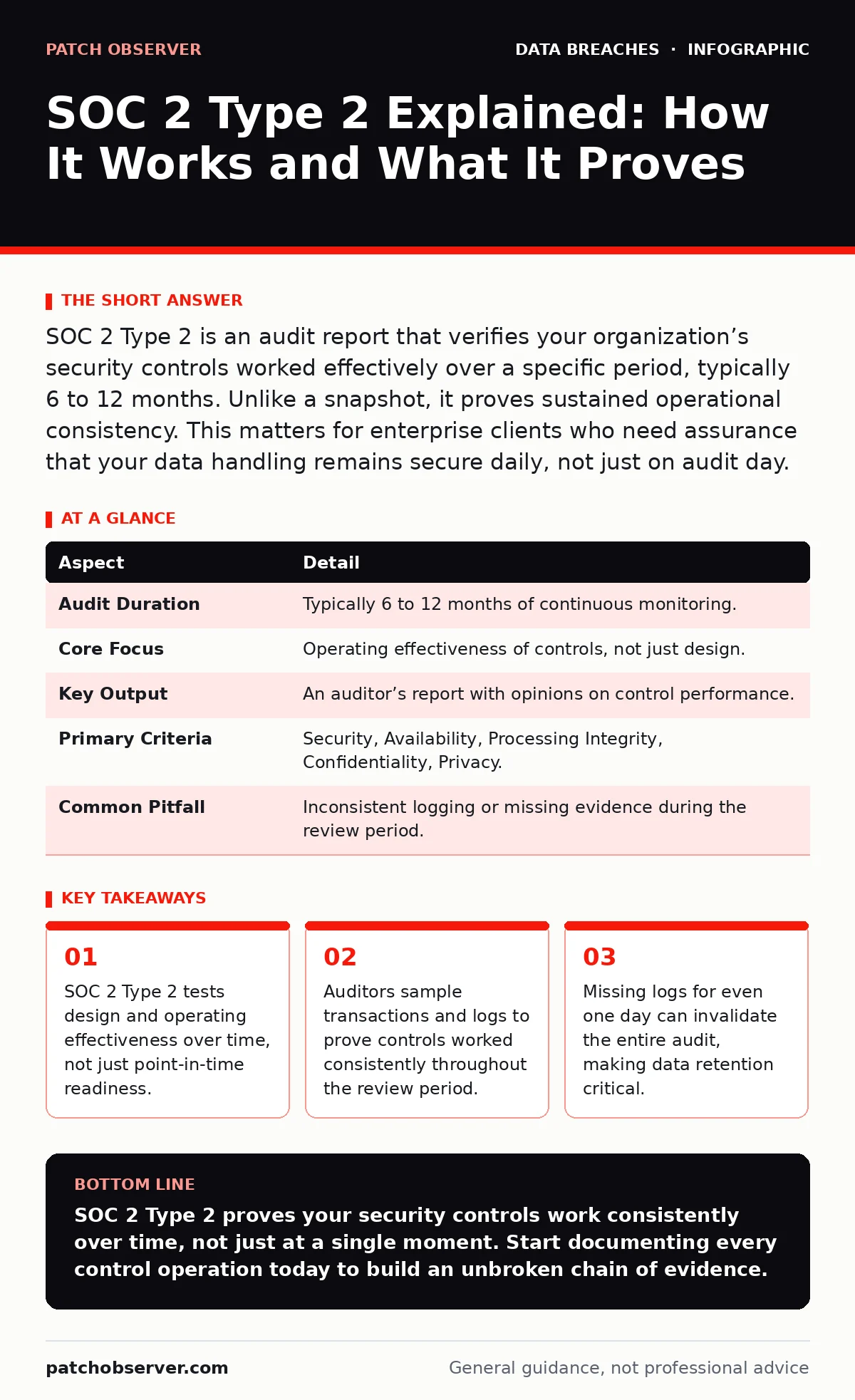
SOC 2 Type 2 is an audit report that verifies your organization’s security controls worked effectively over a specific period, typically 6 to 12 months. Unlike a snapshot, it proves sustained operational consistency. This matters for enterprise clients who need assurance that your data handling remains secure daily, not just on audit day.
What Is SOC 2 Type 2?
SOC 2 Type 2 is an independent audit report that verifies your security controls operated effectively over a sustained period. The Service Organization Control 2 framework focuses on how you handle customer data based on five trust service criteria. These criteria include security, availability, processing integrity, confidentiality, and privacy.
Most organizations prioritize the security criterion because it forms the foundation for the others. This criterion measures your ability to protect system resources against unauthorized access. A Type 1 report only checks if controls exist at a single date. A Type 2 report checks if those controls actually worked during a defined timeframe. This distinction matters because implementation is easier than consistent operation.
At a Glance: SOC 2 Type 2 Basics
| Aspect | Detail |
|---|---|
| Audit Duration | Typically 6 to 12 months of continuous monitoring. |
| Core Focus | Operating effectiveness of controls, not just design. |
| Key Output | An auditor’s report with opinions on control performance. |
| Primary Criteria | Security, Availability, Processing Integrity, Confidentiality, Privacy. |
| Common Pitfall | Inconsistent logging or missing evidence during the review period. |
How The Audit Process Works
Auditors do not watch your systems live. They examine evidence that your controls functioned as intended during the review period. This process requires rigorous documentation. You must prove that your policies were followed repeatedly, not just once. The auditor selects a sample of transactions, incidents, or user access reviews to test.
If your policy states that new employees receive access within 24 hours, the auditor checks multiple instances of this process. They look for the request ticket, the approval email, and the system log showing access granted. If one instance shows a 48-hour delay without documented exception handling, that becomes an exception. Too many exceptions lead to a qualified opinion, which signals failure to meet standards.
Who Needs This Report?
Any organization that stores, processes, or transmits customer data benefits from this audit. Software-as-a-Service providers are the most common candidates. Enterprises selling to large corporations often require this report as a pre-contract condition. It serves as a substitute for lengthy security questionnaires.
Vendors in the supply chain also need this. If you handle sensitive data for a client, you become a risk vector for them. Demonstrating compliance shifts the burden of proof. It shows you take data stewardship seriously. This is particularly relevant when discussing data breaches or misconfigured cloud storage leaks with potential partners. Proactive auditing prevents reactive damage control.
The Hidden Cost of Evidence Management
The biggest operational hurdle is not the audit itself. It is the daily discipline required to maintain evidence. Controls must be automated where possible. Manual processes introduce human error and inconsistency. If you rely on staff to manually update spreadsheets for access reviews, one forgotten update breaks the chain of evidence.
Automated logging is non-negotiable. Systems must record who did what, when, and why. If your logs are incomplete, the auditor cannot verify control effectiveness. This often reveals gaps in your data loss prevention strategy. You might think your encryption in transit protects data, but if you cannot prove the encryption key was rotated per policy, the control is unverified.
Full disk encryption on endpoint devices is another area where evidence matters. It is not enough to claim devices are encrypted. You must provide logs showing compliance scans ran and reported success. Without this trail, the control is theoretical. Theoretical controls do not pass an audit.
See also: Data Breaches Explained: Causes, Impacts, and Real Risk Reduction · Medical Identity Theft Mistakes That Expose Patient Records
What People Usually Get Wrong
Many teams confuse SOC 2 Type 2 with ISO 27001. ISO 27001 is a certification of your management system. SOC 2 Type 2 is a report on specific control operations. You can have one without the other, but they serve different purposes. SOC 2 is more detailed about technical controls. ISO 27001 is broader in scope.
Another common error is assuming the audit covers everything. You select the trust service criteria. If you only select security, privacy is out of scope. Clients may assume privacy is included. Misalignment here causes friction in sales cycles. Be explicit about what is in scope. Do not let prospects assume coverage you did not purchase or demonstrate.
Sustaining Compliance After The Audit
The audit concludes with a report. This document is valid only for the period tested. It does not guarantee future security. You must maintain the controls to keep the report credible. If you change systems or processes, you must update your documentation and control design.
Regular internal reviews help. Treat the audit period as a continuous cycle. Monitor for exceptions daily. If your mobile device management system reports a non-compliant device, address it immediately. Do not wait for the next audit cycle. Each unresolved exception is a potential failure point.
Preparing For Your First Audit
Start by defining your system boundary. This includes all hardware, software, and personnel involved in delivering your service. Map your controls to the trust service criteria. Identify gaps where you have a policy but no evidence. Fill these gaps before inviting an auditor.
Engage an auditor early. They can provide a roadmap. Do not wait until the end of the review period to share logs. Share sample evidence early to ensure it meets their standards. This prevents last-minute surprises. A well-prepared organization spends less time gathering evidence and more time improving security.
Key takeaways
- SOC 2 Type 2 tests design and operating effectiveness over time, not just point-in-time readiness.
- Auditors sample transactions and logs to prove controls worked consistently throughout the review period.
- Missing logs for even one day can invalidate the entire audit, making data retention critical.
SOC 2 Type 2 proves your security controls work consistently over time, not just at a single moment. Start documenting every control operation today to build an unbroken chain of evidence.
Frequently asked questions
How long does a SOC 2 Type 2 audit take?
The review period is typically 6 to 12 months. The actual audit fieldwork usually takes 4 to 8 weeks, depending on the complexity of your environment and the completeness of your evidence.
Can we do a SOC 2 Type 2 audit internally?
No. You must hire an independent certified public accounting firm. Internal audits lack the objectivity required for the report to be trusted by external clients and partners.
What happens if we fail the audit?
The auditor issues a report with exceptions. You must remediate these issues. You cannot publish a report with material exceptions as a passing grade. You must fix the gaps and re-test.
Does SOC 2 Type 2 replace a penetration test?
No. A penetration test checks for vulnerabilities at a point in time. SOC 2 Type 2 checks if your ongoing controls are effective. You need both for a complete security posture.
How this guide was produced: written by the Patch Observer editorial team with AI assistance, checked against the public references listed below, and reviewed when the facts change. See our editorial policy or report an error.