AES Encryption Modes: How to Choose the Right One for Data Safety
Counter mode transforms block ciphers into stream ciphers, enabling parallel processing and random access without the chaining vulnerabilities of older standards.

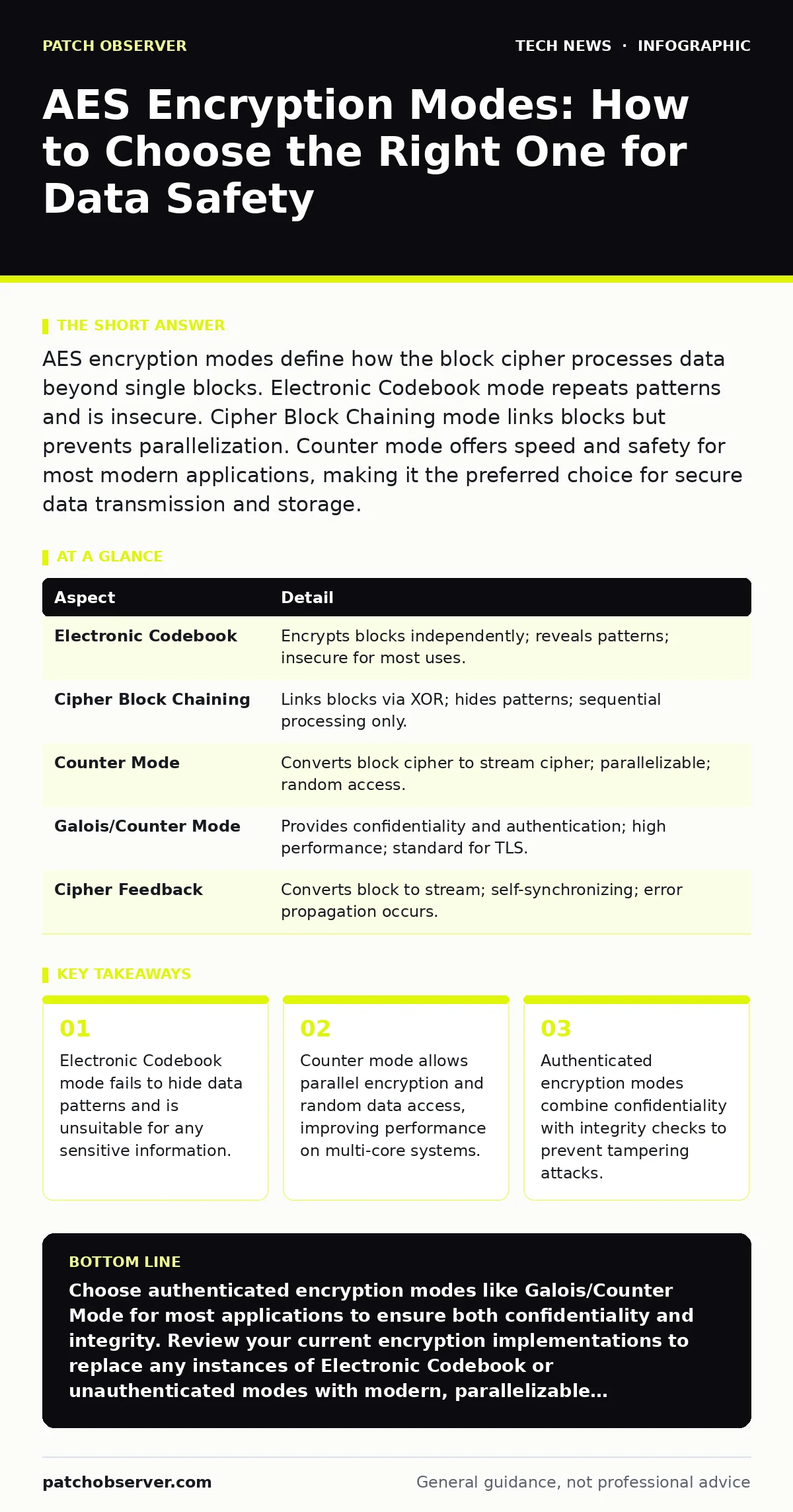
AES encryption modes define how the block cipher processes data beyond single blocks. Electronic Codebook mode repeats patterns and is insecure. Cipher Block Chaining mode links blocks but prevents parallelization. Counter mode offers speed and safety for most modern applications, making it the preferred choice for secure data transmission and storage.
Understanding the Core Mechanism of AES
The Advanced Encryption Standard encrypts data in fixed-size blocks using a symmetric key. You must understand that the algorithm itself only processes one block at a time. Modes of operation extend this basic function to handle messages of arbitrary length. The mode determines how each block interacts with the others and the key. This interaction defines the security properties and performance characteristics of the entire encryption process. Choosing the wrong mode can expose your data to pattern analysis or tampering, even if the underlying AES algorithm remains unbroken. The strength of your encryption depends heavily on this structural choice rather than just key length.
Comparing Common AES Encryption Modes
Different modes offer distinct trade-offs between security, speed, and functionality. You need to match the mode to your specific data handling requirements. Some modes are obsolete due to inherent flaws. Others provide modern features like authentication and parallel processing capabilities. Understanding these differences prevents the accidental use of weak configurations in your systems.
| Aspect | Detail |
|---|---|
| Electronic Codebook | Encrypts blocks independently; reveals patterns; insecure for most uses. |
| Cipher Block Chaining | Links blocks via XOR; hides patterns; sequential processing only. |
| Counter Mode | Converts block cipher to stream cipher; parallelizable; random access. |
| Galois/Counter Mode | Provides confidentiality and authentication; high performance; standard for TLS. |
| Cipher Feedback | Converts block to stream; self-synchronizing; error propagation occurs. |
The Danger of Pattern Repetition
Electronic Codebook mode encrypts each block independently using the same key. Imagine an image where every pixel block is identical. If you encrypt this image with Electronic Codebook mode, the resulting ciphertext will show identical blocks. An attacker can see the outline of the original image without decrypting it. This mode fails to provide semantic security, which means the ciphertext reveals no information about the plaintext structure. You should never use this mode for any data that contains repeating patterns, such as images, video, or structured logs. It is only acceptable for encrypting single, unique blocks like cryptographic keys themselves.
Linking Blocks for Better Obscurity
Cipher Block Chaining mode improves upon Electronic Codebook by linking each block to the previous one. Before encrypting a block, you XOR it with the previous ciphertext block. This ensures that identical plaintext blocks produce different ciphertext blocks. The first block uses an initialization vector, which must be unique and unpredictable.
While this hides patterns, it creates a sequential dependency. You cannot encrypt blocks in parallel because each depends on the previous result. This limits performance on modern multi-core processors. Decryption can be parallelized, but encryption remains a bottleneck. This mode is also vulnerable to bit-flipping attacks if integrity is not checked separately.
Modern Performance with Counter Mode
Counter mode transforms the block cipher into a stream cipher. You generate a keystream by encrypting successive counter values rather than the data itself. You then XOR the plaintext with this keystream. This approach allows full parallelization of both encryption and decryption. You can process multiple blocks simultaneously on different cores. It also supports random access to encrypted data without decrypting the entire file. This makes it ideal for disk encryption and high-throughput network traffic. The counter must never repeat with the same key, or the security collapses completely. Proper nonce management is critical for maintaining the integrity of this mode.
See also: Data Loss Prevention Explained: Stop Sensitive Info From Leaving · Mobile Device Management Checklist: Prevent Silent Data Leaks
Integrity Through Authenticated Encryption
Confidentiality alone does not prevent an attacker from modifying ciphertext. Authenticated encryption modes combine encryption with a message authentication code. Galois/Counter Mode is the most widely adopted standard for this purpose. It provides confidentiality using Counter mode and integrity using a polynomial hash. This ensures that any tampering with the ciphertext is detected during decryption. You reject the data if the authentication tag does not match. This prevents padding oracle attacks and other malleability exploits. You should prefer authenticated modes for all network communications and stored data where integrity is as important as secrecy.
Common Misconfigurations and Pitfalls
Many developers assume that choosing AES automatically ensures security. They often neglect the mode of operation or reuse initialization vectors. Reusing a nonce with the same key in Counter mode leaks the XOR of two plaintexts. This allows an attacker to recover both messages if they know part of one. Another common error is using unauthenticated modes like CBC or CTR without a separate HMAC.
This leaves data vulnerable to bit-flipping attacks where an attacker modifies the ciphertext to change the decrypted plaintext predictably. You must treat the initialization vector as sensitive data. It does not need to be secret, but it must be unique and unpredictable for each encryption operation under the same key.
Integrating with Broader Security Frameworks
Encryption is only one layer of your security architecture. You must combine it with public key cryptography to manage key exchange securely. Without secure key distribution, symmetric encryption offers little protection. You should also consider API security practices, as many modern applications transmit encrypted data via APIs that may have their own vulnerabilities. Network access control ensures that only authorized systems can attempt to decrypt or access the encrypted resources.
Even with strong encryption, poor access controls can lead to data exposure. Hashing functions are often used alongside encryption to verify data integrity independently. Understanding how these components interact creates a defense-in-depth strategy. Browser security settings also play a role in how encrypted content is handled and displayed to users, ensuring that mixed-content warnings do not undermine your encryption efforts.
Key takeaways
- Electronic Codebook mode fails to hide data patterns and is unsuitable for any sensitive information.
- Counter mode allows parallel encryption and random data access, improving performance on multi-core systems.
- Authenticated encryption modes combine confidentiality with integrity checks to prevent tampering attacks.
Choose authenticated encryption modes like Galois/Counter Mode for most applications to ensure both confidentiality and integrity. Review your current encryption implementations to replace any instances of Electronic Codebook or unauthenticated modes with modern, parallelizable alternatives.
Frequently asked questions
Is AES-256 better than AES-128?
AES-256 uses a longer key, providing a larger key space and higher resistance to brute-force attacks. For most current applications, AES-128 is considered secure enough, but AES-256 is recommended for long-term data protection and high-security environments.
Can I use the same initialization vector twice?
No, reusing an initialization vector with the same key compromises security in most modes. In Counter mode, it leaks plaintext information. In Cipher Block Chaining, it allows attackers to compare blocks. Always generate a unique, random IV for each encryption operation.
What is the difference between encryption and hashing?
Encryption is reversible; you can decrypt the data with the correct key to retrieve the original plaintext. Hashing is one-way; it produces a fixed-size digest that cannot be reversed to reveal the original input. Use encryption for confidentiality and hashing for integrity verification.
Does Counter mode require padding?
No, Counter mode operates as a stream cipher and does not require padding. It can encrypt messages of any length by generating the necessary amount of keystream. This simplifies implementation and avoids padding oracle vulnerabilities associated with block modes like CBC.
How this guide was produced: written by the Patch Observer editorial team with AI assistance, checked against the public references listed below, and reviewed when the facts change. See our editorial policy or report an error.