SASE Architecture Checklist: Verify Identity, Network, and Policy Alignment
Secure Access Service Edge architectures often fail because identity policies remain disconnected from network routing decisions, creating blind spots that perimeter tools cannot see.

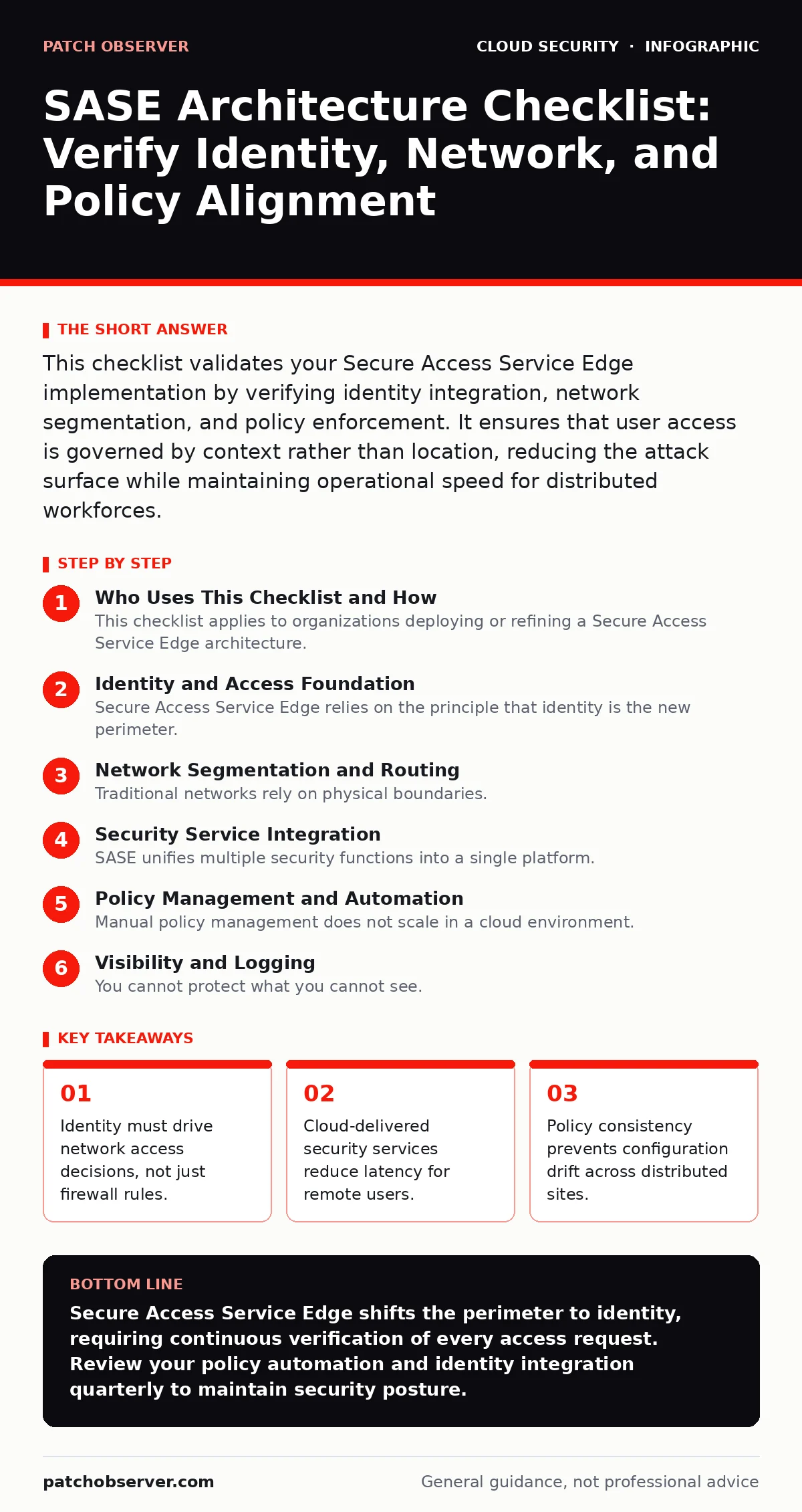
This checklist validates your Secure Access Service Edge implementation by verifying identity integration, network segmentation, and policy enforcement. It ensures that user access is governed by context rather than location, reducing the attack surface while maintaining operational speed for distributed workforces.
Who Uses This Checklist and How
This checklist applies to organizations deploying or refining a Secure Access Service Edge architecture. You use it to verify that your network and security functions are unified and cloud-delivered. The goal is to ensure that every user and device is authenticated and authorized before accessing resources, regardless of their physical location.
Identity and Access Foundation
Secure Access Service Edge relies on the principle that identity is the new perimeter. Without strong identity verification, network controls are ineffective. These items ensure that access decisions are based on who the user is and what device they use, not just where they connect from.
- Integrate with centralized identity provider: Single sign-on ensures consistent authentication across all cloud and on-premises applications.
- Enforce conditional access policies: Access rights change dynamically based on risk signals like location or device health.
- Verify MFA for cloud accounts: Multi-factor authentication stops attackers who have stolen passwords from entering the environment.
- Map cloud IAM policies: Clear identity and access management roles prevent privilege creep in cloud environments.
Network Segmentation and Routing
Traditional networks rely on physical boundaries. SASE moves these boundaries to the cloud. You must verify that traffic is segmented logically, not just physically. This prevents lateral movement if an attacker compromises one segment.
- Define micro-segmentation rules: Restrict traffic flow between workloads to limit the blast radius of a breach.
- Verify virtual private clouds configuration: Proper VPC isolation ensures that sensitive data does not leak into public subnets.
- Optimize path selection for latency: Routing traffic through the nearest point of presence improves application performance for remote users.
- Inspect encrypted traffic: Decrypting TLS traffic allows security tools to detect threats hidden inside secure connections.
Security Service Integration
SASE unifies multiple security functions into a single platform. You must ensure these functions work together seamlessly. Gaps between firewalls, intrusion prevention, and data loss prevention create vulnerabilities that attackers exploit.
- Align cloud guardrails: Automated policy enforcement ensures that infrastructure configurations meet security standards continuously.
- Validate zero-trust network access: Every request is verified, regardless of its origin, eliminating implicit trust.
- Check for shadow IT exposure: Unmanaged applications bypassing security controls create data leakage risks that are hard to detect.
- Ensure consistent threat intelligence: Shared threat data across services allows for faster detection and response to emerging attacks.
Policy Management and Automation
Manual policy management does not scale in a cloud environment. You need automation to keep policies consistent and up-to-date. This section checks for the mechanisms that enforce security rules without human intervention.
- Implement policy as code: Treating security policies as code allows for version control, testing, and automated deployment.
- Audit policy exceptions: Regular reviews of temporary access grants prevent them from becoming permanent security holes.
- Monitor for OAuth token abuse: Misconfigured authorization tokens can grant attackers persistent access to cloud resources.
- Verify automated remediation: Systems should automatically block or isolate non-compliant devices to reduce response time.
Visibility and Logging
You cannot protect what you cannot see. SASE generates massive amounts of telemetry data. You must ensure that this data is collected, stored, and analyzed effectively. This visibility is critical for forensic investigations and compliance reporting.
- Centralize log aggregation: Combining logs from all SASE components provides a unified view of security events.
- Define retention periods: Long-term log storage supports forensic analysis and meets regulatory compliance requirements.
- Set up real-time alerts: Immediate notification of suspicious activity allows for faster incident response.
- Validate audit trails: Complete records of who accessed what and when are necessary for accountability and investigation.
Supply Chain and Third-Party Risk
Your security is only as strong as your weakest partner. SASE architectures often involve multiple vendors and integrations. You must assess the security posture of these third parties to prevent supply chain attacks.
- Assess vendor security practices: Regular reviews of partner security controls ensure they meet your organization's standards.
- Monitor cloud supply chain risks: Changes in third-party software or services can introduce vulnerabilities into your environment.
- Verify data handling agreements: Clear contracts define how third parties protect and process your sensitive data.
- Test incident response coordination: Joint drills with vendors ensure smooth collaboration during a security incident.
Key takeaways
- Identity must drive network access decisions, not just firewall rules.
- Cloud-delivered security services reduce latency for remote users.
- Policy consistency prevents configuration drift across distributed sites.
Secure Access Service Edge shifts the perimeter to identity, requiring continuous verification of every access request. Review your policy automation and identity integration quarterly to maintain security posture.
Frequently asked questions
Does SASE replace the traditional firewall?
SASE incorporates firewall capabilities but extends them with cloud-delivered security services and identity-based access controls, making it more suitable for modern distributed workforces.
How does SASE handle encrypted traffic?
SASE platforms decrypt TLS traffic at the edge to inspect it for threats, then re-encrypt it before sending it to the destination, ensuring visibility without compromising security.
Is SASE suitable for on-premises data centers?
Yes, SASE can secure access to on-premises resources by routing traffic through the cloud security stack, providing consistent policy enforcement regardless of resource location.
What is the biggest challenge in implementing SASE?
Integrating identity management with network controls is often the most complex part, requiring careful planning to ensure seamless user experience and security.
How this guide was produced: written by the Patch Observer editorial team with AI assistance, checked against the public references listed below, and reviewed when the facts change. See our editorial policy or report an error.